
To find your way around the Grand Mosque in Makkah, combine the official interactive map with the signs and staff guidance in front of you. Before your visit, identify the place you want to reach, the level or entrance relevant to it, and a practical way to regroup with companions. Keep that pedestrian plan separate from your taxi pickup: an indoor landmark or mosque gate is not automatically somewhere a car can stop.
The most useful preparation is modest. You do not need to memorise the entire mosque. You need to recognise the information that describes your current position, know how to ask for help, and avoid turning an old screenshot or a distant building into a fixed instruction for everyone else.
Begin with the official map, not a forwarded diagram
The General Authority for the Care of the Affairs of the Grand Mosque and the Prophet’s Mosque provides an official interactive-map page linking to maps for both mosques. Its published categories include gates, toilets, landmarks, on-site services, lifts and escalators. Open the Grand Mosque option for Makkah; the Prophet’s Mosque is in Madinah and has a separate map.
Use the service to become familiar with the type of information available. Look up one destination you may need, then examine the surrounding identifiers. A map can help you form a question such as “Which level is this service on?” or “Which entrance is relevant from where I am?” It should support observation, not replace it.
The authority’s launch information, also published by the Pilgrim Experience Program, describes multilingual access and QR-code entry without requiring an additional application. Start from the official page so that you know which service you are opening. There is no need to assume that a paid third-party application is necessary merely because someone forwards a download link.
Save the official starting page in your own bookmarks. If a relative sends a screenshot, ask which place and level it describes and when they used it. A picture can be a useful reference, but it does not establish today’s permitted direction of movement, an open gate or a current meeting arrangement.
Use four pieces of information to describe a place
When you are trying to locate a facility or meet another person, collect more than a name. A useful description contains the destination, the level where relevant, a visible gate or other identifier, and whether you mean inside the building or outside in the surrounding area. These details help distinguish places that seem close on a small screen but require different approaches on foot.
For example, “We are near the mosque” does not tell a companion much. “We are at the information point beside the identifier shown in this message, on the level marked on the sign; we have not gone outside” is much more useful. This is a format to adapt using the actual signs you see, not a suggested official meeting location.
If you photograph an identifying sign for your own reference, include enough context to remember what it marks. A tightly cropped number might belong to an entrance, a service counter or a different feature. Add a short note explaining it while the meaning is still clear. Avoid photographing other people’s documents or including strangers unnecessarily.
Use the same identifier in the family conversation. One relative may refer to an Arabic name while another uses an English spelling. Compare the sign or official map entry rather than deciding that the two names must be different places. Where the meaning remains unclear, ask on-site staff.
A gate number is a reference, not a promise
A gate identifier can make a conversation much clearer, but it should not be treated as a permanent instruction to enter or leave there. Follow the current signs, barriers and staff directions when you arrive. If the route you planned is not being used, ask which permitted route serves your destination instead of attempting to continue against the direction being given.
Do not build a family plan around “always use the same gate” without an alternative. The group needs to know what to do if that reference is unavailable or unsuitable when you leave. Agree that any change will be communicated and confirmed, rather than allowing several people to choose separate replacement points.
When you ask for directions, explain where you are trying to go rather than insisting on the route in your screenshot. A member of staff may be able to direct you to your intended area by a different approach. The destination is the useful constant; the route is the part that may need to change.
Keep architectural interest separate from navigation. A photograph of a distinctive entrance may be memorable, but the photograph alone does not show whether you are approaching it from the same side, level or surrounding courtyard. Match a landmark to the signs around you before using it as your only reference.
Plan for levels and changes in level
When a place is above or below your current position, looking directly towards it is not enough to explain how to reach it. Before moving, check which level the destination occupies and how the current route connects to that level. Ask for clarification if the map or sign does not make the transition clear.
For a family with different walking abilities, discuss the route everyone can actually use. Do not assume that a staircase visible to one person is suitable for the whole group. If you need a lift, an accessible route or another specific arrangement, ask the responsible staff about the current option rather than improvising from a general map.
The interactive map includes lifts and escalators among its categories, but an icon is not a personal assistance booking or a guarantee that a particular route suits every traveller. Check the practical arrangement on site. Our guide to Grand Mosque wheelchair assistance addresses that separate planning task in more detail.
If members of your party take different routes between levels, agree where the routes end before separating. “We will meet upstairs” is too broad. Identify the destination and how you will recognise it, then decide who will stay with anyone needing support. Do not make a young child responsible for navigating between adult groups.
Find the service you need before making a long detour
A useful map question begins with the actual need: a toilet, a guidance point, an entrance or another service. Select the relevant category rather than moving towards a familiar landmark and hoping the required facility will be nearby. If several options appear, ask which is appropriate from your present location.
The authority’s on-site service directory describes multilingual guidance within the Grand Mosque. Use official staff and guidance services when you need a location explained. Do not assume that a shopkeeper, another visitor or a transport driver has current information about an indoor service simply because they know the area generally.
Keep service conditions separate from finding a location. Locating an entrance to a service does not confirm its opening arrangements, eligibility or what assistance is available. If the visit depends on a particular facility, check that service’s current information before setting out and ask again if the situation is unclear when you arrive.
For a planned reading visit, for example, use the dedicated Grand Mosque Library guide to prepare the visit, then use current official directions to reach the appropriate place. The library decision and the route through the mosque are connected, but they are not the same question.
Choose a regrouping method that does not obstruct others
Before your party separates, agree a suitable place and a way to communicate if the plan changes. Ask on-site staff where waiting is appropriate if you are unsure. Do not choose a doorway, narrow passage or the top or bottom of moving equipment as a waiting place simply because it is easy to describe.
Give everyone the complete instruction. It should say where to meet, how to identify the place, and which person to contact if someone cannot reach it. A family member who joins later needs the same version, not an abbreviated message that assumes they heard the original conversation.
Decide whether the group intends to meet at a particular time or after an agreed message. Either approach needs a fallback if the message is delayed or one person’s plans change. Avoid a vague arrangement in which some people wait indefinitely while others assume the party has already left.
For children and anyone who wants support, decide which adult remains with them. If you become separated or someone may be at risk, ask official staff for help promptly. This article cannot provide a personalised search or safeguarding procedure. Keep the person’s needs and the directions of the responsible staff ahead of an improvised plan to search different areas independently.
When two people are describing different places
Stop comparing vague landmarks and compare specific facts. Ask each person to describe the level, the nearest readable identifier and whether they are inside or outside. A short, calm exchange can reveal that both people are referring to the same building from different approaches, or that one person has crossed into another area.
Do not ask both parties to keep moving towards each other while neither knows where the other is. Agree which person will remain at a suitable place while the location is clarified. If that place is not appropriate for waiting, ask staff for a nearby option and communicate the change.
A shared live location may help outdoors, but it should not be treated as a precise description of an indoor level or the route between two people. Add words identifying what is around you. If a device suggests you are somewhere that does not match the signs you can see, prioritise checking your actual surroundings and asking for help.
Once the misunderstanding is resolved, update the whole group. Leaving an old meeting message uncorrected can send the next person to the wrong place. One clear replacement message is easier to follow than a series of fragments saying “other side”, “upstairs” and “not there”.
Keep a practical fallback if the map will not load
Try the official page before leaving your accommodation so you are not learning the interface while carrying bags or supervising children. Check that the language and text display are usable on your device. If you rely on accessibility features, use your usual settings and decide what additional explanation you may want from a companion or staff member.
Carry a small personal record of the details that matter to your own return: hotel name and address, a contact number, the agreed family contact and the transport instruction. A screenshot of a relevant map area may help as a reference, but label it as a saved image and avoid treating it as a live update.
If the connection fails during the visit, use the signs and official guidance available where you are. There is no need to follow a partly loaded route simply because it was the last thing on the screen. Ask about your actual destination and explain any requirement, such as avoiding stairs, that affects the answer.
For a group, do not put all essential information on one phone if several people may separate. Share an appropriate copy with the people who need it, without circulating full personal documents. Each travelling adult should understand the return plan rather than merely knowing which relative has the screenshot.
Connect the walking plan to a realistic taxi pickup
The mosque meeting place and the vehicle collection point have different purposes. First regroup where it is appropriate for pedestrians. Then move to the pickup location that your transport provider has confirmed can be used. Do not send an indoor map pin to the driver and assume that it is a road-access instruction.
Ask the provider to explain the collection point in terms you can use: the named place, the relevant entrance or surrounding landmark, and any final instruction for contacting the driver. If the location changes, update the walking plan as well as the driver’s message. Everyone in the party needs to understand the new destination before leaving the regrouping place.
Allow the people who are travelling to reach the agreed place before treating the group as ready to board. A relative still finding their way from another level is not ready merely because the rest of the family has reached the car. Tell the provider about a delay through the confirmed contact route and follow the booking’s actual arrangements; no general guide can promise unlimited waiting.
If your journey begins at your hotel instead, the hotel frontage or agreed meeting-point guide explains the separate question of where the vehicle collects you. Keep the two location records distinct so a driver does not receive the wrong instruction for the wrong journey.
Example: a family leaves in two walking groups
Imagine a family whose members finish their visit at different times. Two adults are together on one level, while another adult accompanies a grandparent elsewhere. Their first message says only “meet at the usual gate”. That may sound familiar, but it does not say which side, level or waiting location they intend to use.
They replace it with a description checked against the signs around them and ask staff where the party can wait without obstructing others. The adult with the grandparent confirms the route suitable for them. Nobody is told to rush down an unfamiliar route merely because a car has already been requested.
Once reunited, they check the separately confirmed vehicle collection point. One adult contacts the provider if the walk to that location differs from the original arrangement. They keep the taxi instruction separate from the family meeting instruction, so the driver is not asked to find an indoor landmark.
This example illustrates a planning method, not a recommended gate or a promised access route. The useful habit is to confirm the place you actually mean, make changes explicit and connect the pedestrian and vehicle parts only when both are understood.
Before your next visit
Open the official map and identify one or two places relevant to your visit. Save your accommodation details separately. Agree a family contact and a regrouping method, including what to do if the original place cannot be used. If anyone needs assistance, confirm who provides it and where the responsibility begins and ends.
On the day, use current signs and staff guidance alongside the map. Treat levels, inside-versus-outside and exact identifiers as useful information to share. Avoid fixed claims about walking times or universal “best gates”: the right route depends on where you are, where you need to go and the directions in operation.
For a road journey before or after your visit, search your Makkah Cabs journey with the actual pickup and destination. Confirm the vehicle meeting place with the provider, then make a pedestrian plan that reaches it. A well-described handover is more useful than an impressive-looking map pin.
Sources and review
Reviewed 4 October 2026. This guide uses the Grand Mosque authority’s official interactive-map page and on-site service directory, and the Pilgrim Experience Program’s report on the map service. Linked sources describe available information; they do not guarantee a particular gate, route, service or vehicle access on your visit. The family scenario and planning method are editorial examples.
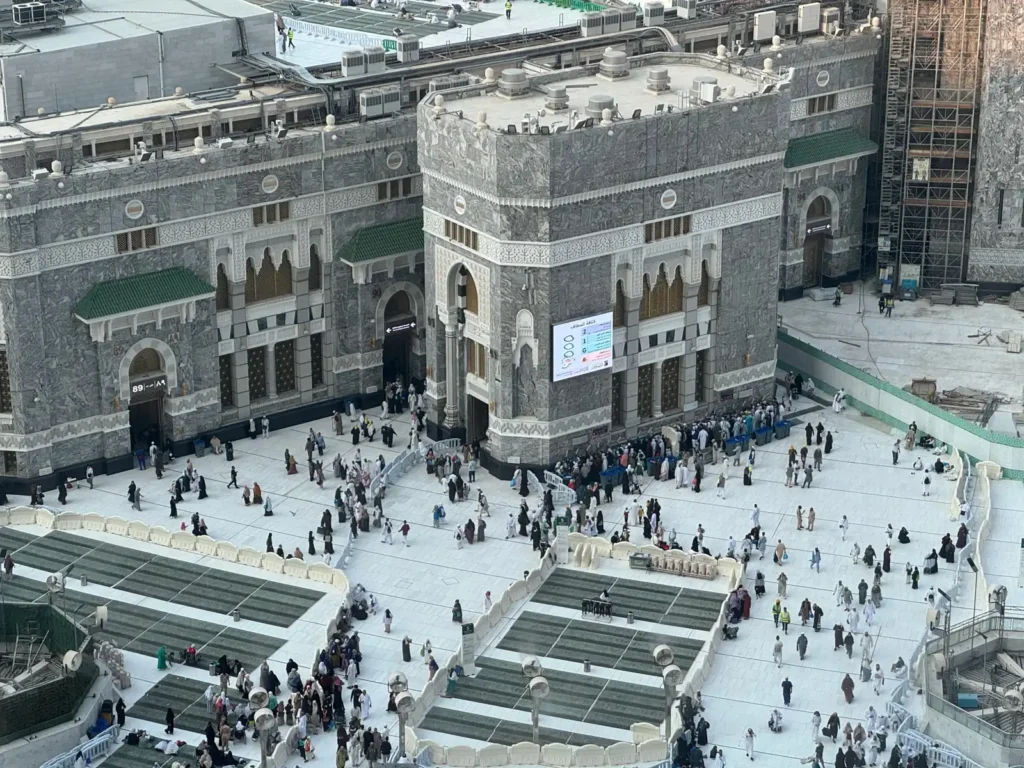
Photo: Earth Photart / Pexels, used under the Pexels licence. The image illustrates mosque entrances and the surrounding pedestrian area; it is not a current access map.