
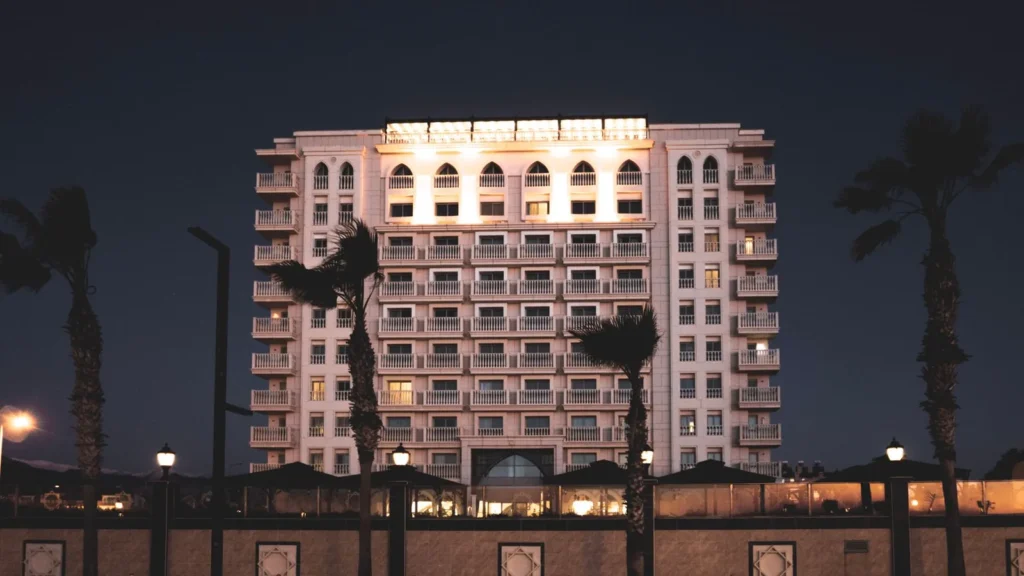
Your Makkah hotel pickup point can be one of two things: the hotel frontage, where the car pulls up at the building itself, or an agreed meeting place a short walk away that both you and the driver can find without guesswork. Neither is better in every case. The right choice depends on how busy the streets around your hotel are at the time you travel, who is in your party, how much you are carrying and whether you can describe the place well enough for a driver who has never met you.
This article is for anyone staying in central Makkah who has booked, or is about to book, a Makkah Cabs journey from their hotel: an outing, a move to another hotel or a transfer to the airport. It covers meeting your driver outside a Makkah hotel as a decision: the two kinds of pickup point, how to choose, how to record the choice in your booking, and what to do if the agreed place cannot be reached on the day.
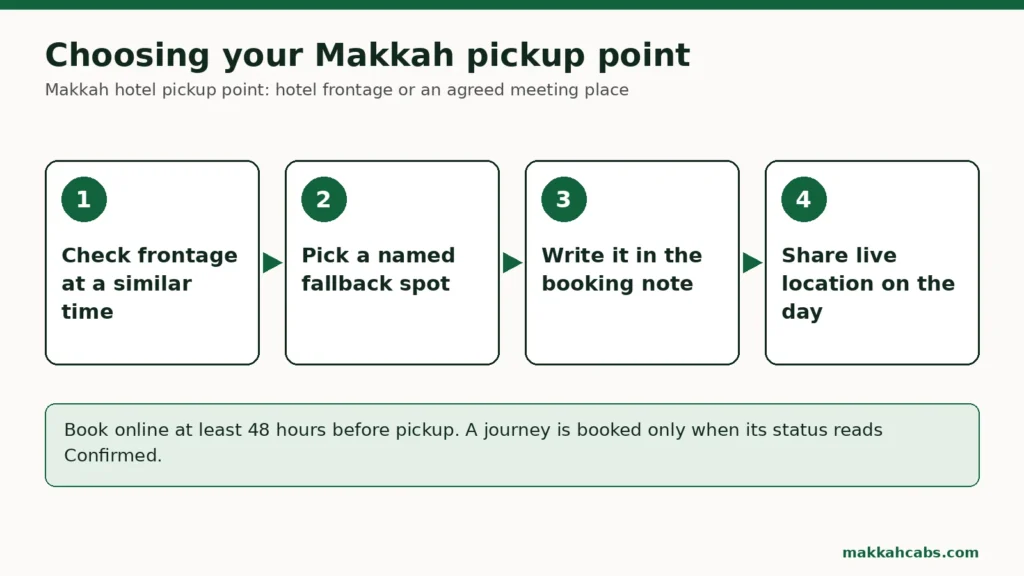
Two kinds of pickup point, and why the difference matters
A hotel frontage pickup means the driver aims for the vehicle drop-off area of your hotel: the covered driveway, the lay-by or the kerb directly outside the main door. You wait inside or just outside, and you walk a few steps to the car.
An agreed meeting place means you and the driver fix a named spot that is not the hotel door. It might be a side street where cars can stop more easily, a clearly signed corner, a petrol station forecourt, or the entrance of a neighbouring building with a recognisable sign. You walk there; the car meets you there.
The two plans fail in different ways. A frontage pickup fails when the driveway is closed, full or unreachable at that moment. A meeting place fails when it is vague (“near the clock”, “by the big mall”), when the two sides wait at different corners of the same junction, or when the walk is harder than expected for an older traveller or a family with bags.
In both cases, the fix is the same: one specific place, described in words, with a live location to back it up, and one person on each side who is responsible for the meeting.
Taxi pickup near Haram hotels: what we can and cannot promise
The streets closest to the Grand Mosque carry very large numbers of people on foot, and access for vehicles is managed by the authorities rather than by hotels or transport companies. During peak periods such as Ramadan, for example, the General Department of Traffic has announced designated parking sites near Makkah and at the city’s entrances, with public and shuttle transport carrying visitors on to the Grand Mosque. You can read one such announcement of parking sites for Umrah performers on the Saudi Press Agency. Arrangements like these change with the season and sometimes with the hour.
So Makkah Cabs does not promise where a car may stop near the Haram, which hotel entrance can be used, or whether a frontage will be open to vehicles at your pickup time. Those arrangements are managed on the day. What we can do is help you choose a point with the best chance of working, record it in your booking and adjust if the plan meets a closed road.
Frontage or meeting place: a side-by-side comparison
The table below sets out how the two options usually compare. Use it as a starting point, then apply it to your own hotel and your own party.
| Factor | Hotel frontage | Agreed meeting place |
|---|---|---|
| Ease of finding for a first-time driver | High, if the hotel name is exact | Depends entirely on how well it is described |
| Walking distance for the party | Shortest | Longer, sometimes on busy pavements |
| Suits older travellers or anyone who tires easily | Usually better | Only if the walk is short and level |
| Suits heavy luggage | Better, if the car can reach the door | Harder; suitcases must be wheeled to the spot |
| Risk that vehicles cannot reach it at that time | Higher for hotels closest to the Haram | Can be lower if chosen away from the busiest streets |
| Risk of confusion over the exact spot | Lower if the hotel has one vehicle entrance | Higher if the name is vague or there are several similar corners |
| Easy to describe in a booking note | Yes: hotel name plus entrance description | Needs a landmark, a street name and a live location |
In general, hotels set back from the immediate Haram area, with one obvious driveway, suit frontage pickups, while hotels beside the busiest pedestrian areas sometimes work better with a meeting place a short walk away. The only reliable test is local knowledge at the time: ask.
How to choose a meeting place that actually works
If a meeting place looks like the better option, choose it with the same care you would give an address. A good meeting place has five qualities.
It has a name that does not change
A petrol station, a numbered building, a named hotel next door or a signed street is better than “the corner by the shops”. Avoid anything that describes a crowd, such as “where the buses stop”.
A car can normally stop there
This is not something you can judge from a map. Ask the booking team, or ask the driver once one is assigned, whether cars normally stop at the place you have in mind at that time of day. If the answer is “sometimes”, pick somewhere else or agree a second spot nearby.
Your party can walk to it
Walk the route once before the day, at a similar time if you can. A two-minute walk for one adult can be a long one for a grandmother, a child who needs carrying or someone pulling two suitcases.
Someone can wait there without standing in the road
There should be a pavement, a building edge or a shaded spot where the party can stand safely. A meeting place that forces people to wait in a traffic lane is not a meeting place.
It can be described in one sentence
If you cannot describe it in a single clear sentence (“the forecourt of the petrol station on the left side of [street name], opposite the green pharmacy sign”), a driver will struggle too.
Writing the pickup point into your booking
In the Makkah Cabs planner you choose a pickup place: your hotel from the popular locations, or a place you type and then check in the route summary. The place you select sets the route and the price. The detail of exactly where to meet belongs in the booking notes at checkout, which exist for entrances, gates and practical needs.
A useful booking note does three things. It names the building, it says which side or entrance, and it tells the driver what the party will look like. For example:
Pickup at the main vehicle driveway of the hotel. If the driveway is closed, we will walk to the forecourt of the petrol station on the corner of the next street to the north and send a live location. Party of five: two adults, one older lady walking slowly, two children. One folded pram.
Keep the note factual and leave out room numbers. The driver needs a place, a fallback and a picture of who they are looking for.
If you are not sure which is best, say so in the note and ask the booking team for advice. Our guide to how Makkah Cabs works explains the steps from search to confirmation, and the planning questions page covers the common ones.
Remember that a paid booking is a provisional request at first. The booking team updates the status, usually within 1 to 12 hours, and the journey is booked only when your account shows Confirmed. If you have asked a question about the pickup point in your note, look for the answer before you rely on the arrangement.
Live location: the backup that makes both options work
A written description is the plan; a live location is the proof. Once the driver’s name appears in your account, which happens after one is assigned, keep your phone charged and be ready to share your position through a messaging app when you are asked or when you reach the pickup point.
A few habits make this far more useful:
- Share the location from where you will actually stand, not from a room several floors up, which can place you on the wrong side of a block.
- Send a short message with it, such as “At the petrol station forecourt, five people, older lady in a blue scarf”.
- If you move, say so. An old pin may no longer be where you are.
- Keep one phone as the contact phone. Three relatives sending three different pins is worse than none.
Older relatives: the “one goes ahead” method
Many families travelling in Makkah include a parent or grandparent who can walk but tires quickly or finds crowds difficult. For them, the pickup point decision is really a question of how long they stand and how far they walk.
A method that works for many families is to split the roles. One adult goes ahead to the agreed point, confirms that the car has arrived or is about to, and stays in contact with the driver. The rest of the party waits seated in the hotel lobby until that adult calls them across. Our note on choosing an assembly plan for your visit covers how households get ready together. This keeps the older traveller out of the heat and the crowd for as long as possible, and it means the driver deals with one person rather than a group arriving in stages.
This works only if everyone agrees it in advance, the person going ahead has the booking details, and the walk from the lobby to the car is short. If the meeting place is several minutes away on foot, the frontage may be the better choice even with its risks.
The included waiting allowance, which varies by vehicle class, covers the ordinary minutes it takes a party to reach the car. It is not currently shown on search results, so ask the booking team to confirm it in writing if your plan depends on a few extra minutes for a slower walker.
Luggage changes the answer
A pickup point that suits an outing with day bags may be a poor choice for a departure with suitcases. Wheeling several large cases along a crowded pavement, across junctions and up kerbs is slow and tiring, and it puts the whole party under pressure.
For journeys with luggage, such as a transfer to Jeddah Airport, which is about 91 km by road from Hilton Jabal Omar on our live route check, or a move to another hotel, give the frontage more weight in your decision. If the frontage is known to be difficult at your time of day, ask the booking team whether a meeting place close to the hotel, reachable without crossing a main road, is a better compromise. Then make sure the luggage count in your booking is correct, because search results show only vehicle classes that pass the capacity check for the party and bags you entered.
If your bags are being held by the hotel while you are out, our note on collecting bags after a Makkah visit explains how to make that collection part of the plan.
When the agreed point cannot be reached on the day
Sometimes the plan meets a closed road, a diverted route or a crowd that was not there yesterday. The driver may call to suggest a different spot nearby. When that happens:
- Stay where you are until you have agreed the new place. Walking towards where you think the car might be usually makes things worse.
- Ask for the new place in words, not only as a pin: a building name, a sign, a side of the street.
- Tell the rest of the party once, clearly, and keep the older travellers seated until the new place is confirmed.
- If the new place is much further away, say so. The driver may be able to suggest an alternative.
Changes made in advance work differently. The pickup time of a paid booking can be changed through your account using “Request a new pickup time”, but the pickup place cannot be changed online. An approved new time carries a £5 rescheduling fee, converted into your booking currency and added to the cash paid to the driver at pickup; a rejected request costs nothing. If you need a different pickup place, contact the booking team rather than simply moving and hoping the driver finds you. Our note on why a room change is not a pickup change covers a related situation.
Worked example: a family deciding on a pickup point
Imran and Nadia are staying in a hotel a short walk from the Haram with their two children and Imran’s father, Rafiq, who is in his late seventies. They have booked a morning outing to Hira Cultural District, about 13 km from the Clock Tower area on our live route check, with a separate journey back later.
Their first instinct is to be picked up at the hotel’s main door. Imran walks down the evening before to look. The driveway is shared with coaches and he sees cars being waved on at busier moments. There is a side street a short, level walk away where several cars are stopping to collect passengers.
They weigh it up. Rafiq can manage a short, level walk but not a long wait in the sun. The outing needs only day bags and a folded pram. So they choose the side street as their agreed meeting place, with the hotel driveway as the fallback.
Nadia writes the booking note: the side street by name, the landmark on the corner, the fallback, and a description of the party. When the driver is assigned, Imran messages to confirm that cars normally stop there at that time. On the morning, Imran goes down first while Nadia, the children and Rafiq wait seated in the lobby. When the car arrives, Imran shares his live location and calls Nadia, who brings everyone across. Rafiq’s walk takes a couple of minutes; he spends almost no time standing outside.
For their final departure a week later, with five large suitcases, they make a different choice: the hotel frontage, with an earlier pickup time requested well in advance, because wheeling the cases to the side street would be harder than a short wait for the driveway.
The same family chose differently for two journeys because the people and the luggage were different.
Booking rules that affect your pickup plan
- Online bookings need at least 48 hours’ notice before the pickup time, so settle the pickup point early.
- Each journey has a minimum booking value equivalent to £40.
- Only the pickup time can be changed online. The place, destination, passengers and vehicle need the booking team, or a new booking plus a cancellation request.
- Bookings are subject to our cancellation terms (free cancellation with a full refund up to 48 hours before pickup; inside 48 hours the deposit element of the price is kept) if you cancel. If we or our transport partner cancel, or cannot supply the journey, you receive a full refund for the affected journey. The cancellation and refund policy sets this out in full.
Because customer cancellations are subject to our cancellation terms (free cancellation with a full refund up to 48 hours before pickup; inside 48 hours the deposit element of the price is kept), get the pickup place right before you pay, and ask the booking team first if anything is uncertain.
Your pickup point checklist
- Decide whether the journey is an outing with day bags or a journey with suitcases; give the frontage more weight when luggage is heavy.
- Look at the hotel frontage at a similar time of day, and note whether cars are stopping there.
- If you prefer a meeting place, pick one with a fixed name, a place to stand safely and a short walk for the slowest person in your party.
- Ask the booking team, or the driver once assigned, whether cars normally stop there at your time.
- Write one clear booking note: the place, a fallback, and a description of the party and any equipment.
- Check that your account shows Confirmed and that any pickup question has been answered.
- Choose one contact phone and make sure it is charged, with the booking details saved.
- On the day, send one person ahead, share a live location from where you are standing, and keep older relatives seated until the car is there.
- If the plan changes on the day, agree the new spot in words before anyone moves.
- For a different time, use “Request a new pickup time” in your account; for a different place, contact the booking team.
When you are ready, start with the pickup place and destination in the Makkah Cabs planner, enter your full party and luggage, and use the booking note to describe the meeting point you have chosen.