
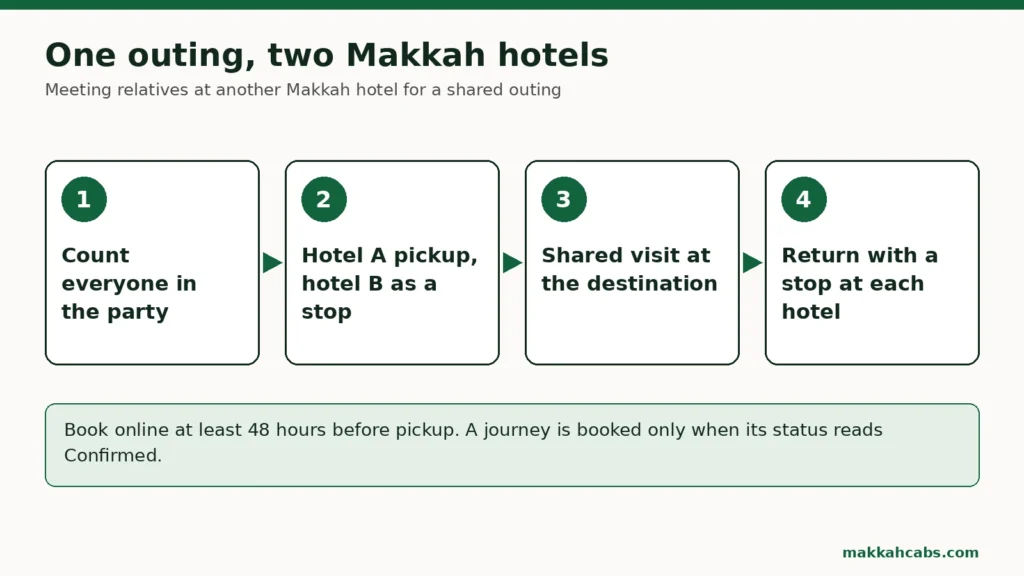
Meeting relatives at another Makkah hotel before a shared outing works best when you decide one thing early: will the car collect both households, or will one household come to the other? There are three sensible ways to do it. One journey can start at your hotel and add the relatives’ hotel as a stop. Everyone can gather at one hotel and leave from there. Or each household can travel separately and meet at the destination. Each works, but each is booked differently, and the choice needs to be made before you pay, because the pickup place, the stops and the number of passengers cannot be changed online afterwards.
This guide is for families and friends who are in Makkah at the same time but staying in different hotels, and who want to spend a day or an afternoon together: a visit, a meal, a museum, a park. It covers how to choose between the three structures, how the planner handles a second pickup, what to agree about lobbies and frontages when you are visiting a hotel that is not your own, who should hold the booking, how to time the day, and how to get everyone back to the right hotel afterwards. Airport arrivals to two hotels are a different problem, and so is a Masjid Aisha visit from two hotels, which we cover in a Taneem visit from two hotels.
Three ways to start the day together
| Structure | How it is booked | Works well when | Watch out for |
|---|---|---|---|
| Collect at hotel A, stop at hotel B | One journey, hotel B added as a stop | Both households are ready on time and the car fits everyone | The second household must be ready when the car arrives |
| Everyone gathers at one hotel | One journey from the gathering hotel | One household can easily walk or ride to the other | Visitors need somewhere suitable to wait |
| Separate journeys, meet at the destination | Two journeys, one from each hotel | The households have different pace, bags or finishing plans | Two bookings to manage and a meeting point at the destination |
There is no single right answer. What matters is that the booking describes what will actually happen. If the plan is to collect the cousins on the way, the booking must include their hotel as a stop and their seats in the passenger count. If the plan is for the cousins to come to you, the booking starts at your hotel only.
Option one: a pickup from a second hotel in Makkah as a stop
The planner lets you add up to eight stops to a journey, in the order the car will visit them. A second hotel can be one of those stops. The journey then runs: your hotel, the relatives’ hotel, the destination.
A few points to get right:
- The passenger count is the whole party. The vehicle has to be large enough for everyone who will be in it after the second pickup. The planner shows only the vehicle classes that pass the capacity check for the party you enter, so enter the full number from the start. Our guide on counting the people joining a visit helps with this.
- Order matters. Put the stops in the order you want the car to follow. Think about which order makes sense on the way to the destination, and which household is readier, then check the route summary before you pay.
- A stop is a pickup, not a waiting period. The relatives at the second hotel need to be ready at the point the car will reach, when it reaches it. Do not plan on the car waiting outside the second hotel while someone finishes getting ready. If you think waiting will be needed, ask the booking team before you pay and get the answer in writing.
- Describe the second pickup point. Use the booking notes to say exactly where the second household will be waiting, and in which name.
This option suits two households who are both organised and staying close to each other. It is less suitable when one household is often late, because the delay then falls on everyone already in the car.
Option two: gather at one hotel first
Here the households meet at one hotel and the journey starts there. It is simpler to book: one pickup place, one destination, one party.
It does, however, ask one household to be a visitor at a hotel that is not theirs. That brings two practical questions.
Where the visitors wait
Large hotels in central Makkah can be busy, with several entrances and levels. The Royal Commission for Makkah City and Holy Sites lists the Abraj Al Bait complex among the city’s landmarks, describing it as right next to Al-Masjid Al-Haram, and it is a good example of how large and busy these buildings can be. Ask the hotel what is appropriate for visitors joining a guest. Do not assume a lobby corner, a restaurant area or a private lounge is available as a meeting room because it looked quiet when you walked past. If the hotel suggests a place, use it.
Where the car collects you
That is a separate question from where you gather. Around the Haram, where a vehicle can stop is managed on the day by the authorities, and we cannot promise a particular entrance or frontage. Agree a findable pickup point with the driver and be ready to send a live location. Our article on choosing between a frontage and an agreed assembly point looks at that decision in more detail.
The second household also needs to reach the gathering hotel. If it is close, they may walk. If not, that is its own journey, and if you want it booked it needs at least 48 hours’ notice like any other.
Option three: meet at the destination
Sometimes the cleanest plan is for each household to travel on its own and meet at the place you are visiting. This suits groups where:
- one household has an older relative who needs a slower start;
- one household has a pushchair, a folding wheelchair or more bags than the other;
- the households want to finish at different times or go on to different places.
You then book two journeys, one from each hotel, each with its own pickup time and its own vehicle size. The cost is that you need a clear meeting point at the destination and a plan for anyone who arrives first. Choose a named, easy-to-find point, not “the entrance”, and agree who will phone whom on arrival.
Who holds the booking
Whichever structure you choose, one adult should be the lead contact. The lead contact:
- makes the booking and pays;
- is the only person who asks the booking team for changes;
- shares the driver’s name, which appears on the booking once a driver is assigned;
- keeps both households informed of the final plan.
Payment secures a provisional request, and the booking team updates the status within 1 to 12 hours. The journey is booked only when it reads Confirmed. If someone in the other household wants to check the details before the lead contact pays, the basket can email a secure review link so they can look it over first.
Avoid the situation where one household books a journey from its own hotel while the lead contact books a shared journey from the other. Two bookings for the same people is expensive, and cancelling one yourself is subject to our cancellation terms (free cancellation with a full refund up to 48 hours before pickup; inside 48 hours the deposit element of the price is kept). Our note on two families getting ready for one outing has more on dividing the jobs.
Timing the start when two hotels are involved
With two hotels, the day has two “ready” moments, not one. Plan each separately.
- Household one needs to be at its pickup point at the booked pickup time.
- Household two needs to be at its pickup point before the car can reach it from the first hotel. The planner calculates the route, but the actual time depends on traffic, so ask them to be ready early rather than to the minute.
- In Option two, the visiting household needs to arrive at the gathering hotel early enough to find the others, not at the pickup time.
A practical approach is to agree a “leave the room” time for each household, not just a pickup time. People who leave their rooms at the right moment are usually ready at the car.
On hot days, waiting outside is the part of the plan that deserves the most care. The Ministry of Health advises scheduling outdoor activities carefully and resting in shaded areas, drinking plenty of fluids and not leaving children in cars. Let older relatives wait indoors until the car is close, and have one younger person watch for it.
A worked example: two households, one afternoon
Imran Qureshi is staying at a hotel in the Clock Tower complex with his wife and their daughter. His sister Nadia is at the Hilton Hotel and Convention Jabal Omar with her husband and their two teenage sons. They want to spend an afternoon together at a place a few kilometres away and come back for the evening.
The count. Three people from Imran’s hotel and four from Nadia’s make seven adults and teenagers. That rules out four-seat cars and the six-seat classes. A seven-seat vehicle such as the Hyundai H1 family van or the GMC Yukon XL is the smallest that fits, and the planner shows only the classes that pass the capacity check.
The structure. The two hotels are close. The road distance from the Clock Tower to the Hilton Jabal Omar is about 1.5 km. Nadia’s household is quick to get ready; Imran’s is slower. So they choose Option one, with Imran’s hotel first and Nadia’s hotel as a stop.
The notes. Imran writes in the booking notes where each household will be waiting and gives Nadia’s mobile number as the contact for the second pickup.
The timing. Imran books more than 48 hours ahead. He tells Nadia’s family to be at their pickup point from the booked pickup time at Imran’s hotel, not later, because the second hotel is so close.
The return. The afternoon will end in one place, but the families are going back to two hotels. Imran books a second journey from the destination with Nadia’s hotel as a stop and his own hotel as the final destination. Distances differ by direction because of one-way systems, so the planner routes the return on its own terms.
The check. Both journeys read Confirmed. Imran shares the driver’s name with Nadia when it appears in his account.
What to send the household at the other hotel
The relatives at the second hotel were not the ones who booked, so they will not see the booking in their own account. Send them a short message once the journey reads Confirmed, with everything they need and nothing they do not. For example:
“Outing on Thursday. The car is booked from our hotel first, then collects you at your hotel as the second stop. Please be at the agreed pickup point, ready to leave, from the time the car leaves us. Driver’s name will follow once assigned. If anything changes, tell me, not the driver or the hotel, and I will contact the booking team.”
A message like this does three jobs. It tells them when to be ready, it tells them where, and it makes clear who handles changes. Keep it short enough to read on a phone in a hotel corridor. If an older relative will not read messages, ask a younger member of that household to be responsible for bringing them down.
If the second household is running late on the day
Even with a good plan, someone may not be ready when the car reaches the second hotel. The included waiting allowance is short and is meant for the normal minutes it takes to reach the car, not for a household that has not left its room.
- Tell the lead contact straight away. The lead contact, not the late household, speaks to the booking team.
- Be realistic. A delay of a few minutes may be absorbed. A longer one may be charged, or may mean the car carries on and the late household travels separately.
- Do not ask the driver to change the plan. The driver works from the booking. A change to the stops or passengers is a matter for the booking team.
- Have a fallback. Agree in advance that if the second household is not ready, the first carries on and the second follows by its own arrangement to a named meeting point at the destination.
That last point is the difference between a delay and a spoiled afternoon.
Getting everyone back to the right hotel
The return is where shared outings most often go wrong, because the morning’s arrangement is assumed to work in reverse.
- Two hotels on the way back: book the return with one hotel as a stop and the other as the destination. Put first the hotel that makes sense on the route, or the one whose household needs to be home first.
- Different finish times: if one household wants to stay longer, book two returns, each for the people in it. Our piece on agreeing one return deadline helps if you would rather keep everyone together.
- Someone changing hotels that day: if a household is checking out, the destination may be a new hotel. Our article on returning from a visit to a different hotel covers that.
Remember that the return is its own journey. The outward booking does not include it.
Changing the plan after booking
Only the pickup time can be changed online, by requesting a new time from your account. The request stays pending until the booking team approves it. An approved new time carries a £5 rescheduling fee, converted into the booking currency and added to the cash paid to the driver at pickup. A rejected request costs nothing.
Everything else needs the booking team:
- adding or removing the second hotel;
- adding or removing passengers;
- changing the vehicle;
- changing the destination.
If the answer is a new booking, the old one may need a cancellation request, and a booking you cancel yourself is subject to our cancellation terms (free cancellation with a full refund up to 48 hours before pickup; inside 48 hours the deposit element of the price is kept) at any time. Contact the booking team before you cancel anything. If we or the transport partner cancel, or cannot supply the journey and you do not accept a suitable alternative, you receive a full refund for the affected journey. The cancellation and refund policy sets this out.
This is the main reason to settle the structure before paying. A family that books from one hotel and later decides to collect the cousins on the way is not making a small change. It is a different journey.
Common mistakes and simple fixes
- Booking for one household and “adding the cousins later”. The vehicle was sized for the first household. Enter everyone from the start.
- Assuming the car will wait at the second hotel. Ask the booking team in writing if waiting is needed, and otherwise have the second household ready in advance.
- Two people contacting the booking team. Only the lead contact asks for changes.
- Treating the gathering hotel’s lobby as a public waiting room. Ask the hotel what is suitable for visitors.
- Forgetting the return. Book it as its own journey, with the right stops.
- Using hotel names loosely. Hotel names can be similar. Use the full name exactly as the planner shows it.
A checklist for a shared outing from two Makkah hotels
- Agree which of the three structures you will use.
- Count every person who will be in each vehicle, including children and infants.
- Choose one lead contact to book, pay and handle any changes.
- If collecting from two hotels, add the second hotel as a stop in the right order.
- Write each pickup point and each household’s contact number in the booking notes.
- Book at least 48 hours ahead, and wait for each journey to read Confirmed.
- Agree a “leave the room” time for each household.
- Book the return as a separate journey, with stops for each hotel if needed.
- Share the driver’s name with both households once it appears.
- Keep older relatives in the shade or indoors until the car is close.
Once you have agreed who is collected where, and in which order, the booking is simple. Enter both hotels, the destination and the whole party in the Makkah Cabs planner, and book the return from the start so both households get home.