

A large family ziyarah in Makkah, for somewhere between eight and nineteen people who want to see the sites together, usually comes down to one of three vehicle plans: an 11-seat Toyota Hiace, a 19-seat Toyota Coaster minibus, or two seven-seat vans travelling as a pair. If everyone will leave from one hotel, visit the same places and come back together, one vehicle is normally the calmer choice, and the party size decides which one. Up to eleven people with modest equipment fit the Hiace class. Twelve to nineteen need the Coaster, or a split. Above nineteen, you are into a coach or more than one vehicle.
This guide is for the person organising a big family day out to the ziyarah sites: grandparents, several adult children, spouses and a crowd of grandchildren, all wanting to travel as one party. It explains how the larger classes compare, how to decide by party size, what changes on the day when a whole family climbs in and out of a minibus at each stop, how the outing is booked as journeys, and what can and cannot be changed after you pay. If your family would rather travel in two groups with different timetables, our guide to splitting one outing across two vehicles covers that decision in depth. This article is about keeping a big group together.
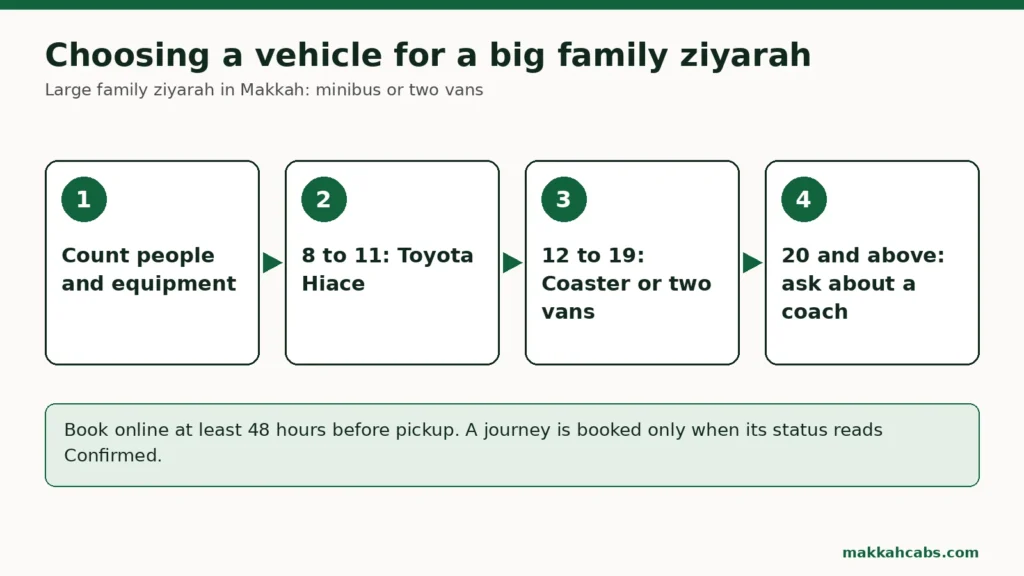
Large family ziyarah in Makkah: what changes above seven people
Past seven people, three things change at once.
First, the choice of vehicle narrows sharply. The booking system offers vehicles by class, each shown with an example model “or similar”, and only the classes that pass the capacity check for your passengers and luggage appear in the results. There is a jump from seven seats to eleven, and another from eleven to nineteen, with nothing in between.
Second, time on the ground behaves differently. Seventeen people, including toddlers, a grandparent with a stick and a teenager who has wandered off for a photograph, take far longer at every stop than a family of five.
Third, the organiser’s job becomes real work: counting heads, keeping children with their own adults, holding the booking and speaking for the whole family. Name that person before the day.
If you have not yet built an honest count of who is coming, start with our note on counting passengers for a Makkah taxi, because every decision below depends on that number.
The larger vehicle classes side by side
These are the classes in the booking system that matter for a large party. Figures are seats and large bags for the example model, or similar. On a ziyarah day the “large bags” column is mostly for pushchairs, folding wheelchairs, walking frames and cool boxes rather than suitcases.
| Class (example, or similar) | Seats | Large bags | Fits a large family ziyarah when |
|---|---|---|---|
| Hyundai H1 family van or MPV | 7 | 6 | The party is seven, or it is one of a pair |
| GMC Yukon XL | 7 | 6 | The party is seven and prefers an SUV, or it is one of a pair |
| Toyota Hiace | 11 | 10 | The party is eight to eleven, with room for equipment |
| Toyota Coaster (minibus) | 19 | 11 | The party is twelve to nineteen and wants one vehicle |
| Coach | 53 | Not stated | The party is well above nineteen |
| Two seven-seat vans | 14 | 12 | The party is up to fourteen and happy in two vehicles |
Two details are easy to miss. Infants and children count as passengers, and each fitted child seat uses a seat position. And the large-bag figure is a limit, not a suggestion: a party of eleven with three pushchairs and a folding wheelchair uses four of the Hiace’s ten spaces before anyone adds a cool box.
Choosing by party size
The most reliable way to choose is to start with the number and then ask one question: does the whole family genuinely want to move as one group all day?
| Party size | One-vehicle plan | Two-vehicle plan | Usually works best |
|---|---|---|---|
| 8 to 11 | Toyota Hiace | Two seven-seat vans, or a van plus a car | The Hiace, unless households want different return times |
| 12 to 14 | Toyota Coaster | Two seven-seat vans | Either; the Coaster keeps everyone together, two vans suit two households |
| 15 to 19 | Toyota Coaster | A Hiace plus a seven-seat van | The Coaster, if everyone starts and finishes together |
| 20 and above | Coach | A Coaster plus another vehicle | Ask the booking team which combination fits your list |
Where the table offers a real choice, the deciding factor is rarely the seats. It is whether the group will stay together all day. If the grandparents will want the hotel after two sites, a single minibus forces everyone onto one timetable.
Toyota Hiace for ziyarah: when eleven seats are enough
The Toyota Hiace for ziyarah suits a family of eight to eleven who want to stay together. It seats eleven and carries ten large bags, which on a day out is generous room for pushchairs, a folding wheelchair and a cool box.
It works well when:
- the family is one extended household, or two closely linked ones, leaving from the same hotel;
- nobody needs a separate return time;
- the count is settled, with no cousins who might join at the last moment.
It is a tight fit when the family sits at exactly eleven and someone might yet join. There is no class between eleven and nineteen seats, and the number of passengers cannot be changed online after you pay, so settle a possible twelfth person before booking. A Hiace also suits a family of nine or ten with older relatives who would find a crowded seven-seater uncomfortable.
A minibus for a family ziyarah: when the Coaster makes sense
A minibus for a family ziyarah, in booking terms the Toyota Coaster class, seats nineteen and carries eleven large bags. It is the one-vehicle answer for a family of twelve to nineteen.
Its strengths are simple: everyone arrives together, there is one driver and one booking, and at each site only one vehicle to find again. Its practical demands are worth thinking through too.
Getting in and out
A minibus has a single passenger door and steps up to the floor. Older relatives, anyone recovering from an injury and small children being lifted will take longer than in a van. Put the people who find steps hardest in the seats nearest the door, and let them get in first and get out last, so nobody climbs past them.
Equipment on board
Count prams and wheelchairs as large bags in the search. If a traveller needs the wheelchair requirement, add it when you search; it is then confirmed for the vehicle.
A partly empty minibus
A family of twelve or thirteen may find a nineteen-seat minibus more space than they need. That is not a problem in itself, but it is worth comparing with two seven-seat vans before you choose.
Two vans instead: when splitting still wins
Sometimes the big family is really two or three families who happen to be related. In that case two vehicles can suit the day better, even when everyone intends to stay together.
Two seven-seat vans make sense when:
- the households are staying at different hotels and each van can collect from its own;
- one household has small children who may need to go back early;
- the party size falls awkwardly, such as twelve people who would rattle around a Coaster;
- the family prefers two smaller vehicles for any reason of its own.
The trade-off is coordination: two vehicles rarely arrive together, each driver follows their own booking, and a split day has twice as many journeys to manage. The guide linked above walks through leads, meeting points and returns for that plan.
Getting a big group on and off at each site
Most of the difference between a good and a tiring large family ziyarah in Makkah happens at the kerb, not on the road.
Give everyone a seat plan
Before the day, write down which household sits where. Keep each child with their own adult, put the organiser near the front and older relatives near the door. It sounds fussy, but it prevents seventeen people boarding in no order.
Count at every stop
Agree one counting rule: each household head confirms their own members to the organiser before the door closes, and the organiser counts households, not individuals. It stops the most common large-group mistake of leaving a teenager at the last site.
Decide who gets out
At a site most people view from outside, grandparents may prefer to stay seated while younger adults walk a short way. Agree this before the stop, not at the door.
Plan for the heat
The Ministry of Health’s summer heat guidance advises scheduling outdoor activities carefully, resting in shaded areas and drinking plenty of fluids without waiting to feel thirsty. It names older adults, infants and children among those who need extra care, and warns never to leave children in cars. Carry water for everyone and keep outdoor time at each site short.
Where the ziyarah sites are, and what a big group finds there
The places on most family lists in Makkah, sometimes spelt Mecca, are spread around the city, and a large vehicle makes the geography matter more, because every extra stop costs a full round of getting out and back in.
Saudipedia describes Jabal al-Nour as lying northeast of the Grand Mosque, about 4 km away, with the Cave of Hira near its summit and Hira Cultural District at its foot. The district’s official website lists the district itself and the path to the cave as open 24 hours, with its museums and exhibitions on shorter hours that differ by day. Saudipedia places the Jabal Thawr Cultural District southeast of Makkah and south of the Grand Mosque, approximately four km away. Its page on the holy sites describes Arafat as active only during the days of Hajj, with no buildings or residents apart from several government facilities.
Official distances are measured from the Grand Mosque, not along roads; on our live route checks the Clock Tower area to Hira Cultural District was about 13 km by road, and about 11 km back. The practical lesson for a large family ziyarah in Makkah is to keep each outing to one side of the city. Our guide to the Makkah ziyarah itinerary with must-see and optional stops shows how to group sites by direction before you book.
How a large family ziyarah is booked
Journeys, stops and waiting
Each journey has one pickup place, one destination, a date and a pickup time in Saudi local time, plus the passengers and luggage. Up to eight stops can be added in journey order. A stop is a point where people get in or out along the way; it is not a period when the vehicle waits while the family visits a site. The pickup and destination must differ, so going out and coming back is two journeys, each with its own time.
That gives a large family two sensible shapes:
- Out and back. Hotel to the main site, then a separate return journey at a time you choose in advance. Best when the day centres on one place, such as Hira Cultural District.
- A chain of one-way journeys. Hotel to the first site, first site to the second, second site back to the hotel, each booked for the end of the time you plan to spend at the site before it.
A vehicle that stays with the family between sites is a request the booking team must agree in writing; our note on whether a Makkah taxi can wait during ziyarah explains why.
Each class has an included waiting allowance at pickup, but it is not shown on the search results. A large family is slow to board, so ask the booking team to confirm the waiting for your chosen class in writing before you pay.
Notice, payment and status
- Online bookings need at least 48 hours’ notice before pickup, so decide the vehicle and the count early.
- Makkah Cabs takes full payment online.
- Each journey has a minimum booking value equivalent to £40, which matters on short legs between nearby sites.
- Payment secures a provisional request. The booking team updates the status within 1 to 12 hours, and each journey is booked only when it reads Confirmed.
- If another adult should check the details before one person pays, the basket can email a secure review link.
Worked example: the Rahman family of sixteen
Nadia Rahman is organising a morning outing for her parents, her three brothers and their wives, and seven grandchildren, two of them under four. That is sixteen people. Her father uses a folding wheelchair for longer distances, and two households bring pushchairs.
The count. Sixteen passengers, including the two small children, and three large items: the wheelchair and two pushchairs. She adds two child seats and the wheelchair requirement in the search.
The choice. Sixteen rules out the Hiace. The options are a Coaster, or a Hiace plus a seven-seat van. Nadia asks each brother whether his household would want to leave early. None would; the point of the day is to be together. She chooses the Coaster.
The plan. The destination is Hira Cultural District, so Nadia checks the official museum hours for that day of the week. She books two journeys: hotel to the district, and back at a time the family agrees allows for the exhibitions and a rest. The notes mention the wheelchair and the young children.
The seat plan. Her parents sit by the door. Each brother’s household sits together. Nadia sits at the front with the booking on her phone. Her eldest brother, Imran, counts his own family and the next household at each stop.
The status. Both journeys read Confirmed the same evening, and Nadia sends the family one message with the pickup times, the seat plan and the meeting point at the district for the return.
On the day. Boarding takes longer than anyone expected, which is why she had asked the booking team to confirm the waiting in writing.
Changing the plan after booking
- Time. Only the pickup time can be changed online. On a paid booking, “Request a new pickup time” in your account asks for a new time before the pickup. An approved new time carries a £5 rescheduling fee, converted into your booking currency and added to the cash paid to the driver at pickup. A rejected request costs nothing.
- Passengers, vehicle, pickup and destination. These cannot be changed online. If the family grows past the vehicle’s seats, or shrinks enough that you would prefer a smaller class, contact the booking team first. The answer may be a new booking plus a cancellation request for the old one.
- Cancellation. Bookings are subject to our cancellation terms (free cancellation with a full refund up to 48 hours before pickup; inside 48 hours the deposit element of the price is kept) if the customer cancels. If we or the transport partner cancel, or cannot supply the journey and you do not accept a suitable alternative, you receive a full refund for the affected journey. The cancellation and refund policy sets this out.
For the return, set one time the whole family keeps. Our guide to setting a group return time on a Makkah outing shows how to work back from the booked pickup.
Where the minibus collects you
A nineteen-seat vehicle is harder to place than a car. Around the Haram and in busy central areas, where vehicles may stop is managed on the day by the authorities, and we do not promise a particular entrance or hotel frontage. Agree a meeting point the whole family can reach and the driver can find, write it in the notes, and be ready to send a live location. Our note on choosing a Makkah hotel pickup point covers the options. Gather in the lobby first, then go out together.
Large family ziyarah checklist
- Count every traveller, including infants and children, household by household.
- Count pushchairs, wheelchairs, walking frames and cool boxes as large bags.
- Ask each household whether it will stay with the group all day.
- Choose from the table: Hiace for eight to eleven, Coaster for twelve to nineteen, coach or a combination above that.
- Keep the outing to one side of the city and check opening hours for any site you enter.
- Decide between out-and-back and a chain of one-way journeys.
- Add child seats and any wheelchair requirement in the search, and describe equipment in the notes.
- Ask the booking team to confirm the waiting for your class in writing.
- Book at least 48 hours ahead and wait until every journey reads Confirmed.
- Send one message with the seat plan, the counting rule, the pickup times and the meeting point.
When your count is settled and the family has agreed to travel as one party, enter your hotel, your first site and every passenger in the Makkah Cabs planner, and choose the class that carries the whole family comfortably.