
Two vehicles for a Makkah outing make sense when a single vehicle would force the whole party into one timetable that does not suit everyone, or when the party is simply larger than the vehicle you would prefer to travel in. For a large family of eight to fifteen, the choice is usually between one bigger vehicle, such as an 11-seat Toyota Hiace or a 19-seat Toyota Coaster, and two smaller ones, such as a pair of seven-seat family vans or a van and a car. One vehicle keeps everyone together. Two vehicles let households leave and return at different times, from different hotels, with their own bags and pace. Neither is automatically cheaper or better. The right answer depends on what the day actually looks like.
This guide to large family transport within Makkah is for organisers of larger family groups staying in Makkah who want to plan a shared outing within the city: a visit, a park, a museum or a meal. It explains how to count seats and bags properly, when one vehicle is the better choice, when a split works better, how the booking and payment work for two vehicles, how to organise leads and meeting points, and what happens to the return when the groups want different things.
Start with the numbers, not the vehicle
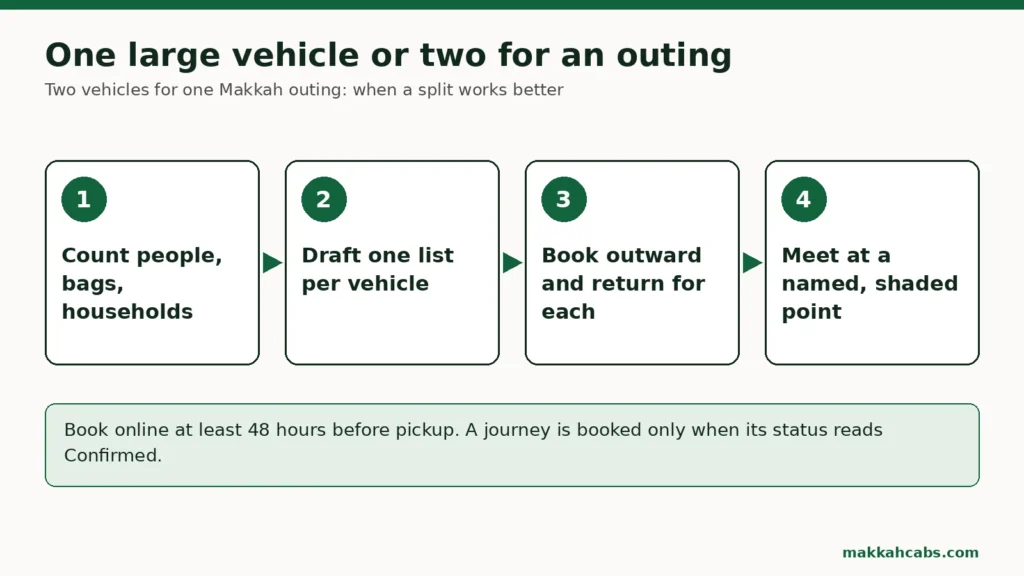
Before choosing, write down three figures for the outing:
- People. Every adult, child and infant who will travel. Infants count.
- Bags that go in the boot. On an outing these are usually day bags, but a folded pushchair, a folding wheelchair or a cool box all take boot space.
- Households. How many separate family units are in the party, and which of them need to stay together.
The planner uses the first two figures. When you search, it shows only the vehicle classes that pass the capacity check for your party and luggage, with each class shown as an example model “or similar”. Our guide on counting the people joining a visit goes through the count in detail, and a stroller and bags for the day covers the items that are easy to forget.
The third figure is the one the planner cannot see, and it is usually what decides whether a split is worth it.
The vehicle classes for a larger party
These are the classes in the booking system, with typical seat and large-bag capacity. Each is an example “or similar”.
| Class (example) | Seats | Large bags | Typical use for an outing |
|---|---|---|---|
| Economy (Toyota Camry class) | 4 | 2 | A small household, or the second car in a split |
| Hyundai Staria (VIP van) | 6 | 2 | Six people with light day bags |
| Premium SUV (Chevrolet Tahoe) | 6 | 4 | Six people with more to carry |
| Hyundai H1 (family van) | 7 | 6 | Seven people, or a household with a pushchair |
| GMC Yukon XL | 7 | 6 | Seven people with room for bags |
| Toyota Hiace | 11 | 10 | One vehicle for a party of up to eleven |
| Toyota Coaster (minibus) | 19 | 11 | One vehicle for a party of twelve to nineteen |
| Coach | 53 | Very large groups |
Two points follow. First, there is a step from seven seats to eleven, and from eleven to nineteen. A party of twelve does not fit a Hiace and has to choose between a Coaster and two vehicles. Second, bag capacity matters as much as seats. A party of eleven with two pushchairs and a folding wheelchair needs the boot space to match.
When one vehicle is the better choice
One larger vehicle usually works best when:
- everyone starts from the same hotel at the same time;
- everyone is going to the same place and coming back together;
- the organiser wants one contact point, one driver and one booking to manage;
- no one in the party needs a different pace, such as an older relative who wants to leave early.
In that situation, a Hiace or a Coaster keeps the family together, arrives in one go, and makes the regroup at the destination simple, because there is only one car to find.
When two vehicles work better
Splitting a group across two cars in Makkah usually earns its keep when one or more of these applies:
- Two starting points. Part of the family is in a different hotel. Two vehicles can collect from each directly rather than one vehicle making a stop.
- Different return times. Grandparents want to rest after a couple of hours, while the younger adults want to stay for a meal. Two returns at two times suit both.
- Different endings. One household is going back to the hotel; the other is going on somewhere else.
- Different needs. One household has a pushchair and small children; the other has an older relative who prefers a quieter vehicle with an easier step.
- Party size falls between classes. Twelve or thirteen people may find two seven-seat vans more comfortable than a nineteen-seat minibus that is two-thirds empty.
Families also sometimes choose to travel as separate groups for their own reasons. That is a personal decision and needs no justification. What matters is that each vehicle is booked for the people who will actually travel in it.
How a split is booked and paid
Each vehicle is its own booking, and each outward and return trip is its own journey. So a split outing with returns is usually four journeys:
- Vehicle A outward.
- Vehicle B outward.
- Vehicle A return.
- Vehicle B return.
Each journey is searched separately, with the passengers and bags for that vehicle only. The planner then shows the classes that fit that subgroup. Makkah Cabs takes full payment online, and each journey has a minimum booking value equivalent to £40, shown as a “Minimum booking amount” line if a fare would otherwise be lower. On very short trips within Makkah, that minimum can apply to each vehicle.
Payment secures a provisional request. The booking team updates the status within 1 to 12 hours, and a journey is booked only when it reads Confirmed. Wait until every journey reads Confirmed before telling the family the plan is fixed. If another adult in the family wants to check the details before you pay, the basket can email them a secure review link.
All journeys need at least 48 hours’ notice when booked online.
Comparing one vehicle with two fairly
Transport is priced per vehicle and per journey, not per person, so the comparison has to be between complete plans. A single Coaster there and back is two journeys. Two vans there and back is four. Compare the whole set in each case.
Keep the plans like for like
When you run the searches, use the same pickup places, the same destination and the same times for both options wherever you can. If one plan includes a stop at a second hotel and the other does not, you are comparing different services. Note the minimum booking value on each journey, which can matter on short trips across Makkah.
Count what the price does not show
Some differences do not appear on a search result:
- Waiting. Each class has an included waiting allowance at pickup, but it is not shown on the results. If you expect a group to be slow to board, ask the booking team to confirm the waiting in writing.
- Flexibility. Two returns give you two finishing times. One return gives you one.
- Management. Four bookings take more looking after than two.
A split is not a way to save money by default, and a single large vehicle is not a way to save it either. The useful question is which plan fits the day you want.
A smaller example: nine people
A party of nine can travel in one Hiace, or in a seven-seat van plus an Economy car. If the nine are one household going and coming together, the Hiace is the simpler plan. If they are a household of six with a pushchair and a couple with their own plans for the evening, the van and car may suit them better, because each group can return when it wants.
One lead per vehicle, one organiser overall
With two vehicles, the day needs a little structure:
- One organiser holds all the bookings and is the only person who contacts the booking team about changes.
- One lead per vehicle is the person the driver can speak to, who knows who is in that vehicle and has the organiser’s number.
- Children travel with their own responsible adults. Do not split a young child from their parent to balance the numbers.
- Each lead has the driver’s name for their vehicle. It appears on the booking in the organiser’s account once a driver is assigned.
Write the passenger list for each vehicle and send it to both leads. It avoids the moment at the pickup point when three people are unsure which car they are in.
Arriving at the same place
Two vehicles booked for the same time rarely arrive together. Routes, traffic and the pace of loading differ. Plan for that rather than hoping against it.
- Agree a named meeting point at the destination, not “the entrance”, and tell both leads.
- The first group waits at the meeting point, not at the kerb. On hot days, pick somewhere shaded. The Ministry of Health advises resting in shaded areas and drinking plenty of fluids, and never leaving children in cars.
- Do not ask one driver to follow the other. Each driver works from their own booking and route.
- Stagger the pickups on purpose if one group takes longer to get ready. It is better that the slower group leaves a little later than that the whole party waits at the kerb.
Around the Haram and in busy central areas, where vehicles can stop is managed on the day by the authorities, and we do not promise a particular entrance or frontage for either vehicle. Agree a findable pickup point for each and be ready to send a live location.
If one group is late on the day
With two vehicles, one group being late does not have to hold up the other.
- The late group’s lead tells the organiser straight away. The organiser, not the lead, contacts the booking team.
- The other vehicle goes as booked. It is a separate journey and its passengers should not wait at the kerb for the first group.
- Be realistic about the new time. The included waiting allowance is short and is meant for the normal minutes it takes to reach the car. A longer delay may be charged, or may mean a new pickup time.
- The meeting point absorbs the gap. Because you agreed where to meet at the destination, the early group can go ahead and wait there.
Returns: the real reason to split
The outward trip is often similar for both groups. The return is where two vehicles show their value.
- Same time, same place: book two returns at the same time from the same meeting point, one for each group. Tell both leads the meeting point.
- Different times: book each return for its own time. The group that leaves first should not feel rushed by the other.
- Different destinations: book each return to its own hotel or next destination.
- Someone swapping groups: if a person is going back with the other household, change the passenger lists before booking the returns, so each vehicle is sized for the people in it.
If you would rather keep everyone together, our article on agreeing one return deadline together looks at how to set a single time. If one person needs to leave well before the rest, one person leaving the visit early covers that case.
A worked example: a family of thirteen
The Siddiqui family has thirteen people in Makkah: grandparents, three adult children with their spouses, and five grandchildren, two of them under five. They are in two hotels: the grandparents and one household in one, the other two households in another. They want to spend an afternoon at one of the city’s parks. The Royal Commission for Makkah City and Holy Sites lists Al-Ju’ranah Park and King Abdullah Park among Makkah’s parks, and the family picks one. Because the park is not one of the planner’s popular locations, they type it in and check the route summary.
Option A: one vehicle. Thirteen people rule out the Hiace, so the planner offers the Coaster and larger. One vehicle would have to collect from both hotels, adding one as a stop, and bring everyone back at one time. The grandparents would have to stay as long as the grandchildren, or everyone would leave early.
Option B: two vehicles. Vehicle A carries the grandparents and their household: six people with a folding wheelchair, so a Premium SUV or a seven-seat van. Vehicle B carries the other two households: seven people with two pushchairs, so a seven-seat van with room for bags. Each vehicle collects from its own hotel.
The decision. The family chooses Option B. The grandparents’ vehicle returns after a shorter visit. The other returns later in the evening. Samir, the eldest son, is the organiser and holds all four bookings. His sister Huda is the lead in vehicle B. Both have the passenger lists, the park meeting point and each other’s numbers.
On the day, vehicle B arrives first and waits in the shade at the agreed point. Vehicle A arrives a little later. Everyone meets without anyone standing at the kerb.
Changing a split after booking
Only the pickup time can be changed online. A request for a new time stays pending until the booking team approves it. An approved new time carries a £5 rescheduling fee, converted into the booking currency and added to the cash paid to the driver at pickup. A rejected request costs nothing.
The number of passengers, the vehicle, the pickup place and the destination cannot be changed online. If the family decides to merge into one vehicle, or move people between vehicles, contact the booking team first. The answer may be a new booking and a cancellation request for an old one, and bookings are subject to our cancellation terms (free cancellation with a full refund up to 48 hours before pickup; inside 48 hours the deposit element of the price is kept) when the customer cancels. If we or the transport partner cancel, or cannot supply a journey and you do not accept a suitable alternative, you receive a full refund for the affected journey. The cancellation and refund policy is the reference.
This is why the passenger lists should be settled before you pay.
Common mistakes with two vehicles
- Balancing the numbers instead of the households. Keep families together; seats follow.
- Booking outward trips but forgetting the returns. A split outing is usually four journeys.
- Assuming the vehicles will wait for each other. Each driver follows their own booking.
- Two people contacting the booking team. One organiser only.
- Treating a similar total as the same thing. Thirteen seats across two vehicles is not the same as thirteen seats in one. Check that each subgroup fits its own vehicle.
For a longer look at how splitting affects a visit with more than one activity, see two shorter Makkah outings.
A checklist for deciding and booking
- Count people, boot items and households for the outing.
- Decide whether everyone starts, finishes and returns together.
- If not, draft two passenger lists, keeping children with their adults.
- Search each group separately and note which classes fit each.
- Compare with a single vehicle for the whole party, including how the return would work.
- Choose one organiser and one lead per vehicle.
- Book outward and return journeys for each vehicle at least 48 hours ahead.
- Agree a named, shaded meeting point at the destination.
- Wait until every journey reads Confirmed, then share lists, driver names and numbers.
- Send any change through the organiser to the booking team before cancelling anything.
When you know who is travelling with whom, the booking is straightforward. Search each group in the Makkah Cabs planner, book the outward and return journeys together, and let each household enjoy the day at its own pace.