
Two short Makkah ziyarah trips often work better than one long day, especially with older relatives or young children. Splitting the sites lets you go out when the group has most energy, stay inside during the hottest part of the day, keep to the prayer times your family wants to observe in comfort, and come back before anyone is exhausted. The trade-off is in the booking: each trip is its own set of journeys, each needs 48 hours’ notice online, and each journey is checked against the minimum booking value. It is not automatically cheaper, but it is often the plan people actually enjoy.
This guide is for the family member deciding how to fit a list of Makkah sites into a stay. It is written for visits to Makkah, sometimes spelled Mecca, and looks at when splitting ziyarah over two days makes sense, how to divide the sites so each trip hangs together, what changes in the booking, and how to shape shorter Makkah outings for elderly pilgrims and small children. It ends with a worked example and a checklist. We do not quote fares or journey times, and questions about religious practice are for a qualified scholar and the official Nusuk guidance.
When one long day stops working
A long ziyarah day looks efficient on paper: one car, one morning, every site ticked off. In practice, a few things tend to go wrong.
- Heat. The Saudi Ministry of Health’s summer heat guidance lists older adults, infants and children, and people with chronic conditions such as heart disease among those most at risk. It advises scheduling outdoor activities carefully and resting in shaded areas. A long day makes both harder.
- Energy falls faster than the plan assumes. The first site gets full attention. By the fourth, the grandparents are tired, the toddler has missed a nap and the teenagers have stopped listening.
- Prayer times break the day. Families often want to be back at the hotel or near a mosque at certain times. A long circuit either cuts across those times or has to rush to avoid them.
- Every delay stacks up. A slow start, a longer stop or a queue at one site pushes back every place that follows, including the return.
If two or more of these apply to your group, two short Makkah ziyarah trips are worth considering.
Splitting ziyarah over two days: what actually changes
Splitting ziyarah over two days is more than halving a list. It changes the shape of the booking, because Makkah Cabs books journeys rather than blocks of time.
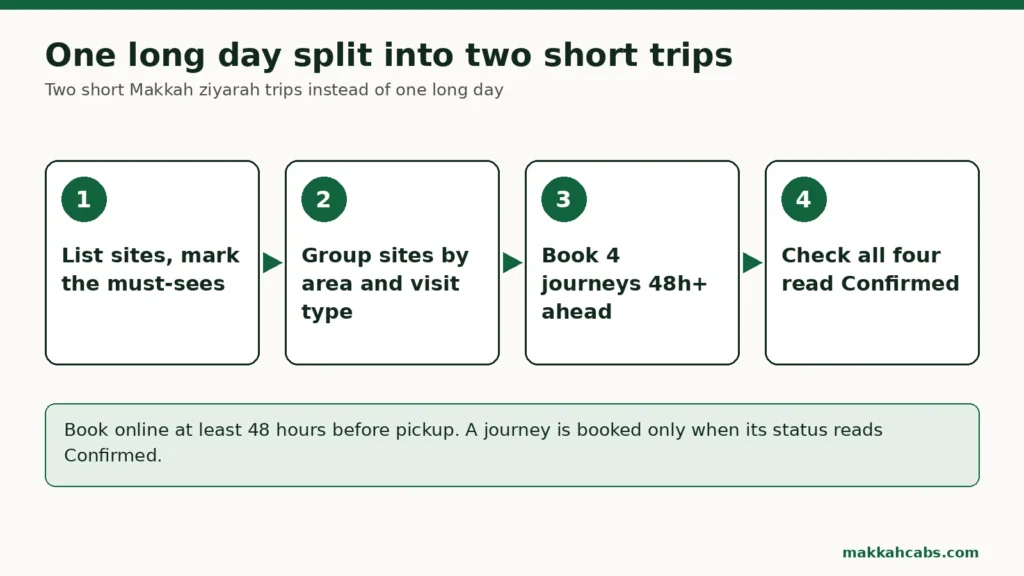
A journey has one pickup, one destination, up to 8 stops in order, a date and a pickup time in Saudi local time. The pickup and destination must differ, so a trip out and back is two journeys. One long day might be a single journey with several stops followed by a return. Two short trips usually become four journeys: out and back on the first day, out and back on the second.
| One long day | Two short trips | |
|---|---|---|
| Journeys to book | Usually two, sometimes more | Usually four |
| Notice needed online | 48 hours before the first pickup | 48 hours before each pickup |
| Minimum booking value | Checked per journey | Checked per journey, so four times |
| Energy and heat | Hardest on the slowest member | Each outing fits the best hours |
| Effect of a delay | Pushes back everything after it | Contained within one trip |
| Flexibility | Change one time, whole day shifts | Each trip can be retimed separately |
| Confirmation | Each journey confirmed separately | Each journey confirmed separately |
Two points in that table deserve attention. First, the minimum booking value, equivalent to £40, applies to each journey. Short journeys inside Makkah can fall below it, and you then see a “Minimum booking amount” line at checkout. Four short journeys may therefore cost more than two longer ones. Second, each trip needs its own 48 hours’ notice when booked online, so book the second trip at the same time as the first, not after you see how the first went.
When one long day is still the better choice
Splitting is not always right, and it is worth being honest about when a single outing wins.
- Your time in Makkah is short. If you have only one free morning between other commitments, one well-planned outing is better than two rushed ones.
- The list is mostly outside views. A handful of short stops where nobody leaves the car for long can sit comfortably inside one journey with stops, followed by a return. The heat and fatigue problems grow mainly with long visits on foot.
- Everyone travelling is fit and keen. A group of adults who are used to the climate may prefer to see everything in one go.
- The minimum booking value tips the balance. If all the journeys would be short and each would fall below the minimum, four journeys may cost noticeably more than two. Compare real previews for both plans before deciding.
If none of the problems described above apply to your group, one day may be the simpler answer. Our guide to essential and optional Makkah stops helps you trim a single-day list so it stays realistic.
Dividing the sites so each trip makes sense
The best split groups sites that belong together, by place and by kind of visit.
Group by area
Using distances from official sources, Makkah’s best-known ziyarah sites fall into rough areas. Saudipedia places Jabal al-Nour about 4 km north-east of the Grand Mosque, with Hira Cultural District at its foot, and Al-Ma’la cemetery at the base of Jabal al-Sayyidah in al-Hajun, north of the Grand Mosque. It places Jabal Thawr south of the Grand Mosque, about 4 km away, in its page on the Jabal Thawr Cultural District. Masjid Aisha at Al-Taneem is about 13 km by road from the Clock Tower area in our own route checks.
A split that keeps northern sites on one day and the southern site on another avoids crossing the city twice in one outing.
Group by the kind of visit
Some places are viewed from outside, such as Jabal Thawr or Jabal al-Nour from below. Others are visited inside, such as the exhibitions at Hira Cultural District. Our guide to Makkah ziyarah sites you view from outside versus places you go in explains the difference. A sensible pattern is one trip built around a single inside visit, and another made of short outside stops.
Put the most important site first
If the family would be disappointed to miss one place, put it at the start of the first trip. Our article on choosing one meaningful Makkah stop helps you decide which one that is.
Shorter Makkah outings for elderly pilgrims
Older relatives are often the reason families split the day, and shorter Makkah outings for elderly pilgrims are worth shaping around them rather than around the list.
- Choose the hours they are at their best. Many older people are most comfortable early in the day. Plan each trip for that window rather than squeezing in a second site at the hottest time.
- Keep walking short and known. Where vehicles may stop is managed on the day, so the walk from the car to a viewpoint or entrance can vary. Do not promise anyone a door-to-door stop; settle on a meeting place in advance and share your live location when the car is near.
- Plan rest, water and toilets into each trip. A short outing with a proper rest is better than a long one with none.
- Add mobility needs in the search. A wheelchair requirement can be added and is then confirmed for the vehicle. Include it for both trips.
- Let people opt out. On the second trip, a grandparent may prefer to stay at the hotel. Because each trip is booked separately, you can search again with the right passenger count before you book it.
Our guide to different walking plans within one visit covers groups where some people walk more than others.
Children, naps and routines
Young children follow their own timetable. A long day tends to break it; two short trips can fit around it.
- Plan each trip to finish before the usual nap or meal time.
- Count children and infants separately in the search, and add any child seat, infant seat or booster requirement so it is confirmed for the vehicle.
- If you are taking a pushchair, count it with the luggage so the capacity check shows vehicles that can carry it.
Fitting trips around prayer times
We do not give guidance on religious practice. As a practical matter, though, many families want to be back at the hotel, or at the Haram, at particular times of day. Two short trips make that easier: you can plan each one to start after one prayer and finish comfortably before the next.
Check the day’s prayer times locally when you set the pickup times, and allow for the time it takes to get from the drop-off to where the family wants to pray. Do not plan a return pickup for the exact minute a prayer ends, when many people are moving at once.
What happens between the two trips
The gap between trips is part of the plan, not empty time. It is when older relatives rest, children sleep and the family goes to the Haram or eats together. Plan it deliberately.
- Do not expect a vehicle to stay with you. Waiting during a visit, or holding a car between two outings, is not something you can select in the planner. If you need that, it must be agreed with the booking team in writing. Our article on whether a Makkah taxi can wait during ziyarah explains why two journeys are usually surer.
- Leave a clear break. If the two trips are on the same day, one in the morning and one late in the afternoon, make sure the first return and the second pickup are far enough apart that a delay in the first does not squeeze the second.
- Keep bags light. Between trips, leave what you do not need at the hotel. Luggage storage is not offered as a product, and a smaller day bag makes each outing easier.
- Recheck the party. Someone who came on the first trip may prefer to rest on the second. Adjust the passenger count before you book, not on the day.
Most families find the second trip goes better than the first, because they now know how long things take for their own group.
Booking two trips without gaps
The weakest point of a split plan is the second trip. Families often book the first and leave the second “until we see how it goes”, then find the 48-hour notice period has passed.
Book both trips together
Search and pay for all four journeys at the same time if you can. Each becomes a provisional request once paid. The booking team updates each one within 1 to 12 hours, and each journey is booked only when it reads Confirmed. Check all four.
Give each trip its own details
Do not copy the first trip’s settings without checking. The second trip may have a different pickup time, a different passenger count, or different bags. Our guide to choosing a car or van for a Makkah outing helps you match the vehicle to each trip.
Keep the references apart
Label each journey clearly in your notes: “Day 1 out”, “Day 1 back”, “Day 2 out”, “Day 2 back”. If you later request a change, you want to change the right one.
Explaining the split to the rest of the family
A split plan only works if everyone knows which trip they are on. Send one short message to the family group once all the journeys read Confirmed, with a line for each trip:
- the day and the pickup time in Saudi local time;
- where the car will collect you, described in words;
- which sites that trip covers, and which are outside views only;
- who is coming, so nobody turns up for the wrong outing;
- the lead contact’s phone number for the day.
Avoid saying “the car is booked” before each journey reads Confirmed. Until then, it is a paid, provisional request. If a relative at home is helping to pay, the basket can email a secure review link so they can check the journeys before one person pays.
It also helps to say plainly why you have split the day. When older relatives understand that the second trip exists so they can rest in between, they are less likely to push on at the first site “to get it all done”.
If the plan changes
Two short Makkah ziyarah trips give you room to adjust, but only within the rules.
- Changing a time. From your Makkah Cabs account you can request a new, future pickup time for any paid journey before its pickup. The request stays pending until approved. An approved change carries a £5 fee, converted into the booking currency and added to the cash paid to the driver at pickup; the booking team may waive it. A rejected request costs nothing.
- Changing anything else. Only the time can be changed online. A different place, destination, passenger count or vehicle needs the booking team, or a new booking plus a cancellation request.
- Cancelling the second trip. Bookings are subject to our cancellation terms (free cancellation with a full refund up to 48 hours before pickup; inside 48 hours the deposit element of the price is kept) if the customer cancels. If we or the transport partner cancel, or cannot supply the journey, you receive a full refund for the affected journey. Read the cancellation and refund policy before you book a second trip you are unsure about.
That last point is the real cost of flexibility. If you are not sure the second trip will happen, it is better to decide now than to book it “just in case”.
A worked example: the Chaudhry family splits the list
Nadia Chaudhry is in Makkah with her husband Tariq, their daughters aged six and two, and Tariq’s parents, both in their seventies. Her list has five places: Jabal al-Nour, Hira Cultural District, Al-Ma’la, Jabal Thawr and Masjid Aisha.
Her first plan is one long day. She sketches it out and sees the problems: the grandparents would be in and out of the car five times, the two-year-old would miss her nap, and the return would land in the middle of the afternoon heat.
She splits it. The first trip covers the northern sites: a short outside stop near Al-Ma’la, then Hira Cultural District, where the family will see Jabal al-Nour from below and visit one exhibition with tickets bought from the district. The first journey ends at the district; a second journey brings them back to the hotel before the hottest part of the day.
The second trip, two days later, is shorter: a view of Jabal Thawr from outside, with a return to the hotel well before the afternoon. Masjid Aisha is further out, about 13 km by road from the Clock Tower, so she plans it as a separate outing using our guide to a Masjid Aisha taxi there and back. Tariq’s father decides he would rather rest, so Nadia searches the second trip with one fewer adult, and a different class is offered.
She books all the journeys five days ahead, labels each one, adds the child seat and infant seat in both searches, and waits for every journey to read Confirmed. Each trip ends before anyone is worn out.
Checklist: planning two short Makkah ziyarah trips
- List every site and mark which ones matter most.
- Mark each site as an outside view or a visit inside.
- Group sites by area so each trip avoids crossing the city twice.
- Put the most important site at the start of the first trip.
- Choose the hours your oldest and youngest travellers manage best.
- Check the day’s prayer times locally and plan around them.
- Search each trip with its own passenger count, bags, child seats and wheelchair needs.
- Expect four journeys, each checked against the minimum booking value.
- Book all journeys together, at least 48 hours before the first pickup.
- Label each journey clearly: day, and out or back.
- Check every journey reads Confirmed.
- Decide now whether the second trip is certain, because customer cancellations are subject to our cancellation terms (free cancellation with a full refund up to 48 hours before pickup; inside 48 hours the deposit element of the price is kept).
A day split in two is often the day everyone remembers well. When you have grouped your sites, open the Makkah Cabs planner and book the journeys for both trips together.