
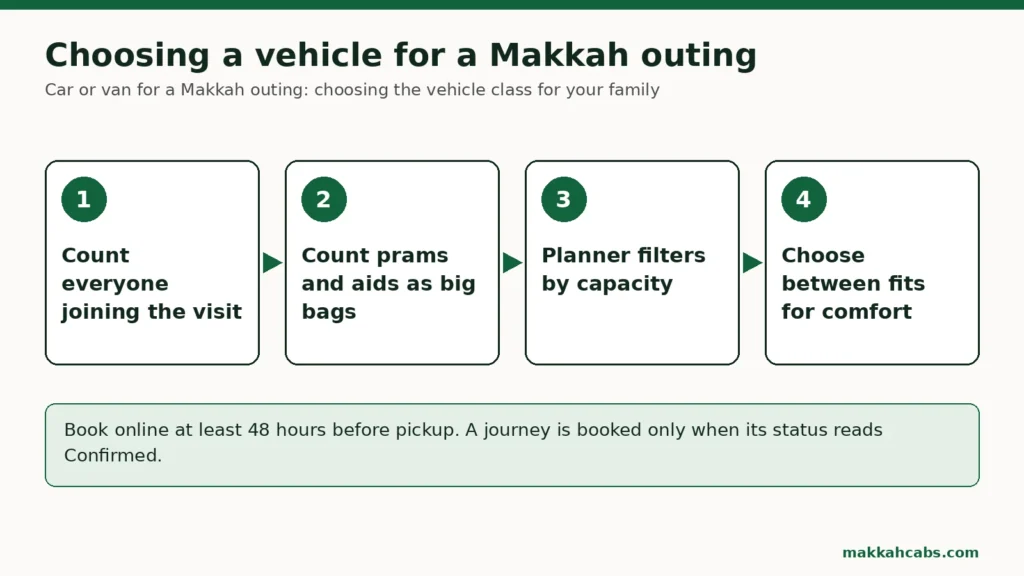
Choosing a car or van for a Makkah outing comes down to three counts: how many people are going, what they will carry for the day, and what equipment, such as a pram or a folding wheelchair, has to travel with them. The distance is rarely the deciding factor for visits within the city. On our live route checks, the Clock Tower area is about 13 km from both Hira Cultural District and Masjid Aisha. What decides the vehicle is the party and the load, and a family outing often needs a very different vehicle from the one that brought the same family from the airport.
This guide is for families and small groups staying in Makkah who are planning a day or half-day outing and want to choose the right vehicle class in the Makkah Cabs planner. It explains the classes on offer and what they hold, how the planner filters options by capacity, why day bags and suitcases should be counted differently, how prams and folding aids change the choice, and when a larger vehicle is worth it for comfort. It includes a comparison table, worked examples and a checklist. It does not cover prices; the planner shows those for your actual journey.
The vehicle classes and what they hold
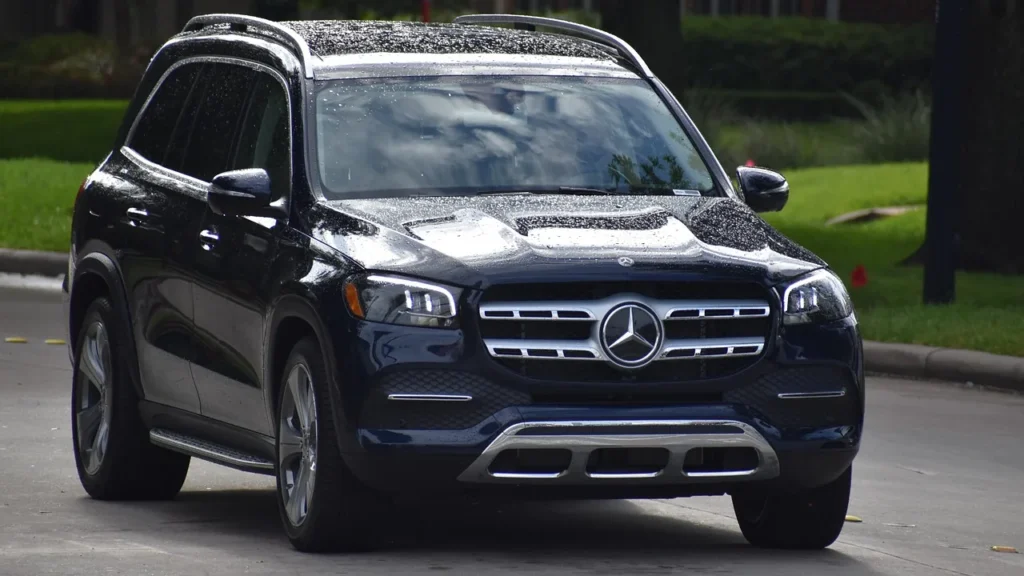
Makkah Cabs shows vehicles by class, each with an example model and the words “or similar”. You are choosing a class with a given capacity, not a specific make and model, so plan around the seats and bag space rather than a photograph.
| Class (example model, or similar) | Seats | Large bags | Typical outing fit |
|---|---|---|---|
| Economy (Toyota Camry class) | 4 | 2 (3 in a Camry) | A couple or a small family with day bags |
| Business and Executive | 4 | 3 | Up to four adults wanting more comfort |
| Luxury (Mercedes S-Class) | 3 | 3 | Up to three passengers wanting the highest comfort |
| Hyundai Staria (VIP van) | 6 | 2 | Five or six people with light day bags |
| Premium SUV (Chevrolet Tahoe) | 6 | 4 | Five or six people with a pram or more to carry |
| Hyundai H1 (family van or MPV) | 7 | 6 | Families of six or seven with equipment |
| GMC Yukon XL | 7 | 6 | Families of six or seven wanting an SUV |
| Toyota Hiace | 11 | 10 | Extended families and small groups |
| Toyota Coaster (minibus) | 19 | 11 | Larger groups travelling together |
| Coach | 53 | Very large groups |
The “large bags” column is the key to reading the table for an outing. On an airport journey it describes suitcases. On a day out, the same space takes prams, folding wheelchairs, cool bags and anything else too big for a lap.
How the planner filters by capacity
When you search a journey, you enter the passengers (adults, children and infants), large bags and cabin bags. The planner then shows only the vehicle classes that pass the capacity check for that party and luggage. You will not be offered a car that the system knows is too small.
Two live checks show how quickly the options narrow. A search for four adults with four large cases showed Premium SUV and larger only. A search for five adults with five large cases showed seven-seat vehicles and larger only.
The filter works only on what you enter, so the quality of the answer depends on the honesty of the count:
- Count every person, including infants and children. A child still needs a seat.
- Count bulky items as large bags. A folded pram or a folding wheelchair takes the kind of space a suitcase does.
- Do not copy the airport numbers. If the suitcases stay at the hotel, the outing load is much lighter.
- Do not enter “no bags” to see smaller vehicles. If the pram does not fit on the day, the outing starts badly.
If a class is missing from the results, that is usually the capacity check at work. Try adjusting only what genuinely changes, such as leaving a second pram at the hotel.
Day bags versus suitcases
A family that needed a seven-seat van with six large bags for the airport may need only a four-seat car for an outing. The difference is the luggage.
For a visit, think in two groups:
- What travels on laps or at feet: handbags, small backpacks, water bottles, prayer mats, a camera. These normally count as cabin bags or nothing.
- What needs boot space: prams and pushchairs, a folding wheelchair or walker, a cool box, shopping you expect to bring back, and any case you are taking to another hotel afterwards.
Only the second group counts as large bags. Our note on a stroller and bags for the day goes into how to build a fresh count for each outing.
Remember that the load can grow during the day. If you plan to shop at a market or collect bags from a hotel on the way back, search the return journey with that larger load, even if the outward journey is light.
Prams, folding aids and child seats
Equipment changes the vehicle more than people expect.
Prams and pushchairs
A folded pram needs boot space. In a four-seat car with two large-bag spaces, one pram and a cool bag may use it all. If you have two prams, or a pram and a folding wheelchair, a Premium SUV or a seven-seat vehicle is often the safer choice. Enter each pram as a large bag.
Folding wheelchairs and walkers
If a traveller uses a folding wheelchair or walker, add it as a large bag, and use the wheelchair requirement in the search if the traveller needs it; that requirement is then confirmed for the vehicle. Describe the equipment and the traveller’s needs in the booking notes. A folded aid carried as equipment is different from a journey that needs an adapted vehicle, and a car booking does not include lifting help unless it has been discussed and confirmed. Our note on describing a folding aid for an outing sets out what to include.
Child seats
Infant seats, child seats and boosters can be added in the search, and are then confirmed for the vehicle. Each fitted seat takes a seat position, so a family of five with two child seats is still five seats. See our note on asking about a child seat for your visit for the questions to raise.
Comfort, not only capacity
A vehicle that passes the capacity check is not always the one your family will be happiest in. Four adults in an Economy car is within its seats, but it is a close fit, and a family with a grandparent who needs to stretch a stiff knee may prefer a van with a sliding door and more space between rows.
Some points that often tip the choice towards a larger class:
- Older relatives. Easier access and more legroom can matter more than the difference in size.
- Several short journeys in a day. Getting in and out repeatedly is easier in a van.
- Longer outings. Most outings within Makkah are short drives, but a day trip such as Taif, about 106 km from the Clock Tower area on our route checks, is a long sit, and a roomier class is worth considering.
- Hot weather. Waiting to board with prams and bags is quicker when everything goes in at once.
It also helps to think about who will actually come. The right Makkah family outing vehicle is chosen for the people joining this visit, not for everyone staying at the hotel. A relative who decides to rest, or a cousin who joins from another hotel, changes the count, and the count decides which classes the planner shows. Our note on counting the people joining this visit explains how to build the number household by household, so that nobody is left without a seat and nobody pays for space the group will not use. Settle the list the day before you search, and search again if it changes before you pay.
Equally, there is no need to book a larger vehicle than your party needs. Choose the smallest class that carries everyone and everything comfortably.
When one vehicle is not enough
Once a party passes seven people with equipment, the choice is usually between an 11-seat Toyota Hiace, a larger minibus, or splitting the group across two vehicles. A single vehicle keeps everyone together and means one driver and one contact. Two vehicles can suit households that want different return times or destinations. Our note on one vehicle or two for your outing covers that decision in detail.
Destinations can also shape the choice. Saudipedia records that Masjid al-Taneem has parking areas for buses, taxis and private cars; that is context about the site, not a promise about where any vehicle will stop or wait on the day. For attractions such as Hira Cultural District, check the venue’s own information for anything that affects your group.
Worked examples: matching families to classes
These examples use ordinary fictional families and the capacity figures above. Your results will depend on your own search.
Omar and Leila, with their daughter Noor, aged three. Three people, one pram, day bags. They enter three passengers, including Noor as a child, one large bag for the pram and add a child seat. Economy, Business and larger classes appear. They choose Business and Executive for the extra bag space, so the pram and a cool bag both fit.
The Hussain family: Faisal, Rubina, their three children and Faisal’s mother, Shamim. Six people, one folding wheelchair for Shamim and one pram. They enter six passengers and two large bags, and use the wheelchair requirement. The Staria, with six seats but two bag spaces, is borderline once day bags are added; the Premium SUV and seven-seat vans also appear. They choose a Hyundai H1 family van because Shamim finds a sliding door easier and it leaves room for shopping on the way back.
Two sisters, Ayesha and Mehreen, with their husbands and five children between them. Nine people, two prams, day bags. The planner shows the Toyota Hiace and larger. They book a Hiace so that both families travel together and share one driver and one contact.
Hamza travelling alone with his father, Ibrahim. Two adults, no equipment, day bags only. Every small class qualifies. They choose Economy, because a larger vehicle would add nothing to this outing.
In each case the choice started with an honest count, then comfort decided between the options that passed the capacity check.
Choosing a vehicle class for Makkah visits by type of outing
The same family may need different classes for different outings. The type of visit changes what travels, how often people get in and out, and how the return is set up.
A short visit to Masjid Aisha
A visit to Masjid al-Taneem is usually light: people, day bags and perhaps a pram. The outward and return drives are separate journeys, and on our live route checks the drive back to the Clock Tower area, about 19 km, was longer than the drive out, about 13 km, because the road layout differs by direction. The smallest class that seats everyone with their equipment is normally enough. If the visit falls on your checkout day with suitcases involved, the load is a different question altogether.
A half-day at Hira Cultural District
A visit to the district often involves more walking, a meal and time in the gardens, so families bring more: water, snacks, a pram, perhaps a folding wheelchair for a grandparent who can walk short distances but not a whole afternoon. Count that equipment as large bags. The return is again a separate journey, and the load on the way back is usually the same as the way out.
An outing with shopping or an extra call
If you plan to buy things on the way, or collect someone or something from a second address, search the return journey with the larger load. A journey can include up to 8 stops in journey order, but a stop is a brief call, not a wait, and every person who joins at a stop still needs a seat from that point on. Choose the class for the fullest part of the journey, not the emptiest.
An outing that ends at a different hotel
If the day finishes at another hotel, for example on the day of a hotel move, the last journey may carry suitcases as well as people. Search that journey on its own with its full load, even if the outward journey is a small car.
Questions to ask before you pay
The planner answers the capacity question. A few other questions are worth raising with the booking team in your notes before you pay, because the vehicle cannot be changed online afterwards.
How much waiting is included. Each class has an included waiting allowance at pickup, and it differs by class, with the larger and premium classes generally allowing longer than Economy. The allowance is not currently shown on search results, so if your family is slow to assemble, ask the booking team to confirm the figure for your chosen class in writing before you pay. It covers the minutes a party takes to reach the car, not the length of a visit.
Whether the equipment fits as described. If you have an unusually large pram or a heavy wheelchair, give its type and folded size in the notes and ask.
Whether the class suits a traveller’s needs. Step height and door type matter to some older travellers. Say so, and let the traveller describe their own needs.
Booking rules that apply to every class
- Online bookings need at least 48 hours’ notice before the pickup time.
- A there-and-back outing is two journeys, each with its own pickup time, because the pickup and destination of a journey must differ.
- Each journey has a minimum booking value equivalent to £40.
- Payment secures a provisional request. The booking team updates the status, usually within 1 to 12 hours, and a journey is booked only when it reads Confirmed.
- Only the pickup time can be changed online. The vehicle, passenger numbers, pickup place and destination cannot; those need the booking team, or a new booking plus a cancellation request. An approved new time carries a £5 rescheduling fee, converted into your booking currency and added to the cash paid to the driver at pickup.
- Bookings are subject to our cancellation terms (free cancellation with a full refund up to 48 hours before pickup; inside 48 hours the deposit element of the price is kept) if you cancel. If we or our transport partner cancel, or cannot supply the journey, you receive a full refund for the affected journey. See the cancellation and refund policy.
Because the vehicle cannot be changed online, it is worth getting the count right before you pay. If someone decides to join after booking, contact the booking team rather than assuming there will be room.
Vehicle choice checklist
- List everyone going on this outing, including children and infants.
- Separate what travels on laps from what needs boot space.
- Count each pram, folding wheelchair, walker and cool box as a large bag.
- Add any child seats and any wheelchair requirement in the search.
- Think about the return: will the load be larger on the way back?
- Search with those numbers and let the capacity check narrow the classes.
- Between the classes that appear, choose for comfort: older relatives, access and length of journey.
- For more than seven people, compare one larger vehicle with two vehicles.
- Describe equipment and needs in the booking notes.
- Book at least 48 hours ahead and check the journey reads Confirmed.
When you have your count, enter your hotel and destination in the Makkah Cabs planner with every passenger and large item, and choose from the classes that fit your family.