
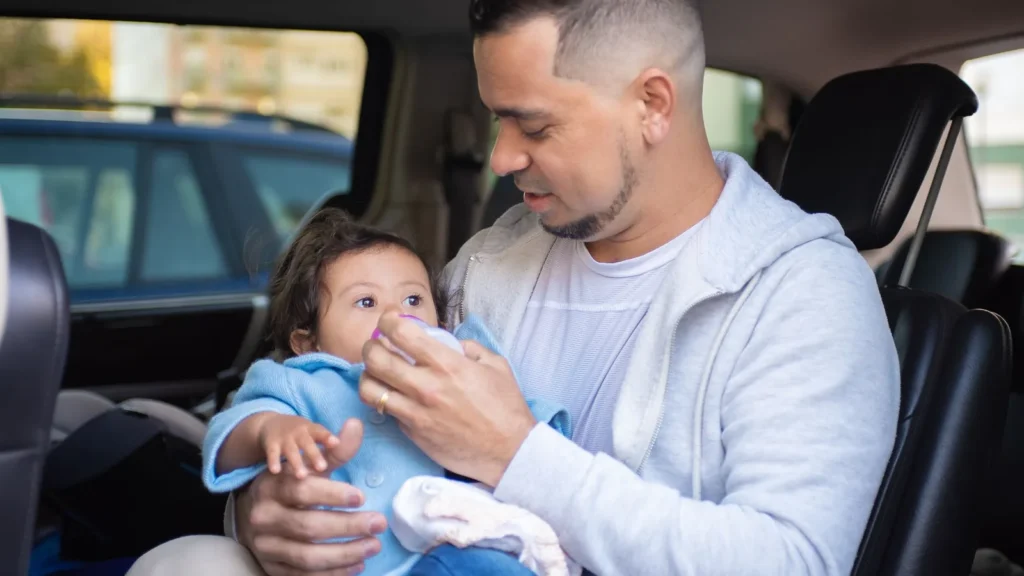
A child seat in a Makkah taxi is booked in the same search as the journey itself: when you enter the passengers in our planner, you can add an infant seat, a child seat or a booster, and the seat is then confirmed for the vehicle. It is not added later by message, and it does not carry over from an earlier trip. Every journey of a family ziyarah, outward and return, needs its own seat request, the right type of seat for each child’s age and size, and a few extra minutes at pickup so an adult can check it is fitted properly before you set off.
This guide is for parents and grandparents staying in Makkah (Mecca) who are planning a visit with babies or young children, for example to Hira Cultural District, Masjid Aisha at Al-Taneem or relatives elsewhere in the city. It explains the three kinds of seat, how to choose between them using the Saudi Ministry of Health’s guidance, how seats change the vehicle you need, what to do if you bring your own, and how to plan the day around a baby. There is a comparison table, a worked example and a checklist near the end.
What a child seat in a Makkah taxi means on our bookings
The planner offers three child seat options in the search:
- Infant seat, for babies;
- Child seat, for toddlers and young children;
- Booster, for older children who have outgrown a child seat.
You choose the seats when you search, alongside the adults, children and infants, the large bags and the cabin bags. The seats you select are then confirmed for the vehicle, so they are part of what the booking team checks before a journey reads Confirmed.
Three things follow from this:
- Each journey carries its own seats. A Makkah outing there and back is two journeys, because the pickup and destination of a journey must be different. Add the seats to both.
- Seats are not assumed. A seat you had on the airport transfer is not automatically in the car for the outing. A larger vehicle class does not include seats unless you add them.
- The seat request is fixed with the booking. After booking, only the pickup time can be changed online. If you realise you need a different seat, contact the booking team rather than waiting for the day.
We cannot promise a particular make or model of seat. What is confirmed is the type you request. If a specific feature matters, such as a seat that reclines for a sleeping baby, say so in the booking notes and ask the booking team before paying.
Which seat does your child need?
The Saudi Ministry of Health publishes in-car child safety guidance that groups car seats by the child’s age and weight. The table below sets out those groups next to the options in our planner. Use it as a starting point, and always check the label on the actual seat and the child’s real weight and height.
| MOH group | MOH description | Planner option to choose | Planning notes |
|---|---|---|---|
| Group 0+ | Rear-facing seats for infants up to 15 months or up to 13 kg | Infant seat | Rear-facing; never in a front seat with an airbag |
| Group 1 | Seats for children of 9 to 18 kg, or about 9 months to 4 years | Child seat | Harnessed seat; allow time to adjust the straps |
| Group 2/3 | High-back seats for children of 15 to 36 kg, or about 4 to 11 years | Booster | Raises the child so the adult belt fits correctly |
The Ministry’s guidance adds several points worth knowing before you book:
- It advises keeping children properly restrained in the back seat for the best protection.
- It says rear-facing seats give more protection to an infant’s head, neck and spine, and should not be placed in a front seat with an airbag.
- It states that all children under 12 who are under 135 cm tall must use an appropriate car seat.
- It advises installing the seat as tightly as possible and making sure it does not move forward or sideways.
The Ministry’s separate child safety page also makes the point that there is no single “best” seat: the right one depends on the child’s age and size and on correct installation and use.
For the current legal requirements on child restraints in Saudi Arabia, check the official traffic authorities. This article is a booking guide, not a legal or fitting guide.
When a child sits between two groups
Children do not grow to a timetable. A two-year-old may be tall for a child seat’s upper limit; a four-year-old may still be light enough for one. The groups overlap on purpose. If you are unsure, weigh and measure the child before you travel, and choose by the child’s size rather than their birthday.
Booster seat for a ziyarah trip: older children
A booster seat for a ziyarah trip is the option families most often skip. An eight-year-old looks too big for “a car seat”, and a short drive across Makkah feels too short to bother. The Ministry’s guidance does not make that distinction. It explains that a booster raises the child so the adult seat belt fits correctly, and it places children of roughly 4 to 11 years, or 15 to 36 kg, in the high-back seat group.
On a ziyarah the drives may be short, but there are usually several of them: to the site, back to the hotel, perhaps a stop on the way. Each drive is a journey with its own seat request. On our route checks, the drive from the Clock Tower area to Hira Cultural District is about 13 km and the return about 11 km, with different routes each way. A booster on both is the simple answer.
If an older child is borderline, ask the booking team for a booster anyway. An unused booster costs you very little inconvenience. A missing one leaves you choosing between a poorly fitting belt and not travelling.
Family ziyarah with a baby: planning around the infant
A family ziyarah with a baby changes more than the seat. It changes the vehicle, the timing and what you carry.
The seat. Choose an infant seat and plan for it to face the rear, in a back seat. That rules out using the front passenger seat for the baby, which matters for families who were counting on it.
The heat. The Ministry of Health’s heat illness guidance warns plainly never to leave children in cars, which can become dangerously hot, and says children are particularly at risk. Never leave a baby in the vehicle, even for a moment, even with the engine running. When you arrive, lift the baby out first.
The timing. Babies do not follow ziyarah schedules. Plan one site rather than three, choose a return time with a margin, and avoid the hottest part of the day where you can. If the baby will need feeding, think about where you will do that at the site rather than in a parked car.
The pushchair. A pushchair or pram takes boot space and should be entered as a large bag. Our guide to a pushchair and day bags on a Makkah day out covers how to fit the day load.
The count. An infant is a passenger. Enter the baby in the infants box, not as a lap passenger. Our guide to counting passengers for a Makkah taxi explains why every person needs a seat position.
Seats take space: how child seats change the vehicle
Each fitted child seat occupies a seat position. A family of two adults and three children needs five seats whether or not the children are in child seats, and three fitted seats in one row can be a tight fit in a smaller car.
Some practical consequences:
- The front seat may not suit. If the baby’s rear-facing seat must go in the back, the number of usable back seats matters more than the headline seat count.
- Three seats across one row. Whether three child seats fit side by side depends on the vehicle and the seats. If you need that, ask the booking team before paying rather than assuming.
- Access to the child. In a van with a sliding door and a second row, an adult can reach a child seat more easily than in a saloon car.
- Boot space still counts. Seats do not replace luggage space. The pushchair, nappy bag and cool box still need room.
This is why, when they book a child seat in a Makkah taxi, families with two or three young children often choose a larger class for an outing than the passenger count alone suggests. Our guide to choosing a car or van for a Makkah outing compares the classes, their seats and their bag space.
Adding the seat when you book
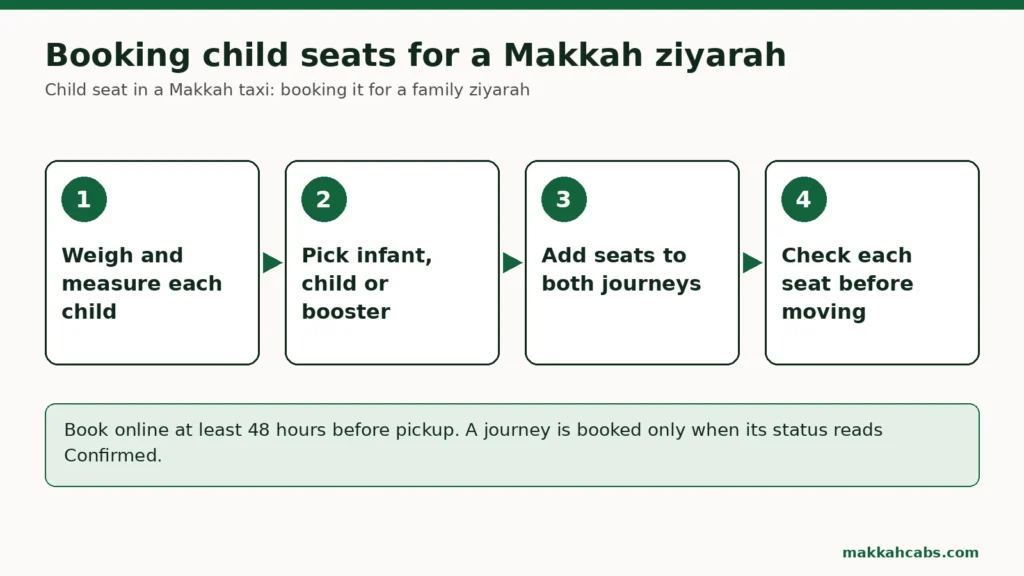
The steps are short, but the order matters.
- Enter the passengers: adults, children and infants, as they will actually travel.
- Add the seats in the search: the number of infant seats, child seats and boosters you need.
- Enter the bags, counting the pushchair as a large bag.
- Check the classes offered. The planner shows only the vehicle classes that pass the capacity check.
- Write a short note if something about the seats matters, such as which child needs which seat or that you are bringing one seat of your own.
- Repeat for the return journey, with the seats for whoever is coming back.
- Pay and wait for Confirmed. Makkah Cabs takes full payment online. The booking team updates the status within 1 to 12 hours; the journey is booked only when it reads Confirmed.
Online bookings need at least 48 hours’ notice. If a ziyarah is planned for the day after tomorrow, book today.
Bringing your own seat
Some families travel with their own seat, particularly for a baby. That is a reasonable choice, but it needs planning.
- Say so in the booking notes. Give the type of seat and which child it is for, so the booking team understands the arrangement.
- Count the space. Your own seat occupies a seat position in the vehicle just as a supplied seat does. When it is not in use, it may need boot space.
- Fitting is your responsibility. Follow the seat manufacturer’s instructions. The Ministry of Health’s advice to install the seat as tightly as possible, with no movement forward or sideways, is a useful check.
- Think about the whole day. A seat that is fitted for the outward drive has to be taken out, carried or left, and fitted again for the return. If the return is a different vehicle, it is fitted again.
If you are unsure whether your seat is compatible with the vehicle, ask the booking team before you pay.
Allow time at pickup to check the seats
Whether the seats are supplied or your own, an adult should check each one before the car moves. Look at the direction the infant seat faces, whether the seat moves when you push it, whether the harness is adjusted to the child, and whether the booster sits flat with the belt across the shoulder rather than the neck.
That takes a few minutes, and the time is yours to plan. Be at the pickup point on time with the children ready, so the checking happens within the time you have booked rather than eating into it. Each vehicle class has an included waiting allowance at pickup, but it is not shown on the search results. If you know the family will need longer at the start, ask the booking team to confirm the waiting in writing. We do not quote per-minute rates.
Outward and return: the seats on both journeys
The return is where child seats are most often forgotten. The morning search had the seats; the afternoon one was booked in a hurry without them.
When you book a family ziyarah, search the return with the seats for the children who are coming back. If the family splits for the return, each vehicle needs seats for the children in it. Our guide to two vehicles for one Makkah outing explains how to decide which child travels with which adult when a group divides. Do not move a young child away from their own parent simply to balance the numbers.
Worked example: Amina and Yusuf at Hira Cultural District
Amina and Yusuf Rahman are staying near the Clock Tower with their daughter Maryam, who is eight months old and weighs 8 kg, and their son Ibrahim, who is five and weighs 19 kg. Yusuf’s mother is with them. They want to spend a morning at Hira Cultural District, visiting the museums without climbing, and be back at the hotel before the heat of the afternoon. They have read our guide to a Hira Cultural District visit without the climb.
Choosing seats. Maryam is well inside the infant range, so she needs a rear-facing infant seat. Ibrahim, at 19 kg and five years old, fits the high-back seat group in the Ministry’s table, so they choose a booster. Yusuf weighs and measures Ibrahim to be sure.
Counting. Three adults, one child, one infant. One infant seat, one booster. A pushchair and a nappy bag.
Choosing the vehicle. Five people rule out the four-seat classes. A six-seat Hyundai Staria would take them, but with two child seats to place and a pushchair plus nappy bag in the boot, they want more room to reach the children. They choose a seven-seat family van, which gives Yusuf’s mother a comfortable seat and the pushchair space.
Booking. Amina books both journeys three days ahead, with the same seats on each, and writes a note: “Infant seat for Maryam (8 months, rear-facing); booster for Ibrahim (5 years). Pushchair in the boot.” Both journeys read Confirmed the same day.
On the day. They are at the pickup point on time. Yusuf checks the infant seat faces the rear and does not move, and adjusts Ibrahim’s booster belt. At the district, Amina lifts Maryam out first, then unfolds the pushchair. On the way back, the same checks take two minutes.
What we can and cannot promise
We can confirm the type of child seat in a Makkah taxi that you request for the vehicle on each journey, once the booking reads Confirmed.
We cannot promise a particular brand or model of seat, that three seats will fit side by side in every class, or advice on fitting a seat of your own. We also cannot change the seats or the vehicle online after booking, because only the pickup time can be changed online. An approved change of time carries a £5 rescheduling fee, converted into the booking currency and added to the cash paid to the driver at pickup.
Bookings are subject to our cancellation terms (free cancellation with a full refund up to 48 hours before pickup; inside 48 hours the deposit element of the price is kept) if the customer cancels. If we or the transport partner cancel, or cannot supply the journey and no suitable alternative is accepted, the customer receives a full refund for the affected journey. The full terms are on the cancellation and refund policy. Each journey also has a minimum booking value equivalent to £40.
Child seat checklist
Work through this before you pay.
- Weigh and measure each child and choose infant seat, child seat or booster by size, not age alone.
- Plan a rear-facing infant seat in a back seat, never in a front seat with an airbag.
- Add the seats in the search for the outward journey.
- Add the seats again for the return journey, for the children who are coming back.
- Enter every child and infant as a passenger, and the pushchair as a large bag.
- Choose a vehicle class that fits the seats and still leaves room for the day bags.
- Write in the notes which child needs which seat, and any seat you will bring yourself.
- Book at least 48 hours ahead and wait until each journey reads Confirmed.
- Be ready on time so an adult can check each seat before the car moves.
- Never leave a child in a parked vehicle, even briefly.
A child seat that is booked, confirmed and checked lets the family think about the visit rather than the drive. When you are ready, open the Makkah Cabs planner, add the seats for each child to both journeys, and read the route summary before you pay.