
A Makkah ziyarah with elderly parents works best when the plan is built around the person who walks least, not the person who walks most. In practice that means fewer places, shorter stretches on foot, shade and a seat at each stop, a clear meeting point, and a return journey booked for a time that suits the slowest member of the group. The car carries everyone between places; it is not a waiting room. So the key decision is where each person will be, and for how long, while the others walk further.
This guide is for adult children and grandchildren planning an outing from a Makkah (Mecca) hotel for a family that includes older parents, a grandparent who tires quickly, or anyone who walks slowly or uses a stick, frame or wheelchair. It covers how to ask about walking in useful terms, which kinds of site suit which walkers, heat, how to split the group without losing anyone, how to book the journeys with Makkah Cabs, and what can change on the day. It deals with transport and planning, not medical or religious advice. If you are unsure whether a parent is fit for an outing, ask their doctor. Questions about acts of worship belong with a qualified scholar and the official Nusuk platform.
Makkah ziyarah with elderly parents: start with what each person wants
Families often plan the day first and ask the parents second. Reverse that. Before you look at a map, ask each older relative two questions: what would make this outing worthwhile for you, and what would make it hard?
The answers are often simpler than expected. One parent may want to see the mountain where the first revelation came and does not mind staying at the foot of it. Another may want to sit quietly at a mosque for a while. A grandparent may simply want to be out with the grandchildren. None of these needs a long list of sites.
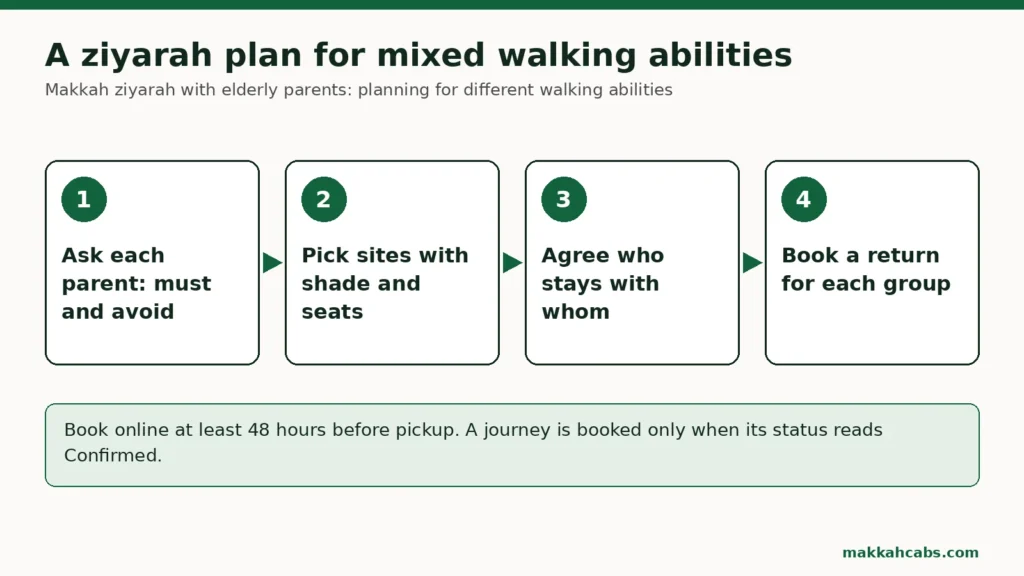
Write down one “must” for each older person and one “must avoid”. That short list shapes the day better than any itinerary copied from elsewhere, and it respects the fact that the parent is the one doing the walking.
Ziyarah for slow walkers: ask about walking in concrete terms
“Can Mum walk?” is not a useful question. Most older people can walk some distance on some surfaces at some times of day. Planning a ziyarah for slow walkers depends on the details:
- Distance. Roughly how far can they walk before needing to sit? Think in terms of familiar distances at home, such as from the car park to the supermarket entrance.
- Slopes and steps. Many sites in Makkah sit at the foot of mountains. A gentle slope and a flight of steps are very different things.
- Standing. Queues and exhibitions involve standing still, which some people find harder than walking.
- Heat. Tolerance falls sharply in the middle of the day, particularly for older people.
- Toilets and water. How often do they need a toilet, and can they manage a long stretch without one?
- Recovery. Did they walk a lot at the Haram yesterday, and will they need to again this evening?
Ask each person directly and let them answer for themselves. A label such as “elderly” hides a wide range of abilities. The goal is not to decide for your parents but to build a day in which they can take part on their own terms.
Choosing sites that suit different walking abilities
Sites differ a great deal in what a visit involves on foot. The table summarises what official sources say about four places often included in a Makkah outing, and what that suggests for mixed groups. Always check current details with the official source before you go.
| Place | What official sources describe | For slower walkers | For stronger walkers |
|---|---|---|---|
| Hira Cultural District, at the foot of Jabal al-Nour | Visitor centre, Revelation Exhibition, Holy Quran Museum, shops and cafes; a paved path towards the Cave of Hira | Indoor exhibition and museum, cafe seating, the visitor centre | The path towards the cave, if they choose and are fit for it |
| Masjid Aisha (Masjid al-Taneem) | Parking for buses, taxis and cars, shaded courtyards, restrooms and water coolers | A shorter visit with shade and facilities close together | Same visit; little extra walking needed |
| Jabal Thawr Cultural District | Visitor reception centre and the Hijrah Exhibition | Check access details directly before planning | The exhibition, and any further plans checked in advance |
| A view of a mountain from its foot | Varies by place | Short time out of the car at a safe, agreed point | The same, with perhaps a short walk |
Saudipedia, the Saudi national encyclopaedia, describes Masjid al-Taneem as having parking areas for buses, taxis and private cars, shaded courtyards, restrooms and water coolers. For an older parent, facilities close together are often more important than the name on the itinerary.
Saudipedia also records that Jabal al-Nour, the mountain that holds the Cave of Hira, is 642 metres high. A visit to Hira Cultural District at its foot is a complete outing in its own right, and our guide to visiting Hira Cultural District without the climb sets out how that works with a taxi.
Heat, shade and the time of day
Heat is the factor families most often underestimate. The Ministry of Health lists older adults, infants and children, and people with chronic conditions such as hypertension or heart disease among those most vulnerable to heat illness. Its summer heat guidance advises scheduling outdoor activities carefully, resting in shaded areas, and drinking plenty of fluids without waiting to feel thirsty.
For pilgrims, the Ministry has also advised avoiding direct sun exposure between 10:00 and 16:00 and using umbrellas when moving between holy sites. That guidance was issued for the Hajj season, but the principle is sensible for any outing in Makkah’s heat.
In practice, for a Makkah ziyarah with elderly parents:
- plan outdoor parts of the visit for the cooler hours;
- make sure each stop has a place to sit in the shade or indoors;
- carry water for everyone, plus an umbrella or sun hat for the parents;
- keep the outing short enough that nobody reaches the point of exhaustion;
- agree in advance that anyone can call an early end without argument.
Watch for the warning signs the Ministry lists, such as headache, dizziness, heavy sweating, intense thirst and nausea. If they appear, move the person into the shade, cool them with water and give fluids, and seek medical help if they do not improve.
Splitting the group without splitting the plan
Mixed walking abilities often mean part of the family wants to walk further than the rest. That is fine, as long as everyone knows where everyone else will be.
The car is not a waiting room
It is tempting to assume that the parents can sit in the car while the others walk. That is not how a Makkah Cabs booking works. Each vehicle class has an included waiting allowance at pickup, but it is not shown on the search results, and it is not a car standing by during a visit. The driver may need to move on, and vehicle access at busy places is managed on the day. If you want the vehicle to wait, ask the booking team before you pay and get the answer in writing. Our article on whether the vehicle can stay with your group looks at this in more detail.
Choose a seated waiting place at the site
Instead, pick a place at the site where the less mobile can wait in comfort. The official Hira Cultural District site describes a visitor centre with staff to assist and a range of shops, cafes and restaurants. A cafe table in the shade is a much better waiting place than a car at a kerb. At a mosque, shaded courtyards may serve the same purpose.
Agree three things before anyone walks off
- Who stays with whom. An older parent should not be left alone in an unfamiliar place, even for a short time. Name the person who stays with them.
- One meeting time and one meeting place. Choose a landmark everyone can find again, not “near the entrance”.
- How you will stay in touch. Check that phones are charged and that the parents’ companion can share a live location.
Planning a Makkah visit for mixed abilities: the journeys
Once you know where people will be, book the journeys to match. Planning a Makkah visit for mixed abilities with Makkah Cabs follows the same rules as any other outing, with a few extra details.
Two journeys for a there-and-back outing. A journey has one pickup place, one destination and a pickup time in Saudi local time. The pickup and destination must differ, so the outward trip and the return are two bookings, each with its own time. Choose the return time around the parents’ stamina, not the walkers’ enthusiasm.
An earlier return for part of the group. If the parents will want to leave before the others, you can book a separate journey for them at an earlier time, and a later return for the rest. Each journey must meet the minimum booking value equivalent to £40. Our article on one person leaving a Makkah visit early covers this situation. For a larger family, using two vehicles for one Makkah outing may suit better.
Wheelchairs, frames and mobility aids. A wheelchair requirement can be added in the search, and it is then confirmed for the vehicle. A folding frame or chair also takes boot space, so count it with the luggage. Our guide to describing a folding mobility aid for a Makkah outing explains what to tell us.
Booking notes. Use the notes to describe practical needs, for example “Father walks with a stick and needs to sit for a few minutes after getting out; please allow time for him to get in and out.”
Vehicle size. Search results show only the vehicle classes that fit your party and luggage. A roomier class can make getting in and out easier for older passengers, and leaves space for a folded chair.
The walking you do not see: pickups and drop-offs
Families plan the walking at the site and forget the walking at each end. Getting from a hotel room to the car, or from the drop-off point to the entrance of a site, can be the longest walk of the day.
Makkah Cabs does not promise where a car may stop at a hotel or a site. Vehicle access is managed on the day, particularly near the Haram. So:
- agree a pickup point at the hotel that the parents can reach easily, and check it the day before;
- ask the hotel desk about the most practical place for a car to collect an older guest;
- at the site, agree a meeting point by phone and share a live location rather than assuming the car can reach the door.
Our guide to a Makkah hotel pickup point, frontage or agreed meeting place goes through this in detail.
A worked example: the Siddiqui family at Hira
Bilal Siddiqui is in Makkah with his wife Sana, their children aged nine and twelve, and his parents, Yusuf and Amina, who are in their late seventies. Yusuf walks with a stick and tires after a few minutes on his feet. Amina walks well but finds heat difficult. Bilal and Sana want the children to see the mountain and the exhibition. The children want to walk as far as they are allowed.
Asking first. Yusuf says his “must” is seeing Jabal al-Nour and his “must avoid” is standing in a queue. Amina wants to see the museum and avoid the midday sun.
The plan. Bilal books three journeys at least 48 hours ahead:
- Hotel to Hira Cultural District at 16:30, for all six, in a vehicle with room for Yusuf’s folding stool.
- Hira Cultural District to the hotel at 18:30, for Yusuf and Amina, with Sana travelling with them.
- Hira Cultural District to the hotel at 20:00, for Bilal and the children.
He adds a note to the first journey: “Grandfather walks with a stick; please allow time for getting in and out.” He books museum tickets for Amina and Sana through the official site.
At the site. Amina and Sana visit the museum while Yusuf rests at a cafe table in the shade. Bilal and the children stay with him first, then go on to the exhibition. At 18:15 the adults meet at the cafe, and Sana takes the parents to the agreed meeting point for the 18:30 pickup, sharing her live location.
What made it work. Nobody waited in a car, nobody was left alone, and the parents went home before they were exhausted. Each journey met the minimum booking value, and the plan did not depend on a change on the day.
What can change on the day
Even a careful plan for a Makkah ziyarah with elderly parents may need to adjust on the day. What you can do depends on what needs to change.
The time. For a paid booking, before its pickup time, your account offers “Request a new pickup time”. It stays pending until the booking team approves it. An approved new time carries a £5 rescheduling fee, converted into your booking currency (about SAR 25), added to the cash paid to the driver at pickup. A rejected request costs nothing.
Anything else. The pickup place, destination, number of passengers and vehicle cannot be changed online. That needs the booking team, or a new booking plus a cancellation request. Online bookings need at least 48 hours’ notice, so a brand new journey for the same day cannot be booked through the planner. This is why it is better to book the parents’ earlier return in advance than to hope to add it on the day.
If a parent feels unwell. Health comes before any booking. Move them into the shade, give them water, and call for medical help if needed. Contact the booking team about the journeys afterwards.
Payment, confirmation and cancellation
Makkah Cabs takes full payment online. Payment secures a provisional request; the booking team updates the status within 1 to 12 hours, and the journey is booked only when it reads Confirmed. The basket can email a secure review link, so a sibling abroad can check the plan before one person pays.
Bookings are subject to our cancellation terms (free cancellation with a full refund up to 48 hours before pickup; inside 48 hours the deposit element of the price is kept) if the customer cancels. If we or the transport partner cancel, or cannot supply the journey, you receive a full refund for the affected journey. The full terms are in the Makkah Cabs cancellation and refund policy. Because of this, agree the plan with your parents before you pay, not after.
Checklist for a mixed-ability Makkah outing
Use this list before booking any Makkah ziyarah with elderly parents or slower walkers.
- Ask each older relative for one “must” and one “must avoid”.
- Ask about walking in concrete terms: distance, slopes, steps, standing, heat and toilets.
- Choose one or two places with seating, shade and facilities close together.
- Check current opening details and any tickets with the official source.
- Plan the outdoor parts for the cooler hours and carry water and an umbrella.
- Pick a seated waiting place at the site for anyone not walking further.
- Name who stays with each older parent, and agree one meeting time and place.
- Book at least 48 hours ahead: the outward journey, and a return for each group that leaves at a different time.
- Add the wheelchair requirement or mobility aid in the search, and practical needs in the notes.
- Wait for every journey to read Confirmed, then share the plan in one message.
When the list is complete, open the Makkah Cabs planner, search the outward journey and each return with the right passengers and equipment, and read the route summary before you pay.