

Leaving a ziyarah early works best when it is planned as its own journey before anyone sets out: a separate ride back to the hotel for the person who needs to stop, booked for a set time from a named place, while the rest of the group keeps the outing it paid for. The car carrying the group cannot simply slip away to the hotel and come back, because every Makkah Cabs journey is a fixed route from one pickup to one destination, with any stops agreed at booking.
This guide is for families and small groups staying in Makkah (Mecca) who suspect that one person, often an older parent, a tired child or someone with a fixed commitment at the hotel, will want to head back before the others. It explains the three workable ways to handle an early return, how to book the extra journey, who should travel with the person leaving, what happens to the main booking, and what to do if the need only appears on the day. It deals with transport. Questions about worship, such as whether to return to the Haram for a particular prayer, are for a qualified scholar and the official Nusuk platform.
Why leaving a ziyarah early needs its own plan
On the planner, a journey is one pickup place, one destination, a pickup date and time in Saudi local time, and the people and bags travelling. You can add up to eight stops, in order. That is the whole of what the driver has been asked to do.
So if your group is booked from the Clock Royal Tower to Hira Cultural District and back, the car that dropped you at the district is not waiting in reserve for anyone who wants to leave. It may well have another job. The return is a second journey at a time you chose. Our guide to the return agreement for a Makkah ziyarah explains why a there-and-back outing is always two journeys.
That structure helps here. You can book a third, smaller journey for one person without touching the group’s plan. What it does not allow is asking the driver at the site to “just take Mum back quickly”. A driver cannot change a booked route, so nobody should promise a relative that this will happen.
Three ways to handle one person going back first
There are three realistic structures. Which one fits depends on whether the early departure is certain, where the group is going next, and how many people need to go back.
| Structure | How it works | Best when | Main drawback |
|---|---|---|---|
| Separate ride back to the hotel | A one-way journey from the site to the hotel, booked for the person leaving and anyone with them | The early leaver is known and the site is a single destination | It is a full booking, with the £40 minimum booking value |
| Drop-off stop between sites | The group’s journey from one site to the next includes a stop at the hotel | The group is visiting two places and the hotel is on the way | Everyone rides via the hotel, and the order is fixed at booking |
| Whole group returns earlier | The return journey is booked, or moved, to an earlier time | Most of the party would also be happy to leave | The keenest visitors lose time at the site |
The separate ride back to the hotel
This is the cleanest arrangement. The group books its outing as usual. Then a further journey is booked from the site to the hotel, at the time the early leaver wants to go, with the right passenger count for that journey. The main return stays exactly as booked for everyone else.
A drop-off stop on the way to the next site
If the group is visiting two places, the leg between them can include the hotel as a stop. For example, a journey from Hira Cultural District to Jabal Thawr Cultural District might have a stop at the hotel, where a grandparent and one companion get out. Saudipedia places Jabal Thawr Cultural District about four kilometres south of the Grand Mosque, so a central hotel may sit roughly between the two; the route summary shows whether it does before you pay. Our article on ordering the stops on a multi-stop Makkah visit goes through how stops are sequenced.
The whole group comes back earlier
Sometimes the honest answer is that the outing is too long for the family as it is. If most people would welcome an earlier finish, book the return earlier in the first place. If the booking is already paid, you can ask for a new pickup time for the return journey from your account, which is covered below.
Who tends to leave early, and why it matters
Name the person and the reason. The usual candidates are these.
- An older parent or grandparent. Walking at Hira Cultural District or standing in the open can tire someone far sooner than the rest of the family expects.
- A young child. Naps and meals do not wait for the end of an exhibition.
- Someone with a fixed time at the hotel. A lecture, a meeting with relatives or a check-in for another family member.
- Someone who wants to be back near the Haram at a particular time. That is a personal decision; the transport job is simply to get them there.
- Someone feeling the heat. This one arrives without warning.
Heat deserves a sentence of its own. Saudi Arabia’s Ministry of Health lists heavy sweating, weakness, dizziness, headache and nausea among the signs of heat exhaustion on its summer heat guidance, and names older adults, infants and children among the groups most at risk. It advises moving the person somewhere cool and, for the more serious signs of heat stroke, getting them to hospital immediately. A person with those symptoms is not an early-return booking. They need care first, and a transport question can wait.
Booking a separate ride back to the hotel
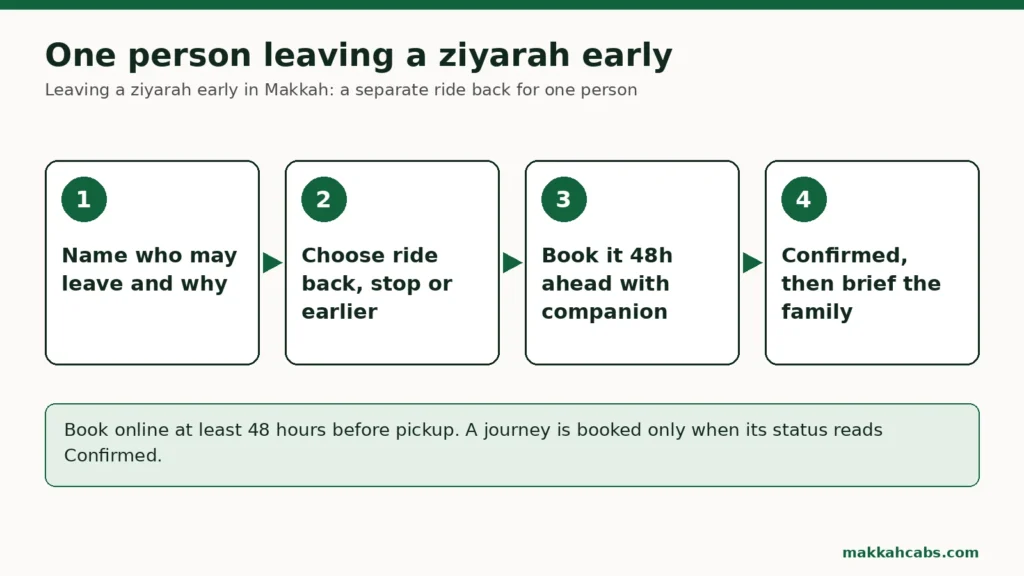
If you already know one person will leave early, book the extra journey at the same time as the outing. Here is how it fits together.
- Pickup: the site where the person will be, for example the Hira Cultural District entry in the planner’s popular locations, or a place you type in and check on the route summary.
- Destination: the hotel, named exactly as on the hotel booking.
- Date and time: the time you want that person collected, in Saudi local time.
- Passengers: only the people on that journey. If a grandmother leaves with her grandson, that is one adult and one child.
- Bags and equipment: a folding wheelchair, a pushchair or a bag of shopping all count.
- Notes: who the traveller is, who is with them, and the meeting point.
Online bookings need at least 48 hours’ notice before pickup, so this is a decision to make while you plan the outing, not on the morning. Each journey also has a minimum booking value equivalent to £40. On a short hop across Makkah, the minimum may be what you pay, and the checkout shows a “Minimum booking amount” line when that applies.
Payment secures a provisional request. The status should update within 1 to 12 hours, and the ride back is only booked when your account shows it as Confirmed. Check that it does before you tell the person leaving that “a car is booked”.
Choosing the time for the early return
Pick a time early enough to help; a return booked for almost the same time as the group’s achieves little. Walk through the visit in order: arrival, the thing everyone wants to see, a rest, the part only the energetic want to do. The early return belongs where the first group has finished what it came for. Our guide on setting a shared return time for a Makkah outing shows how to work backwards from a pickup time to the moment people start walking.
Where the early leaver is collected
The early leaver has to reach the pickup point, and they may be the person least able to walk to it. Agree a place the car can reasonably reach and that the person can get to without a long walk. We cannot promise where a vehicle may stop at any site; that is managed on the day. Write the meeting place into the notes and send a live location from the phone of whoever is with them. Our article on the Hira Cultural District pickup point covers this for the most common ziyarah destination.
One person returning early in Makkah: who should go with them
A fit adult who can find their own way can travel back alone. For most families the early leaver is someone who should not. Ask three questions first.
- Can the person leaving manage the hotel lobby, the lift and their room on their own?
- Do they have their own room key card, a working phone and the hotel’s name in writing?
- If they are unwell, who will stay with them once they are back?
The companion is a passenger on the early return, so count them. They are also no longer in the group for the rest of the visit. If that changes what the remaining group can do, for example because the companion was the only adult comfortable with the climb, think about it now.
One person returning early in Makkah also changes the jobs within the family. Somebody else now holds the group’s phone, the tickets or the pushchair. Hand those over in the hotel lobby before anyone sets out, not at the site.
What happens to the main booking
The group’s original journeys do not shrink because one person leaves early.
- Passenger numbers cannot be changed online. Only the pickup time can be changed from your account. Place, destination, passengers and vehicle need the booking team.
- The vehicle stays the one you booked. A family of seven that loses two passengers for the return still has the seven-seat vehicle.
- The price does not reduce. Bookings are subject to our cancellation terms (free cancellation with a full refund up to 48 hours before pickup; inside 48 hours the deposit element of the price is kept) if the customer cancels, and that applies to a journey or part of a group that is no longer needed. The full cancellation and refund policy sets out the terms, including the full refund for the affected journey when we or the transport partner cancel or cannot supply the journey.
It is still worth telling the booking team, through the contact page, that the return will carry fewer people than booked. It avoids confusion at pickup.
Leaving a ziyarah early when it is only a possibility
The hardest case is the maybe. Grandad might be fine; he might not. You have three honest options.
Book the extra journey anyway. You pay for a ride back that may not be used, and you cannot reclaim it by cancelling. This suits families where the early return is more likely than not.
Plan a shorter outing for everyone. If you suspect the long visit is too long, it probably is. Splitting a big list into two outings is often better; our guide to two short Makkah ziyarah trips instead of one long day looks at this.
Agree a default that everyone accepts. For example: the whole group stays together and returns at the booked time, and the person who tires rests at a seated place at the site. That only works if a seated, shaded place exists, so check the venue’s own information before relying on it. Hira Cultural District lists its experiences and opening hours on its official website, which is the place to check, as hours can change.
Do not leave the question open and hope the driver will sort it out.
If someone needs to leave on the day with nothing booked
The planner will not accept a new booking with less than 48 hours’ notice. A search inside that window returns the message “This journey must be booked at least 48 hours in advance.” So a same-day extra ride cannot be booked online.
You can contact the booking team and explain what has happened, but there is no guarantee that anything can be arranged at short notice, and you should not tell the person leaving that a car is on its way until someone has confirmed it.
If the booked return is a paid journey and its pickup time has not yet passed, you can request a new, earlier pickup time from your account. The request remains pending until the booking team approves it. If it is approved, a £5 rescheduling fee, converted into the booking currency, is added to the cash paid to the driver at pickup. A rejected request costs nothing. Only one time-change request can be open for each booking, so choose the new time carefully.
If the reason for leaving is illness, the transport question is secondary. The Ministry of Health’s 937 service offers medical consultation around the clock, and serious symptoms need emergency care rather than a taxi.
Bags, phones and keys when the party splits
Early returns often go wrong on small things. Before the outing, check each of these.
- Room key cards. If the person leaving early shares a room with someone staying at the site, they need their own card.
- Phones. The early leaver, or their companion, needs a charged phone with the booking details and the number of the family organiser.
- Shared bags. Decide who carries the water, the medicines and the snacks. The person leaving early may need their share of all three.
- Mobility aids. A folding wheelchair goes with the person who uses it, so the early return needs the space for it. Mention it when booking the journey.
- Nothing left in the car. The vehicle is not a store for the day. Bags stay with their owners.
Worked example: the Malik family at Hira and Jabal Thawr
Idris Malik is 78 and is travelling with his daughter Rukhsana, her husband Tariq and their children, Zara, 14, and Adam, 9. They are staying near the Clock Royal Tower and want an afternoon at Hira Cultural District and Jabal Thawr Cultural District.
Idris is keen to see the Revelation Exhibition but knows he will be tired afterwards. Adam, who dislikes long exhibitions, volunteers to go back with him.
Three days ahead, Rukhsana books four journeys:
- Hotel to Hira Cultural District, five passengers.
- Hira Cultural District to the hotel, two passengers (Idris and Adam), mid-afternoon.
- Hira Cultural District to Jabal Thawr Cultural District, three passengers.
- Jabal Thawr Cultural District to the hotel, three passengers.
Rukhsana compared this with a single journey from Hira to Jabal Thawr with the hotel as a stop. The stop would have saved one booking, but it would have forced everyone to leave Hira at Idris’s pace. The separate ride back to the hotel let Tariq and Zara stay longer.
She checks the route summaries, notes that the distance from the Clock Tower area to Hira Cultural District is about 13 km, and writes in the notes for journey 2 that the passengers are an elderly man and a boy, with a folding walking stick. She waits for all four journeys to show Confirmed before telling Idris the plan.
On the day, Idris has his own key card and Adam carries the phone with the booking details. Tariq sends a live location to the driver when the first pair walk to the agreed meeting point. Idris is back in his room before the others reach Jabal Thawr.
The family pays for one more journey, and nobody spends the afternoon waiting for someone else.
Telling the driver and the rest of the family
Two groups of people need the plan: the drivers, and the relatives.
For the drivers, the booking notes do the work. Keep them short and factual: who is travelling, any mobility aid, the meeting place in words, and a contact number. The driver-assigned email includes the vehicle registration and the meeting instructions, and the account shows the driver’s name once assigned. Share both with whoever travels on each journey.
For the family, send one message before leaving the hotel: who leaves early, when, from where, with whom, and who holds which key. If the plan changes, send a new message rather than editing the old one.
Checklist for an early return from a ziyarah
- Name the person likely to leave early, and the reason.
- Decide on the structure: separate ride back, a drop-off stop, or an earlier return for everyone.
- Choose a companion if the person should not travel alone, and count them.
- Book the extra journey at least 48 hours before its pickup.
- Enter only the people and equipment on that journey.
- Write the meeting place and a working phone number in the notes.
- Wait until every journey shows Confirmed before telling the family.
- Give the early leaver their own key card, charged phone and the hotel name.
- Tell the booking team that the main return will carry fewer people.
- Agree what happens if someone feels unwell, and keep the 937 number to hand.
When you are ready, open the Makkah Cabs planner and book the outing and the early return together, so that everyone, including the person who wants to be back first, knows exactly how they are getting home.