
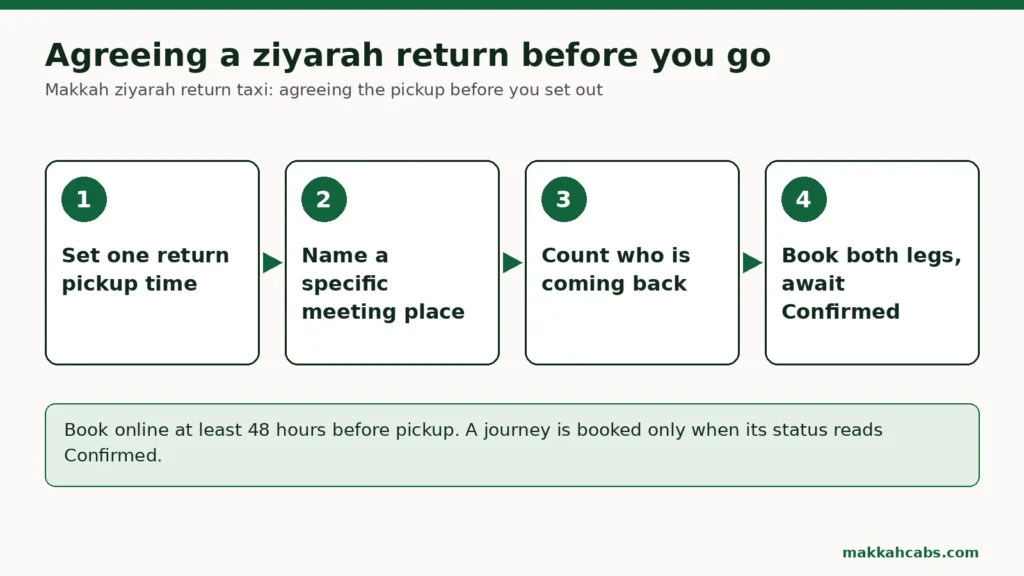
A Makkah ziyarah return taxi works best when it is agreed before anyone leaves the hotel: a separate journey with its own pickup time, a named pickup place, a clear list of who is coming back and the hotel it ends at. On Makkah Cabs the ride back is not an automatic part of the outward trip. It is a second booking, searched and paid for on its own, and it needs the same 48 hours’ notice as the first. Settle those four details at home, write them into the booking, and the end of the visit becomes a short walk to a car you already expect rather than a phone call made in the heat.
This guide is for families and small groups staying in Makkah (Mecca) who are planning a visit, such as Hira Cultural District, Masjid Aisha at Al-Taneem or another ziyarah stop, and want the return settled as firmly as the outward drive. It explains why the return is its own journey, how to choose the time and place, what changes when the returning party is different, how to write the arrangement into the booking, and what the agreement does and does not cover. There is a comparison of the ways to set up a return, a worked example and a checklist to use before you pay.
Why a Makkah ziyarah return taxi is its own journey
Every journey in our planner has one pickup place, one destination, a pickup date and time in Saudi local time, and a count of passengers and bags. The pickup and destination must be different, so a trip there and back cannot be squeezed into one booking. The drive to the site is one journey. The ride home is another, with its own time.
That is the reason a Makkah ziyarah return taxi can be relied on: a fixed time the booking team confirms, a pickup place written down in advance, and a vehicle chosen for the people actually coming back. A separate later collection and a car that waits during the visit are different services. If you are weighing those two, our article on a Masjid Aisha waiting car or a separate return pickup sets out the difference, and whether the vehicle can stay with your group covers what waiting does and does not include. This guide assumes you are booking the return as its own journey, which is the most common arrangement for a ziyarah from a Makkah hotel.
The four parts of a return agreement
A good return agreement fits in one sentence: “We will be collected from this place, at this time, as this group, and taken to this hotel.” If any part of that sentence is vague, the return is not yet agreed.
The time
The time you want the car to be there, not the time you hope to finish looking around.
The place
A site name is not a pickup place. A cultural district covers a large area and a mosque can have several sides and gates. The return needs a named, specific place.
The people
The returning party is not always the outward party. The return is booked for the people who will actually get into the car.
The destination
Most returns end at the hotel you left from. If the group is going on to a meal, another hotel or a relative’s room, that belongs in the booking from the start.
Choosing the return pickup time before you leave
The time is the part families most often guess. Here is a calmer way to set it.
Start from the site, not the clock. Check the official information for the place you are visiting. Hira Cultural District publishes its own opening hours for the museums and exhibitions, which differ from the district itself and by day of the week. If you plan to go inside, the museum hours set the outer limit of your visit.
Allow for prayer. Many families want to pray during an outing. Prayer times change through the year, and the official Nusuk platform includes prayer times. Look at where the prayers fall in your visit and set the return either before one or with enough margin after it. Religious questions about the visit itself belong with a qualified scholar and the official guidance, not with a transport plan.
Think about heat and energy. The Ministry of Health’s heat illness guidance advises planning outdoor activity for cooler times and resting in shade, and names older people among the most vulnerable. A return in the hottest part of the day is hardest on grandparents and small children.
Add the gathering time. A family of seven does not reach a meeting point in one movement. Allow for the walk from the last thing you see, the slowest walker and the person buying water.
Then choose one time and write it down. A range such as “sometime after lunch” cannot be booked. A time can. If the whole group needs to be back for something fixed, such as a checkout or a meal booked at the hotel, work backwards from that commitment. Our guide to agreeing one return deadline together helps a group settle which deadline is real and which is simply preferred.
Where should the return pickup after a Makkah visit be?
The return pickup after a Makkah visit is harder to describe than the drop-off. In the morning you get out wherever the car stops. In the afternoon you have to find the car. We cannot promise where a vehicle may stop at any site or which entrances will be open; those are managed locally on the day. What you control is how clearly you describe the meeting place.
A useful return meeting point:
- has a name or a clear landmark that does not depend on which way you are facing;
- is somewhere the whole party can walk to, including the person who walks most slowly;
- has shade or somewhere to sit while the last person arrives;
- can be described in one sentence in the booking notes.
On the day, the lead traveller should be ready to send a live location to the driver once the driver’s details appear on the booking. Our article on a hotel frontage or an agreed meeting place goes into how to choose a meeting point that works, and much of it applies at a ziyarah site as well as at a hotel.
It also helps to know that the ride back is not always the same road in reverse. On our live route checks, the drive from the Clock Tower area to Hira Cultural District was about 13 km, while the return was about 11 km. The drive to Masjid Aisha was about 13 km, and the return about 19 km. One-way systems and junctions change the route, and they can change which side of a site is easier for a car to reach. That is one more reason to agree the pickup place rather than assume it is where you were dropped.
Who is coming back, and with what?
Count the return party separately from the outward party. Ask three questions:
- Is anyone leaving the visit early? If one person needs to go back sooner, that is a separate journey, not a detour. Our note on one person leaving the visit early explains the options.
- Is anyone joining you at the site? A cousin who meets you at the museum and comes back with you needs a seat on the return.
- Will you be carrying more? Shopping or gifts can make the return load larger than the outward one.
The planner shows only the vehicle classes that pass the capacity check for the passengers and bags you enter. If the return party or load is larger, search the return with those numbers. Our guide to counting the people joining a visit goes through the count household by household.
Booking the ride back to your hotel: the options compared
There are several ways to handle the return. They are not equal, and the right one depends on how settled your plans are. The table compares the common choices when booking the ride back to your hotel.
| Return set-up | How it works | Strengths | Weak points |
|---|---|---|---|
| Outward and return both booked in advance | Two journeys, each with its own time, searched and paid together at least 48 hours ahead | Fixed times, confirmed vehicle for each leg, written pickup place | The return time needs deciding in advance; a change needs a request |
| Outward booked, return booked later | The return is added as a second booking once plans are clearer | Time to think about the return | Online bookings need 48 hours’ notice, so a same-day return cannot be booked online |
| A waiting arrangement | The car stays for an agreed period, only where confirmed in writing by the booking team | Flexible within the agreed period | Waiting is not a standard product; limits must be confirmed, and it is not unlimited |
| Outward only, own plan home | The family books one way and arranges the return itself | Maximum freedom | No confirmed ride back; finding transport at a busy site can take time |
For most families, booking both journeys together is the most dependable choice for a Makkah ziyarah return taxi: you decide the return time at home, when nobody is tired. If you book the return later, remember the 48-hour rule; “we will sort out the return on the day” does not work through the online planner.
Writing the return into the booking
The booking notes are where the agreement becomes something the booking team and driver can read. Keep them short. For the return journey, cover:
- Pickup point: the named meeting place and one landmark near it.
- Lead traveller: the name as it appears on the booking and the number that will be on and charged during the visit.
- Party: how many adults, children and infants will be returning, if different from the outward trip.
- Needs: a folding wheelchair, a pushchair, a child seat, or a passenger who needs a few extra minutes to reach the car.
- Destination detail: the hotel name as the hotel writes it, and which entrance you usually use.
Check the route summary before you pay. It shows the pickup and destination as the system has understood them. If the pin is on the wrong side of a site or the wrong tower of a hotel, correct it before paying, not on the day.
What the return agreement covers, and what it does not
It covers a vehicle of the confirmed class, at the confirmed time, collecting from the pickup place you gave, for the passengers you entered, going to the destination you chose. Each class has an included waiting allowance at pickup, but it is not shown on the search results, so if your party is likely to be slow to reach the car, ask the booking team to confirm the waiting in writing.
It does not cover a promise about where a car can stop at a site, which gates are open, an open-ended wait, or a change of destination or passengers made on the day. Only the pickup time can be changed online. Place, destination, number of passengers and vehicle cannot. A different hotel or a larger group needs the booking team, or a new booking plus a cancellation request on the old one.
Changing the time. A paid booking can have a new pickup time requested from the account before the original pickup time. The request stays pending until the booking team approves it. An approved new time carries a £5 rescheduling fee, converted into the booking currency and added to the cash paid to the driver at pickup; a rejected request costs nothing. How that works for a return that is running late is covered in our guide to changing a Masjid Aisha return pickup time.
Cancelling. Bookings are subject to our cancellation terms (free cancellation with a full refund up to 48 hours before pickup; inside 48 hours the deposit element of the price is kept) if the customer cancels. If we or the transport partner cancel, or cannot supply the journey and no suitable alternative is accepted, the customer receives a full refund for the affected journey. The full terms are on the cancellation and refund policy. This is the main reason to decide the return carefully before paying rather than booking a placeholder.
Worked example: the Qureshi family at Hira Cultural District
Imran and Sadia Qureshi are staying near the Clock Tower with their two children, aged nine and six, and Imran’s mother, who walks steadily but slowly. They want a morning at Hira Cultural District, inside the museums, without climbing the mountain.
Deciding the time. Sadia checks the museum hours on the district’s website and the prayer times on Nusuk. They want to be back before the hottest part of the afternoon so Imran’s mother can rest, and they add fifteen minutes for walking to the meeting point at her pace.
Deciding the place. They agree that the return pickup will be at a named, shaded spot they will identify when they arrive, and write a clear description of the side of the district they expect to use in the notes. Imran is the lead traveller and will send a live location once they are there.
Counting. The outward and return parties are the same: three adults and two children, with one folded walking frame and a small day bag. They enter the walking frame as a large bag. The planner shows the classes that fit.
Booking. Sadia books both journeys four days ahead, pays in full online, and waits. Within the day, both journeys read Confirmed. She sends a short message to the family: “Car back at the time we agreed, from the shaded spot. Imran will share his location. Everyone at the meeting point ten minutes before.”
On the day. The museums take longer than expected. Well before the pickup time, Imran decides the family will shorten the last part of the visit rather than request a new time. They walk to the meeting point as planned, and Imran sends his location as the driver approaches. They had the choice because the return was agreed rather than improvised.
If the visit runs late or finishes early on the day
Running late. Decide quickly whether the group can shorten the visit and still make the pickup. If it cannot, contact the booking team or request a new time through the account before the pickup time. A request is not a change until it is approved, so tell the family the plan is still the original one until the account shows otherwise.
Finishing early. A car booked for a later time is not waiting nearby. Sit somewhere shaded and do not assume an early pickup can be arranged at short notice.
Someone missing. The lead traveller stays at the meeting point with a phone on and sends the live location while another adult goes to look. The waiting allowance at pickup is not unlimited, so do not depend on it.
The meeting point cannot be reached. Move to the nearest place a car can reasonably reach and send the new live location. Our guide to a return that ends at a different hotel covers the separate case where the destination itself changes.
Payment and confirmation for two journeys
Makkah Cabs takes full payment online. Each journey has a minimum booking value equivalent to £40, shown as a “Minimum booking amount” line if a fare would otherwise be lower, and on short drives within Makkah that minimum can apply to both the outward trip and the return.
Payment secures a provisional request. The booking team updates the status within 1 to 12 hours, and a journey is booked only when it reads Confirmed. Check that both the outward and the return journeys read Confirmed before you tell the family the plan is fixed. A confirmed outward trip with a return still pending is half an agreement.
If the adult leading the group back is not the person paying, the basket can email them a secure review link to check the details first.
Return agreement checklist
Use this before you pay for any visit.
- Book the return as its own journey, at least 48 hours before pickup.
- Choose one return pickup time, working back from site hours, prayer times, heat and the slowest walker.
- Name a specific pickup place with a landmark, not just the site name.
- Count the returning party and bags separately from the outward trip.
- Confirm the return destination, and whether it is the same hotel.
- Write the pickup point, lead traveller, phone number and needs in the booking notes.
- Check the route summary pins for both journeys before paying.
- Ask the booking team to confirm in writing if you need more waiting time than usual.
- Wait until both journeys read Confirmed, then share one short message with the family.
- Remember that only the time can be changed online, that an approved change costs £5 at pickup, and that customer cancellations are subject to our cancellation terms (free cancellation with a full refund up to 48 hours before pickup; inside 48 hours the deposit element of the price is kept).
A return that is agreed before you set out lets you give the visit your full attention, knowing exactly where the day ends. When you are ready, open the Makkah Cabs planner, search the outward journey and the return with their own times and passengers, and read both route summaries before you pay.