
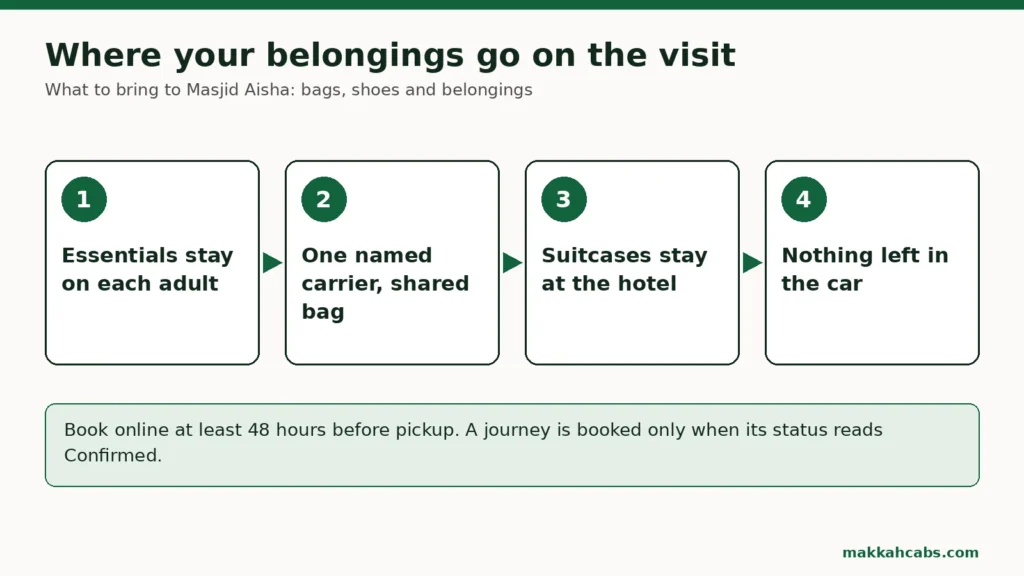
What to bring to Masjid Aisha comes down to one small bag per adult that stays with its owner for the whole visit: identification, a charged phone with the booking details, some money, daily medicines and water, plus anything needed at the mosque itself. Suitcases, spare shopping and anything you would hate to lose stay at the hotel. The car is not a locker, so nothing important should be left in it while you are inside.
This guide is for families and small groups travelling from a Makkah hotel to Masjid al-Taneem, also known as Masjid Aisha, and for the person who packs for parents or children on the day. It covers the three places your belongings can be during a visit, documents and identification, keeping valuables safe on a ziyarah, shoes, heat and health items, children’s things, what changes if you go on to the Grand Mosque afterwards, and what to do if something is left behind. It is practical only. What to wear or carry for an Umrah, and anything about ihram, are questions for a qualified scholar and the official Nusuk platform.
What to bring to Masjid Aisha: the short list
Before the detail, here is what to bring to Masjid Aisha for a visit of an hour or two:
- On every adult: identification, phone, a little cash and a card, daily medicines.
- In one shared small bag: water for everyone, a charging cable and power bank, tissues, and a printed or written note of the hotel’s name and address.
- For children: a change of clothes, snacks you are happy to be carried, and the child’s own water bottle.
- For the mosque: anything you need there that you would otherwise hope to buy. Saudipedia’s entry on Masjid al-Taneem lists shops selling ihram garments and Umrah supplies, as well as restrooms and water coolers, but opening hours are not given, so pack what matters.
- Left at the hotel: suitcases, passports if you do not need them and your hotel has a safe, spare shopping, and anything large or fragile.
If the visit falls on your checkout day, the suitcases cannot simply stay in the room; our guide to Masjid Aisha on checkout day covers that case. The rest of this guide explains why each item sits where it does.
Three places your things can be during the visit
During a Masjid Aisha visit, every item your family owns is in one of three places: with a person, at the hotel, or in a vehicle. Each has different rules.
| Item | With you | At the hotel | In the car during the visit |
|---|---|---|---|
| Passport or identification | Yes, or as your hotel advises | In a safe if you do not need it | Never |
| Phone and booking details | Yes, charged | No | Never |
| Cash and cards | A small amount | The rest | Never |
| Daily medicines | Yes | Spare supply | Never |
| Water | Yes | No | Only if the car is booked to wait, and even then carry some |
| Suitcases | No | Yes | Not unless the journey carries them to a new destination |
| Pushchair | Yes, if you will use it | If you will not | Only on an agreed waiting arrangement |
| Shopping bought on the way | No | Yes | Only if the car is agreed to wait |
The pattern is simple. Things you need, or cannot replace, travel with a person. Things you do not need stay at the hotel. The car is for the drive.
Documents and identification
The Ministry of Hajj and Umrah’s advice for Umrah performers stresses carrying the Nusuk Card or the Umrah Identification Card at all times, particularly for the elderly and children, to help guide them if needed. It also advises asking your hotel or place of residence for an identification card that shows the facility’s name, address and contact details, so you can identify your destination quickly.
That hotel card is one of the most useful things to carry on any outing in Makkah. If an older parent becomes separated from the group, the card tells anyone helping them where they are staying. Ask the hotel desk for one per person before the day of the visit.
Alongside it, keep the transport details:
- the booking reference for the outward and return journeys;
- the return pickup time and the meeting point you have agreed (our guide to finding Masjid Aisha and the right pickup point helps you name it the same way as the booking);
- the driver’s name and the vehicle registration, which arrive in the driver-assigned email and appear in your account once a driver is assigned.
Put these on two phones and on paper. A paper note costs nothing, does not need a battery and can be handed to someone else.
Keeping valuables safe on a ziyarah
Keeping valuables safe on a ziyarah is mostly about carrying less. The fewer valuable things you take out of the hotel, the fewer you can lose.
Cash. Take enough for small purchases and a margin, not your whole travel budget. Makkah Cabs bookings are paid in full online, so you do not need cash for the journey itself, unless an approved change of pickup time adds a £5 rescheduling fee to the cash paid to the driver. Your account shows any cash due to the driver in your booking currency.
Cards. One card per adult is usually enough. Keep a second card at the hotel, so a lost wallet does not leave the family without any way to pay.
Phones. A phone is both valuable and essential. Keep it in a zipped inside pocket or a bag worn across the body, not in a back pocket or an open tote. Charge it fully before leaving and carry a power bank.
Jewellery and watches. If an item is not needed for the visit, leave it in the hotel safe.
Passports. Whether to carry a passport or leave it in the hotel safe depends on your circumstances; carry the identification the Ministry advises and follow your hotel’s guidance for the rest.
A simple rule helps families: each adult is responsible for their own valuables, and nobody hands a wallet or phone to someone else to “hold for a minute” at the mosque.
Bags and belongings at Taneem: choosing the right bag
The right bag for bags and belongings at Taneem is small, closes fully and can be worn on the body. A cross-body bag or a small backpack worn on the front leaves both hands free for holding a child’s hand or an older relative’s arm.
One bag per adult, one shared bag for the family
Many families do best with one small personal bag per adult, holding that person’s documents, phone and medicines, and one shared bag holding water and family items, carried by a named person. The shared bag is the one that goes astray most often, because everyone assumes someone else has it. Decide before leaving the hotel who carries it and who takes it over if that person needs their hands.
Label everything that could be put down
Put the hotel name and a phone number inside each bag. A labelled bag left on a bench or in a car is far more likely to find its way back.
Avoid bags that invite overpacking
A large tote or wheeled bag fills up with things nobody needs, and becomes a burden in the heat. If the bag will not fit on a lap in the car, it is probably too big for the visit.
Shoes
Shoes deserve a moment’s thought, because they come off and on more often than you expect on a mosque visit. Choose shoes that are easy to take off and put on without sitting down, particularly for older relatives who may struggle with laces or buckles.
A slim, washable shoe bag lets each person carry their own shoes rather than leaving them and trying to find them afterwards. It also keeps the family together: if everyone has their shoes, nobody is left searching while the others wait at the meeting point. For children, one adult can carry the children’s shoes in a single bag.
Think about the walk too. The distance between where the car stops and the mosque entrance depends on the day, and pavements can be hot in the sun. Comfortable, closed shoes suit most people better than new or formal ones.
Water, heat and health items
The Ministry of Hajj and Umrah’s advice includes drinking enough fluids regularly, avoiding long exposure to the sun, using an umbrella and sunglasses, and wearing loose, light-coloured clothing. It also advises carrying enough medication for chronic conditions and a detailed report showing diseases, medications and doses.
For a Masjid Aisha visit, that translates into:
- Water for everyone, even though Saudipedia notes water coolers at the mosque. The car journey and the wait at the meeting point also count.
- An umbrella or hat if any part of the visit is in daylight.
- Daily medicines with the person who takes them, not in a shared bag.
- A medical note for anyone with a chronic condition, kept with their identification.
- A light layer for older relatives, because air-conditioned interiors can feel cold after the heat.
Items for worship and ihram
Some visitors go to Masjid Aisha to enter ihram for Umrah, and Saudipedia describes the mosque as a place where pilgrims do so. What that requires, and what may or may not be carried or worn, is a question for a qualified scholar and the official Nusuk platform, not for a transport company. From a practical point of view, two points apply to every family:
- Pack it rather than buy it. The shops at the mosque may help, but do not build the visit around them.
- Keep changed clothes somewhere sensible. If anyone changes clothes at the mosque, decide in advance which bag the other clothes go into and who carries it. Loose clothing in a carrier bag is easily left behind.
Children’s things
Deciding what to bring to Masjid Aisha for children takes the most thought, because children bring more belongings than anyone else and put them down everywhere.
A pushchair is a large item. If you plan to take one, enter it as a large bag in the search, so the capacity check shows only vehicles that fit it. Our guide to a pushchair and day bags in a Makkah taxi explains how to count it. Decide whether it is needed at the mosque at all; a sling or carrier may be easier for a short visit.
Child seats (infant seat, child seat or booster) are added in the search and confirmed for the vehicle. They belong to the vehicle arrangement, not to your belongings, so you do not need to carry them in.
For children old enough to wander, write the hotel name and a parent’s phone number on a card in their pocket, alongside the identification the Ministry advises.
If you are going on to the Grand Mosque afterwards
Many families go from Masjid Aisha straight to the Grand Mosque rather than back to the hotel. That changes what you should carry.
The Ministry of Hajj and Umrah’s list of items not to bring into the Grand Mosque includes large bags and luggage, baby strollers, sharp tools, flammable liquids, and food and drinks other than coffee, dates and water. If your return journey ends at the Haram area, pack for the Grand Mosque, not just for Masjid Aisha: a small bag, no pushchair, and food limited accordingly.
The Saudi Press Agency has reported that the General Authority for the Care of the Two Holy Mosques runs luggage storage at the Grand Mosque, free of charge for up to four hours and open 24 hours a day. Arrangements can change, so check them before you rely on them. For most families it is simpler to end the return journey at the hotel, drop the bags and the pushchair, and walk to the Haram lightly packed.
The car is not a locker
It is tempting to leave bags, shopping or a pushchair in the car while you visit. Unless you have a specific waiting arrangement agreed in writing with the booking team, do not.
A journey ends at its destination. Every journey includes a short waiting allowance at the pickup, meant for getting everyone into the car, not for the length of a visit, and the driver’s day has other journeys in it. The car that brings you back may not be the one that took you. Our guide to whether a vehicle can stay with your group explains why, and our note on a Masjid Aisha taxi there and back compares a waiting arrangement with a separate return.
Even with an agreed waiting arrangement, keep documents, phones, money and medicines with you. Waiting terms cover the car’s time, not the supervision of your belongings.
Counting belongings out and back in
Two short checks prevent most losses.
Before you get out. Each adult checks their own bag, phone and shoes, and the carrier of the shared bag says out loud that they have it. Look under the seats and in the door pockets. A phone slipped between seats is the classic loss.
Before you get back in. At the meeting point, before the return journey, each adult checks again, and someone counts the children’s items. This is also the moment to confirm that everyone who came is coming back. If the family will return in two groups, our note on regrouping a family at Masjid Aisha helps you decide who carries what.
If something is left behind
In the vehicle. Contact the booking team as soon as you notice, with your booking reference, the date and time of the journey and the vehicle registration from the driver-assigned email. We cannot promise an item will be found, but the details make it much easier to trace.
At the hotel. Saudi Arabia’s Ministry of Tourism sets out tourists’ rights at hospitality facilities, including that if the provider finds any of your personal belongings, it must notify you immediately and keep them for up to 30 days until they are returned to you.
At the mosque. Ask the staff on site. Do not delay a booked return journey to search without telling the booking team; if you need a later pickup, request a new time in your account before the pickup time. An approved change carries the £5 rescheduling fee described above, and a rejected request costs nothing.
Worked example: packing for a family visit
Bilal and his sister Amina are taking their mother, Khadija, and Amina’s two children, Zain, who is seven, and Layla, who is two, from their hotel to Masjid Aisha one afternoon. The return is booked to the hotel.
The night before. Amina asks the hotel desk for identification cards with the hotel’s name, address and contact number for Khadija and the children. Bilal writes both booking references and the return time on paper and on his phone and Amina’s.
Packing. Each adult has a small cross-body bag with their own documents, phone and medicines. Khadija’s bag also holds her medical note. Amina carries the shared bag with water, snacks and a power bank. Layla goes in a carrier rather than a pushchair, so the booking shows no large bags, and a child seat and a booster are on both journeys. Shoes go in one slim bag per adult.
Left behind on purpose. Passports stay in the hotel safe on the hotel’s advice. The shopping from the previous day stays in the room.
On the day. Before getting out, Bilal checks the seats and door pockets and finds Zain’s cap. At the meeting point after the visit, Amina counts the children’s items and Khadija confirms she has her bag. Nothing is left in the car, and nobody searches for shoes.
Checklist before a Masjid Aisha visit
- Take any religious questions about the visit to a qualified scholar or Nusuk.
- Ask the hotel for an identification card with its name, address and contact details for each traveller.
- Carry the Nusuk Card or Umrah Identification Card as the Ministry advises.
- Give each adult one small, closed bag for their own documents, phone, money and medicines.
- Name one person to carry the shared family bag.
- Pack water, a light layer, and anything you need at the mosque.
- Leave suitcases, spare shopping and unneeded valuables at the hotel.
- Enter any pushchair as a large bag, and add child seats in the search.
- If the return ends at the Haram area, pack for the Grand Mosque’s rules.
- Leave nothing in the car unless waiting has been agreed in writing, and even then keep valuables with you.
- Check seats and door pockets when you get out, and count belongings before the return.
When your packing plan is settled, choose your hotel and Masjid Aisha / Al-Taneem in the Makkah Cabs planner, then book the return at the time your family has agreed.