
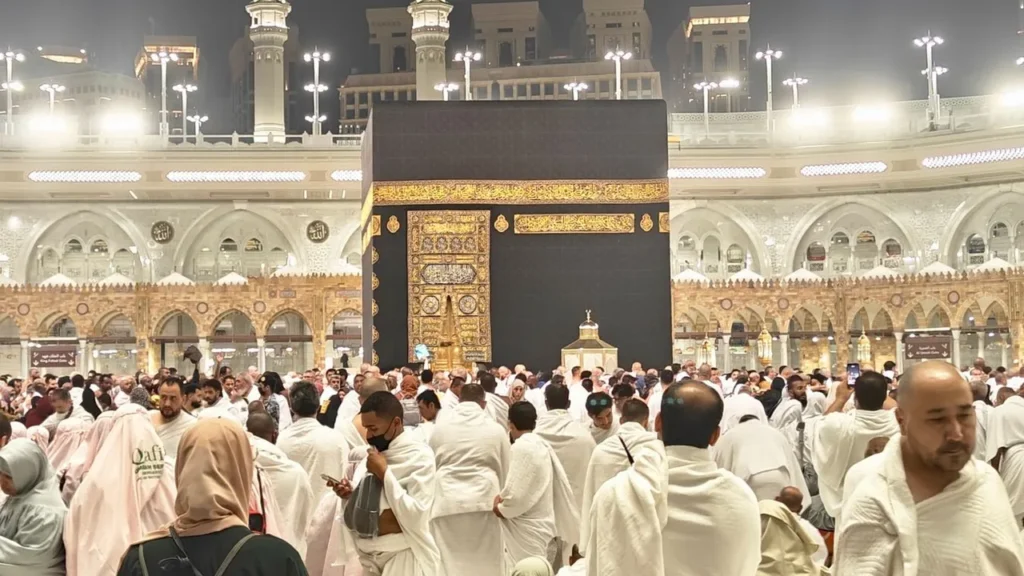
A Masjid Aisha family group visit (Masjid al-Taneem) rarely ends with everyone ready at the same moment. People separate on arrival, move at different speeds, and finish at different times. The families whose return goes smoothly are the ones who decide three things before they leave the hotel: where they will meet, who confirms that everyone is there, and what happens if someone is not. With those settled, the transport side is simple: one return journey for the whole party, or two if the family has already decided to split.
This guide is for anyone organising a group of relatives, whether one household with children and grandparents, or several households staying together. It covers how to plan for the group separating, how to set a regroup point and time, how to handle a missing person calmly, and how to choose between one return vehicle and two. For the basic choice between a separate return pickup and a vehicle that waits, see a Masjid Aisha taxi there and back. For finding the right place and pickup point on the site, see where Masjid Aisha is and how to find the pickup point.
Expect the group to separate
Plan on the assumption that the group will not stay together. The usual reasons are:
- Different areas. Many mosques have separate areas for men and women, and families should expect to be apart for at least part of the visit.
- Different speeds. Older relatives, anyone using a stick or folding wheelchair, and small children all move at their own pace.
- Different preparation. Wudu, changing and organising children can take one person ten minutes and a parent with toddlers much longer.
- Different plans. Some relatives want to stay longer, some want to leave as soon as they have finished, and some want to visit the shops on site.
None of this is a problem if it is expected. It becomes a problem when a family assumes it will walk back to the car together and then discovers, at the pickup time, that three people are somewhere else.
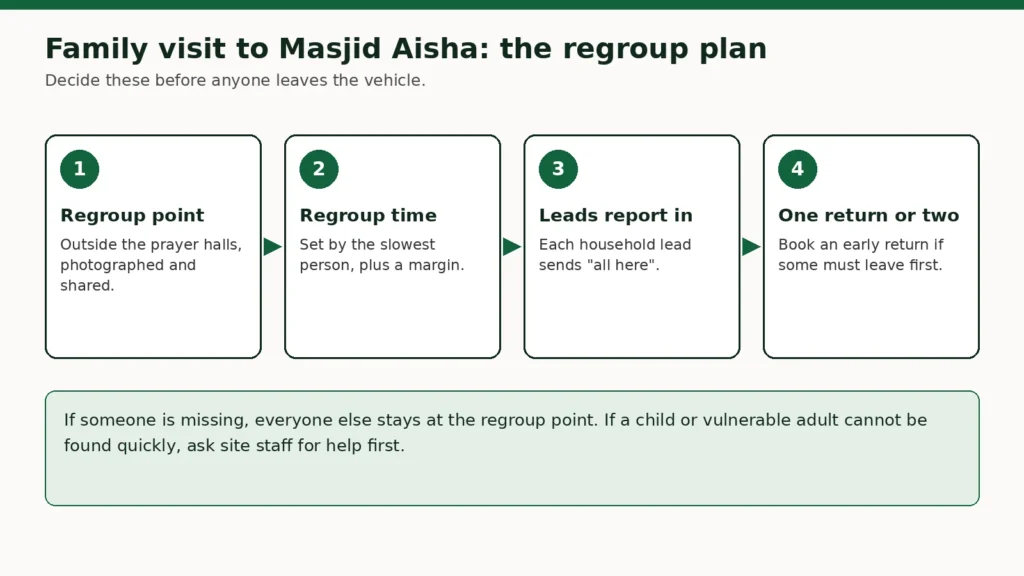
Set the regroup point before you get out of the vehicle
Choose the regroup point while everyone is still together in the vehicle or at the drop-off, not afterwards. A good regroup point is:
- Outside the prayer areas, so no one has to search inside;
- Easy to find again, ideally where you were dropped off or beside a distinctive landmark you can all see;
- Within reach for the slowest walker;
- Near the agreed vehicle pickup point, or the same place, so the last step is short.
Say it out loud and make sure every adult repeats it. For children old enough to understand, point it out and explain what to do if they cannot find their parents: go to the regroup point and stay there, or find a named adult.
Take a photo of the regroup point on at least two phones. It takes seconds and removes any doubt later.
Set a regroup time that allows for the slowest person
The regroup time should suit the person who will take longest, not the person who will be quickest. Work it out from the slowest member’s likely timing:
- time to walk from the drop-off to where they will go;
- preparation time;
- time inside;
- time to walk back to the regroup point.
Add a margin, then agree the time with everyone. If your party includes people who want different lengths of visit, you have two options. Either everyone agrees to wait for the longest visit, or the family plans two returns (see below). Decide which before you go. Deciding at the end of the visit, with some people ready and others not, is what causes arguments and missed pickups.
Give each person a role
A group of eight people needs one person in charge of transport and, ideally, one person in each smaller household who knows where their own people are. A simple way to organise it:
| Role | Who | What they do |
|---|---|---|
| Transport lead | One adult with a working phone and the booking reference | Talks to the driver or booking contact; decides when the group is complete |
| Household leads | One adult in each household or sub-group | Knows where their own members are; reports to the transport lead when their people are at the regroup point |
| Regroup keeper | Whoever finishes first (often someone who does not need long inside) | Waits at the regroup point so there is always someone there |
The transport lead should be the person who will be at the regroup point, not someone who will be inside the longest. If the most organised person in the family also wants the longest visit, pass the transport role to someone else for the day.
Phones and contact
- Charge phones before leaving and bring a power bank if anyone relies on their phone for maps or messages.
- Share numbers in advance, including the transport lead’s number, written on paper for anyone without a phone.
- Set up a short group message for the day only, with the regroup point photo pinned.
- Agree a check-in message, for example each household lead sends “all here” when their people reach the regroup point.
Keep messages about the booking in one place. If several relatives message the driver or booking team with different updates, the result is confusion.
Large extended families
Some families visit with fifteen or twenty relatives. At that size, the choice is between one large vehicle and several smaller ones travelling at the same time. In the Makkah Cabs planner, larger parties see options such as a 19-seat minibus or a coach, as well as family vans.
- One large vehicle keeps everyone together and means one pickup time and one transport lead. It suits families who are happy to arrive and leave as one group.
- Several smaller vehicles give flexibility: households can leave at different times, and one late household does not hold up everyone else. Each vehicle is a separate journey with its own lead contact.
With a large group, name the transport leads before the day, and make sure each person knows which vehicle they are travelling back in. A list in the group message, by vehicle, avoids a crowd trying to fit into the first car that arrives.
Making a plan children understand
Adults can remember a meeting point and a time; young children often cannot. A few simple steps make a big difference:
- A card or band with a phone number. Put a parent’s phone number, with the country code, on a card in the child’s pocket or a band on their wrist.
- One instruction, repeated. “If you cannot see us, stay where you are and tell a woman with children, or someone working here, that you are lost.” Children remember one clear rule better than several.
- A photo of each child that day. A quick photo on arrival, showing what they are wearing, helps if you need to ask others for help.
- Keep small children with a named adult, not just “with the family”. Everyone thinking someone else has them is how children go missing.
Coordinating across separate areas
If men and women in your family will be in different areas, treat them as two groups for coordination:
- each group has its own lead, with a working phone;
- each lead knows the regroup point and time;
- the two leads message each other when their group is ready, rather than one person trying to track everyone;
- nobody goes looking in the other area. Meet outside at the regroup point instead.
Older relatives and mobility
Grandparents often set the pace of the whole visit. Plan around them rather than hoping they will keep up:
- let them get out of the vehicle first and start walking while others organise bags and children;
- if anyone uses a folding wheelchair, add it when you search in the planner so the vehicle is confirmed for it;
- make their comfort the priority in the return plan. A separate, earlier return for them and one companion is often kinder than making them wait for the longest visit.
Heat and water
Makkah is hot for much of the year, and families standing outside at a regroup point can be in the sun for longer than they expect. Saudipedia describes shaded courtyards and water coolers at the mosque. Even so, bring water, keep the regroup point in shade if you can, and consider an early-morning or evening visit for young children and older relatives.
If someone is missing at the regroup time
Stay calm and follow a plan agreed in advance:
- Everyone else stays at the regroup point. Sending more people to look usually creates more missing people.
- Call or message the missing person and, if they are a child or older relative, the adult most likely to be with them.
- One or two adults search, starting with the areas where the person was last seen, and come back to the regroup point at an agreed time whether or not they find them.
- If the vehicle is due, the transport lead tells the driver or booking contact that the group is still regrouping and gives a realistic estimate. Waiting beyond the included allowance may be charged, and a much later pickup may need a changed booking; see changing your Masjid Aisha return time.
- If you cannot find a child or vulnerable adult quickly, ask site staff or security for help immediately. Transport can wait; a missing person cannot.
A two-minute briefing before you get out
Before the doors open at the mosque, the transport lead gives a short briefing. It takes two minutes and saves a lot of searching later:
- “The regroup point is here, beside [landmark]. I have taken a photo and shared it.”
- “The regroup time is [time]. The car comes at [time].”
- “[Name] is the lead for our household; [name] for yours. Tell your lead when you are back.”
- “If you cannot find anyone, come back here and wait.”
- “Children stay with [named adult].”
Ask one person from each household to repeat the time and place. It feels formal, but it works, especially with tired travellers and children.
One return journey or two?
The transport decision follows from the family plan.
One return for the whole party
Everyone travels back together at one time. This works when the family has agreed to wait for the last person. It is simpler and usually cheaper. The return pickup time must allow for the longest visit.
Two returns at different times
Some relatives leave earlier, others later. Each return is its own journey, booked with its own time, passenger count and lead contact. This is the better choice when an older relative needs to rest, young children cannot wait long, or some of the group want to stay much longer.
Book both returns in advance if you can. Online bookings need at least 48 hours’ notice, so a second return cannot be added through the planner on the day, and the booking team may not be able to arrange one at short notice.
Two vehicles at the same time
A large family may not fit in one vehicle. The planner only shows vehicles that pass its capacity check for your party. For example, a group of nine needs an 11-seat family van or two smaller vehicles. Two vehicles are two journeys, each with a lead contact who is physically in that vehicle’s group. Our note on one vehicle or two for an outing explains the trade-offs.
| Family situation | Suggested transport |
|---|---|
| Everyone content to wait for the last person | One return, timed for the longest visit |
| Older relative or young children need to leave early | Two returns at different times |
| More people than one vehicle can carry | Two vehicles, each a separate journey with its own lead |
| Two households staying at different hotels | Returns to each hotel; see a Masjid Aisha visit from two hotels |
A worked example
Nine relatives from two households are staying at one hotel near the Haram. Household A has two grandparents, their son and his wife. Household B has a couple, their two young children and an aunt.
Before leaving. They book an 11-seat family van out at 16:00. The grandparents will want to rest early, while the aunt wants a longer visit. So they book two returns: 17:30 for the grandparents, Household B’s children and one parent (five people), and 18:15 for everyone else (four people).
On arrival. At the drop-off, the son points out the regroup point beside a landmark he photographs, and names himself transport lead for the 17:30 return and the aunt’s brother-in-law for 18:15. Each household lead shares the photo.
During the visit. At 17:20 the first group is at the regroup point except one child, who is with the aunt. The mother messages the aunt, the child is brought back, and the 17:30 group leaves on time.
Later. At 18:05 the second transport lead sends “all here” and a live location to the booking contact, and the second vehicle collects them.
After the visit
Before the vehicle leaves:
- the transport lead does a head count against the booking’s passenger number;
- each household checks its own belongings; see personal items during a Taneem stop;
- anyone travelling in a second vehicle confirms which vehicle they are in.
When one household wants to stay much longer
Sometimes one part of the family wants a much longer visit than everyone else. Rather than asking the whole group to wait, give that household its own later return. Book it in advance with its own passenger count and lead contact, so the rest of the family can leave at a sensible time without feeling they are abandoning anyone. Agree before you set off how the later group will let the others know they are on their way back.
If plans change during the visit
If the regroup time or the return time needs to move, one person, the transport lead, handles it. A change to the booked pickup time is requested through the account that made the booking, and stays pending until approved; see changing your Masjid Aisha return time. Tell the household leads once the change is confirmed, not before.
Back at the hotel
The return journey ends at the hotel entrance, but the family plan does not. Decide in advance:
- who gets out first: usually older relatives and children, while others handle bags;
- who goes straight to the room and who stays in the lobby for anyone still arriving on a second return;
- how the second group will know the first has arrived, for example a short message from the first transport lead.
With two returns, the first group should not assume the second is close behind. Keep the regroup-point messages going until the second vehicle has dropped everyone off.
Checklist for a family group
- Regroup point chosen, photographed and shared before you leave the vehicle.
- Regroup time based on the slowest person, with a margin.
- Transport lead and household leads named.
- Phones charged; numbers shared on paper for anyone without one.
- Plan agreed for a missing person.
- One return, two returns or two vehicles decided, and booked.
- Head count and belongings check before leaving.
Once the family has agreed its plan, book the outward trip and every return in the Makkah Cabs planner; the Masjid Aisha return planning page summarises what each return needs.