
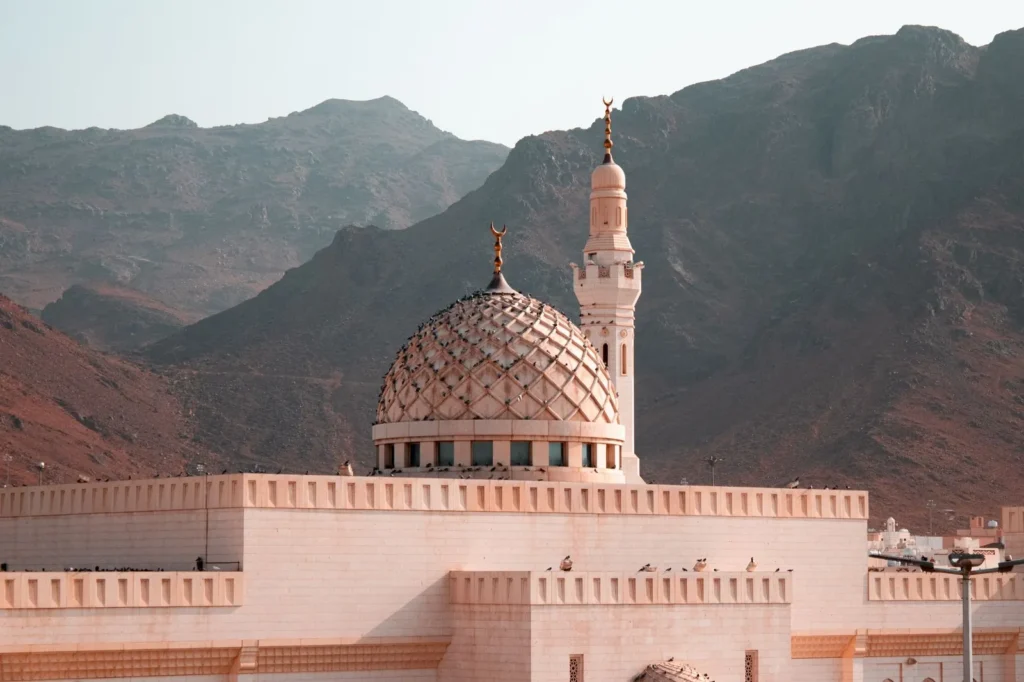
Masjid al-Bay’ah in Mina is the small Abbasid-era mosque that marks where the Ansar of Madinah pledged their support to the Prophet Muhammad, peace be upon him, at Aqabah before the migration. Can you visit it outside Hajj? Yes. The Royal Commission for Makkah City and Holy Sites lists the mosque on its Discover Makkah site as open around the clock and reachable by taxi or private car, and Mina’s roads are open to ordinary traffic for most of the year. The mosque was restored under the Prince Mohammed bin Salman Project for Historical Mosques, so what you see today is a conserved historic building rather than a modern replacement. This guide covers the history behind a Mosque of the Pledge visit, where the mosque sits in relation to the Jamarat, when Mina is and is not accessible, and how to fold a historic mosque in Mina outside Hajj into a short, sensible outing.
What happened at Aqabah, and why is there a mosque here?
The mosque takes its name from the bay’ah, the pledge of allegiance, that a group of men and women from Yathrib (later Madinah) gave to the Prophet in the valley at Aqabah on the edge of Mina. According to the account summarised on the Royal Commission’s Discover Makkah page for Al-Bay’ah Mosque, this took place in the thirteenth year of the Prophethood: the Ansar embraced Islam, promised their protection and invited the Prophet to migrate to their city.
Historians generally describe two meetings at Aqabah in successive pilgrimage seasons, the second being the larger and the one that led directly to the Hijrah. The place where they met was a narrow mountain pass, later known as Shi’b al-Ansar, the Pass of the Helpers. For more than a century after the event there was no building here at all; the meeting had been secret, held at night, and the valley was simply a valley.
The Abbasid caliph Abu Ja’far al-Mansur ordered a mosque built on the spot in 144 AH, which corresponds to 761 CE. Saudipedia’s entry on Al-Bay’ah Mosque records the date and the builder, and a 2013 Arab News interview with Makkah historians adds the tradition that the caliph’s ancestor al-Abbas, the Prophet’s uncle, had been present at the pledge, which gave the Abbasid family a particular interest in commemorating the place.
Where exactly is Masjid al-Bay’ah in Mina?
The mosque stands east of Makkah on the southern slope of Mount Thubayr, at the Makkah-side edge of the Mina valley. Saudipedia places it about 500 metres north-east of Jamarat al-Aqabah; the Royal Commission’s page gives roughly 450 metres from the Aqabah pillar toward Makkah. Either way, it is within sight of the Jamarat Bridge complex, tucked against the hillside at the mouth of the old pass.
For centuries the building was hidden from the main road by a spur of the Aqabah hill. Both sources note that it only became visible to passing traffic in 2007, when the hill was removed during the expansion of the Jamarat area. Pilgrims who had walked past the spot for decades suddenly found an eighth-century mosque standing in plain view, and that is still the reaction of many first-time visitors.
Give your driver the Arabic name, مسجد البيعة, and say “near Jamarat al-Aqabah, Mina side towards Makkah”. Drivers who work the Mina road know it; those who mainly serve the hotel districts may not, so the reference to the Jamarat helps. Our article on attaching saved map pins to a Makkah taxi booking explains how to share the exact location so there is no roadside discussion.
Can you visit a historic mosque in Mina outside Hajj?
Outside the Hajj period, Mina is a quiet district of tented camps and service buildings, and its roads carry ordinary Makkah traffic. The Royal Commission’s visitor page lists the mosque as open 24 hours and names taxis and private cars as the way to reach it. There is no ticket, no booking and no formal visitor centre; you simply arrive, remove your shoes and enter as you would at any mosque.
The situation changes completely in the weeks around Hajj. Mina becomes a closed zone for pilgrims holding permits, roads are controlled, and casual visits are not possible. If your Umrah or visit falls in the lead-up to Dhul Hijjah, or in the days immediately after Hajj while camps are being cleared, ask your driver or hotel whether the Mina road is open before you set out. Our broader guide to visiting Mina, Arafat and Muzdalifah outside Hajj covers the seasonal pattern in more detail.
Even in the open season, parts of the Jamarat precinct are fenced and maintenance work can close individual access roads. We cannot promise that every approach road will be open on a given day, so a driver who knows the area is an asset: he will choose the route that avoids closed sections and park where the walk to the mosque is shortest. Allow a generous buffer rather than assuming a quick stop, and if a closure does block the way, the fallback is simply to view the building from the Jamarat side and continue to Masjid al-Khaif.
What did the Abbasids build, and what has survived?
The caliph al-Mustansir restored the mosque in 625 AH (1227 CE), and both the Royal Commission and Saudipedia note that this restoration is recorded in inscriptions still fixed to the walls. Saudipedia counts three stone plaques carrying construction dates from different eras: one on the outside of the qiblah wall to the right of the mihrab, and two on the southern wall. Look for them; they are the most direct physical link to the building’s history.
The fifteenth-century Makkan historian al-Fasi described a layout of two arcades, each roofed with three domes carried on four arches, with a courtyard behind and two doors in each of the north and south walls. Saudipedia records further rebuilding in the early seventeenth century and notes that the present form differs from al-Fasi’s description. The Royal Commission adds that renovations continued in the eleventh and thirteenth centuries of the Hijri calendar, which is to say the Ottoman period and the early twentieth century.
What stands today is a rectangular stone, brick and plaster building of roughly 25 by 15 metres, according to the Royal Commission’s figures. The prayer hall has a portico on four columns carrying five pointed arches, a qiblah wall with three arched niches, a small open courtyard, and entrances on the north and south sides. Saudipedia’s slightly larger area figure of about 458 square metres probably reflects a different method of measurement; in either case this is a very small mosque, with room for a few dozen worshippers.
What did the Prince Mohammed bin Salman Project do here?
Masjid al-Bay’ah was included in the second phase of the Prince Mohammed bin Salman Project for the Development of Historical Mosques, a national programme that conserves old mosques using traditional materials and techniques while keeping them in use for prayer. Saudipedia records that it was the first mosque in Makkah Province chosen for that phase, and a September 2025 report in Riyadh Daily on the Royal Commission’s heritage work lists the mosque as rehabilitated in 2025.
The project’s stated approach is conservation rather than enlargement. Saudipedia notes that the mosque’s area was unchanged after restoration and that its capacity rose by a single worshipper, from 67 to 68, which tells you the work was about stabilising the historic fabric, not adding floor space. The Royal Commission’s page states that the historic structure was preserved and restored under the programme.
For a visitor this means two things. The building you see is the genuine Abbasid-and-later mosque, repaired, not a reconstruction. And because it is so small, a group of more than about ten people will fill the prayer hall; large tour groups should visit in turns and keep the courtyard clear.
What to look at in the few minutes you have
Stand first at the qiblah wall outside and find the dated plaque to the right of the mihrab, then walk round to the southern wall for the other two. Step into the portico and count the five pointed arches on their four columns, then look up at the plain plastered surfaces that replaced al-Fasi’s domes. Finally, turn and look back toward the Jamarat to understand how completely the hill once hid this spot from the road.
Is Masjid al-Bay’ah the same as Masjid al-Khaif?
No, and the two are often confused because both are in Mina. Masjid al-Khaif is the large congregational mosque in the centre of the Mina valley, used by hundreds of thousands of pilgrims during Hajj and associated with the Prophet’s prayer in Mina. Masjid al-Bay’ah is the small historic mosque at the valley’s western mouth near Jamarat al-Aqabah. They are a drive apart along the Mina roads and are quite different experiences.
If you tell a driver “the mosque in Mina” you may well be taken to al-Khaif. Name al-Bay’ah specifically, and mention the Jamarat. If you have time, visiting both in one short outing is reasonable outside Hajj, since al-Khaif is open as an ordinary mosque for most of the year and sits on the same road network.
What is the etiquette for a Mosque of the Pledge visit?
Treat it as a working mosque first and a historic site second. Remove shoes, dress modestly, keep voices low and do not step in front of anyone praying. Women should expect a small building with limited or no separate prayer space; check on arrival and, if there is no designated area, pray at another mosque and view the building from the courtyard and exterior.
Photography of the exterior and the inscriptions is normally unremarkable, but do not photograph worshippers, and put the camera away if a caretaker asks. There is no formal guide on site, so read about the pledge beforehand if you want the visit to carry meaning for younger members of the group.
On the question of what acts of worship are or are not appropriate at a historic site, we do not offer religious rulings. Ask a qualified scholar or your group’s religious guide. Our role is to get you there and back safely.
A fictional family’s short outing to Mina
This is a fictional scenario, not a real customer. Picture a couple from Leeds travelling with the wife’s parents in late November, well outside the Hajj season. The father-in-law has read about the pledge of Aqabah for years and wants to see the place. None of them wants a long day out, and the mother-in-law walks slowly.
They book a Makkah Cabs car for a late afternoon pickup from their Aziziyah hotel, choosing a waiting vehicle because the whole stop will be brief. In the notes they write “Masjid al-Bay’ah near Jamarat al-Aqabah, then Masjid al-Khaif, then return”. The driver parks as near to al-Bay’ah as the road allows; the couple and the father-in-law spend twenty minutes at the mosque reading the plaques while the mother-in-law rests in the car with the air conditioning on. They stop briefly at al-Khaif, then return to the hotel before the evening prayer.
The whole outing is unhurried because they chose a waiting car and kept the plan to two stops. Had they tried to add Arafat and Muzdalifah, the afternoon would have run into the prayer-time traffic. Our guide to whether a Makkah taxi can wait during a ziyarah explains the waiting-car option in detail.
How does Masjid al-Bay’ah fit into a wider ziyarah?
Because the mosque sits at the Makkah end of Mina, it combines naturally with the Holy Sites loop: Mina, Muzdalifah and Arafat, with Jabal al-Rahmah as the far point. Most drivers run that loop clockwise or anticlockwise depending on traffic, and al-Bay’ah is a sensible first or last stop. It also pairs well with Jabal Thawr to the south if the group is energetic, though that makes for a long outing.
If you are planning a half-day with a fixed list of stops, our article on essential and optional stops on a Makkah ziyarah helps you decide what to keep. Our advice is to treat al-Bay’ah as a short, high-value stop: it does not need long, but it rewards a few minutes of attention.
For a group with limited time or energy, al-Bay’ah on its own is a perfectly good single-stop outing from the Haram-side hotels. Book the car, see the mosque, come back.
What should go into the taxi booking?
Write the mosque’s name in Arabic and English, add “near Jamarat al-Aqabah”, and state whether you want the vehicle to wait. A waiting car suits this visit because the stop is short and the surrounding area has no cafés or shade where a group could comfortably wait for a second pickup. Name your pickup point precisely, including the hotel tower if there are several.
Say how many passengers and whether anyone needs help with steps; the mosque sits a little above road level and the approach is uneven in places. If anyone uses a wheelchair or folding walker, mention it so the driver can choose the nearest stopping point. Our piece on taking a wheelchair or folding walker on a Makkah ziyarah covers what to tell us.
Check the live quote in the booking tool before confirming so there are no surprises about what the journey includes.
A second fictional scenario: a study group with a tight schedule
Also fictional. A group of eight students from Nigeria on an Umrah trip are following a reading programme on the Prophet’s biography with their teacher. They want to stand at Aqabah on the day their syllabus reaches the pledges, between the afternoon and sunset prayers.
They book a people carrier with a fixed return pickup rather than a waiting car, because they plan to spend an hour at the site with the teacher speaking. They arrive, split into two groups of four so that nobody crowds the tiny prayer hall, and take turns inside while the others sit on the low wall outside and listen. The driver returns at the agreed time. The teacher reminds everyone beforehand that questions about specific acts of worship at the site should go to a scholar, not to a travel guide.
Checklist for visiting Masjid al-Bay’ah outside Hajj
- Confirm you are travelling outside the Hajj closure period; if in doubt, ask the driver or hotel whether Mina roads are open.
- Name the mosque in Arabic and English and add “near Jamarat al-Aqabah” so it is not confused with Masjid al-Khaif.
- For a brief look, keep the car waiting; if you will linger, agree a return pickup at a fixed point.
- Expect a very small building; visit in turns if your group is larger than ten.
- Look for the three dated stone plaques on the qiblah and southern walls.
- Modest clothing, shoes off at the door, quiet voices, and no camera pointed at anyone praying.
- Avoid timing the return against the pre-prayer traffic peak around the Haram.
Why this small mosque is worth the detour
Few places connected with the Prophet’s life survive as buildings at all, and fewer still are as old as this one. Masjid al-Bay’ah is a modest eighth-century structure, repaired over twelve centuries and conserved again in our own time, standing on the spot where a secret meeting reshaped history. It asks for twenty minutes of your day and gives back a sense of scale that the vast modern Haram cannot.
Once the date is fixed, reserve the trip with Makkah Cabs, put the mosque’s name and the Jamarat reference in the notes, and let the driver handle the Mina roads while you give the place the attention it deserves.
Sources reviewed 15 October 2026: the Al-Bay’ah Mosque entry on Discover Makkah, run by the Royal Commission for Makkah City and Holy Sites; Saudipedia (Al-Bay’ah Mosque; mosques of the Holy Sites), Riyadh Daily report on RCMC heritage site development (9 September 2025), Arab News interviews with Makkah historians (27 October 2013). Opening and road access reflect the published position outside the Hajj season; closures during Hajj and any temporary works were not verified and readers should check locally. Photo: Samet Kaplan 🇹🇷 / Pexels.