
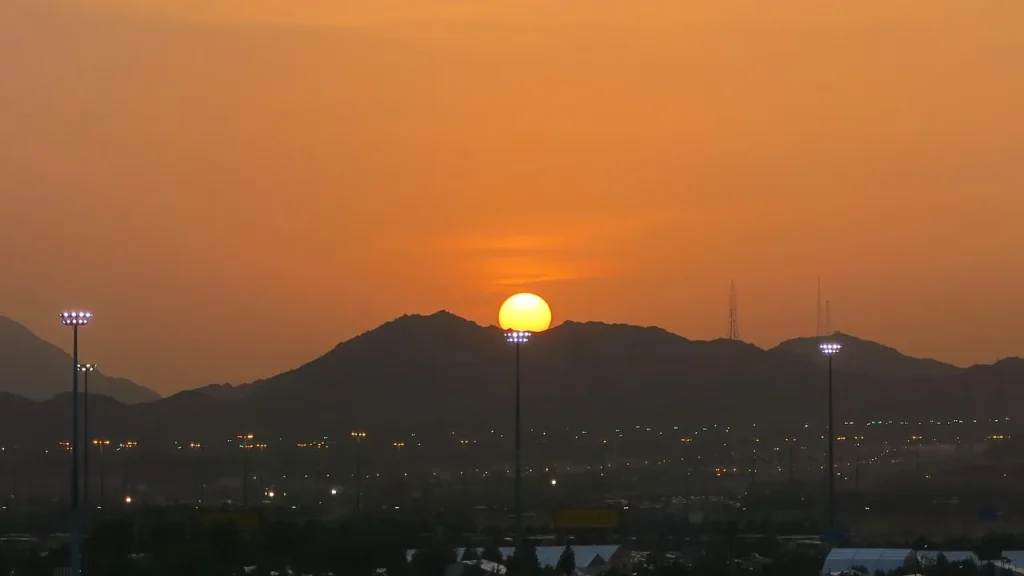
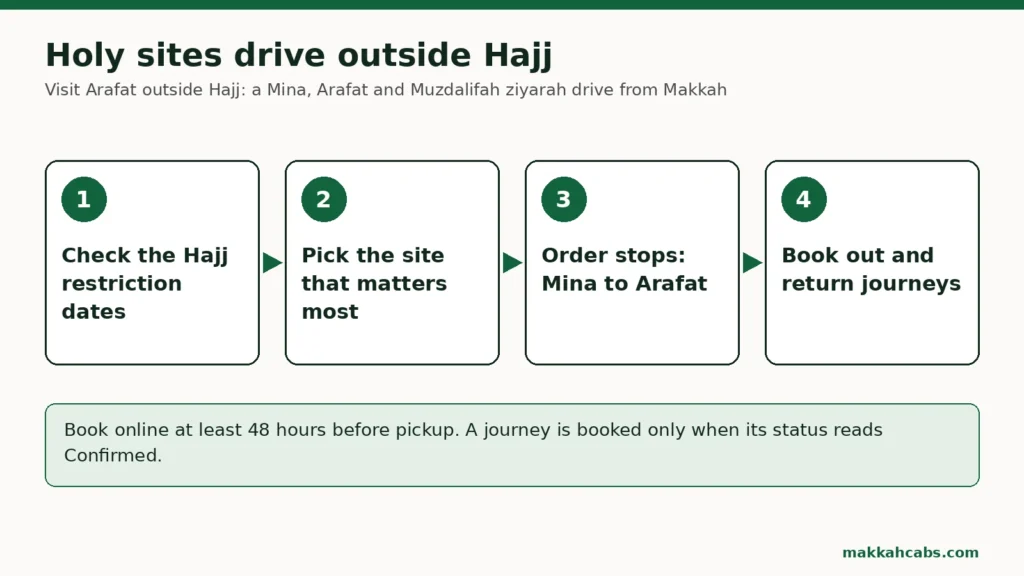
You can visit Arafat outside Hajj as part of a ziyarah drive from your Makkah hotel, usually taking in Mina and Muzdalifah on the same outing, because official sources describe the three holy sites with Muzdalifah lying between Mina and Arafat. Outside the Hajj period they are wide, largely empty landscapes: you see Masjid al-Khayf and the Jamarat in Mina, Al-Mashar al-Haram mosque in Muzdalifah, and Masjid Namirah and Jabal al-Rahmah in Arafat, mostly from the vehicle or on short stops. The key rules are to go only outside the restricted Hajj window announced each year, to book at least 48 hours ahead, and to plan it as two journeys.
This guide is for Umrah visitors and families staying in Makkah (Mecca) who want to see the places they have read about in accounts of Hajj, perhaps before performing Hajj themselves one day, or because a parent has asked to see where they once stood. It covers what official sources say about each site, the access rules that matter, the order of stops, how to book the drive, and a worked example. It does not describe Hajj logistics or give guidance on worship. For any religious question, speak to a qualified scholar and follow the official Nusuk guidance.
What you can see when you visit Arafat outside Hajj
The most useful thing to know before you go is what the sites are like when Hajj is not taking place. Saudipedia’s page on the holy sites describes Arafat as active only during the days of Hajj, with no buildings or residents apart from several government facilities. It is a very large area, about 33 square kilometres, which is why photographs taken on the Day of Arafat look nothing like a quiet weekday visit.
So set expectations with your family. When you visit Arafat outside Hajj, you are making a drive through open ground, with a small number of recognisable landmarks, rather than going to a site with a visitor centre, exhibitions or guided tours. Many people find the emptiness moving in itself, precisely because they know how full it becomes.
We could not find an official page setting out whether the mosques at the holy sites are open for prayer outside Hajj, or at what times. Treat any mosque as something you will see from outside unless you have confirmed otherwise locally.
The landmarks, site by site
The details below come from Saudipedia, the Saudi national encyclopaedia, and the official Nusuk platform. We have left out distances, because we do not have live route checks for these places.
Mina
Saudipedia describes Mina as a valley surrounded by mountains to the north and south, bordered on the Muzdalifah side by Wadi Muhassir, and covering about 16.8 square kilometres. It is the site of the three Jamarat, the pillars used in the stoning ritual of Hajj, now housed in a Jamarat facility that Saudipedia describes as five storeys high and designed to take more. It also describes the upgraded tents that house pilgrims in Mina during Hajj.
Two mosques in Mina appear on official lists:
- Masjid al-Khayf, on the slope of Mount al-Sabih near the smallest Jamarah. Saudipedia records its 1987 expansion to about 23,500 square metres, with room for about 25,000 worshippers.
- Masjid al-Bay’ah, a historic mosque near Jamrat al-Aqabah, associated with the pledges of the Ansar.
Muzdalifah
Saudipedia places Muzdalifah between Mina and Arafat, covering about 9.63 square kilometres, with Wadi Muhassir separating it from Mina. Its main landmark is Al-Mashar al-Haram mosque, at the base of Mount Quzah, which Saudipedia describes as having two minarets and room for about 12,000 worshippers.
Arafat
Saudipedia notes that Arafat lies outside the boundaries of the Haram and on the road that leads towards Taif. Its two best-known landmarks are:
- Masjid Namirah, on the western side of Arafat, part of it in the valley of Uranah (spelled Arnah on some official pages). Saudipedia describes it as covering more than 110,000 square metres, with six minarets and room for around 400,000 worshippers. Nusuk notes that pilgrims pray Dhuhr and Asr combined there on the Day of Arafat.
- Jabal al-Rahmah, the Mount of Mercy. Nusuk describes it as a modest hill in the Arafat plain with a modern marker on top; Saudipedia describes it as made of solid black stone.
Access rules you must know
Two sets of official statements matter for this outing.
The restricted Hajj window
In May 2025 the Ministry of Interior said, as reported by the Saudi Press Agency, that visit visa holders who enter or remain in Makkah and the holy sites between 1 Dhu al-Qi’dah and 14 Dhu al-Hijjah would face fines, deportation and a ban on re-entry. The Transport General Authority warned transport operators over the same period not to carry people to Makkah or the holy sites without a Hajj permit or an entry permit for work or residence.
Those statements were for 1446 AH, and the rules are announced for each season. The practical point for a family on an Umrah or tourist visa is simple: “outside Hajj” means outside that window, and in practice well clear of it. Check the current year’s announcement from the Ministry of Interior before you plan anything close to it, and never try to visit the holy sites during that period without the required permit.
Who may enter Makkah
The drive starts in Makkah. The Saudi Press Agency, reporting a Makkah Police statement, referred to the laws that prohibit entry to Makkah for non-Muslims. This outing is therefore for Muslim visitors staying in Makkah.
The order of stops
Because official sources place Muzdalifah between Mina and Arafat, the three sites fall naturally into one direction. There are two sensible ways to order them.
| Order | How it runs | Best for | Watch out for |
|---|---|---|---|
| Mina, then Muzdalifah, then Arafat | Outward journey with stops at Mina and Muzdalifah, ending at Arafat; a separate return to the hotel | Families who want to follow the sequence pilgrims know from Hajj | The longest time outdoors comes last, when people are tired |
| Arafat first, then back through Muzdalifah and Mina | Outward journey straight to Arafat; the return journey stops at Muzdalifah and Mina on the way back | Older relatives for whom Arafat matters most | The Mina and Muzdalifah stops may be cut if energy runs out |
| Arafat only | Hotel to Arafat, and a separate return | A short outing focused on Jabal al-Rahmah and Masjid Namirah | Nothing is seen in Mina or Muzdalifah, except from the road |
Whichever order you choose, decide in advance which single place matters most. If time or energy runs short, that is the one you keep. Our guide to essential and optional Makkah stops helps with that decision, and our guide to putting the stops of a multi-stop visit in the right order goes further into sequencing.
Mina and Arafat ziyarah by taxi: booking the drive
A Mina and Arafat ziyarah by taxi is booked in the Makkah Cabs planner as journeys, not as a tour. Each journey has one pickup place, one destination, a date and a time in Saudi local time, the passengers and any bags, and it can include up to 8 stops in the order you enter them.
The pickup and destination must differ, so a drive that starts and ends at your hotel is at least two journeys. The simplest plan is:
- Hotel to Arafat, with stops such as Masjid al-Khayf and Al-Mashar al-Haram along the way if you are following the Mina-first order. Use Jabal al-Rahmah or Masjid Namirah as the destination.
- Arafat to hotel, at a return time you set in advance, with any stops you are saving for the way back.
None of these places is a popular location in the planner, so type each one and check every pin in the route summary. We have no live route checks for the holy sites, so check the distance shown in the planner rather than relying on any figure you have read elsewhere.
Stops, not visits
A stop is a pause inside a journey. It suits a short look, a photograph or a moment outside the vehicle. If you expect to spend longer anywhere, say so in the booking notes for that journey, and do not assume it is possible until the journey reads Confirmed. Where a vehicle may pull in at any of the holy sites is managed on the day, and roads and access points can differ from what you see on a map. Our guide to what happens if a requested stop is unavailable explains how to keep a fallback in mind.
Notice, payment and confirmation
Every journey needs at least 48 hours’ notice before its pickup time. Payment secures a provisional request. The booking team updates the status, usually within 1 to 12 hours, and a journey is booked only when it reads Confirmed. Makkah Cabs takes full payment online, and each journey has a minimum booking value equivalent to £40.
A Jabal al Rahmah visit: time at Arafat and waiting
Most families want their longest stop at Arafat, and for many the Jabal al Rahmah visit is the heart of the day. That makes the Arafat end the natural place to finish one journey and start the next, with a return pickup time you set in advance.
Waiting counts from the booked pickup time of the return journey, not from when the car arrives. The free minutes and the rate after them depend on the vehicle class: Economy has 15 minutes free and then SAR 1.50 per minute; Business & Executive, the Staria VIP van and the H1 family van have 30 minutes and then SAR 2.00 per minute; minibuses and coaches have 30 minutes and then SAR 2.50 per minute; the Premium SUV has 45 minutes and then SAR 2.50 per minute; and the Luxury class has 60 minutes and then SAR 4.00 per minute.
If you are unsure how long the family will want, add extra waiting to the return journey at checkout, in 15-minute steps up to 2 hours. It is priced at the class’s per-minute rate and the driver’s instructions show the total. The driver cannot wait beyond what was booked. Our note on the return agreement explains why the return time shapes the whole outing.
Whether anyone should climb Jabal al-Rahmah, and what to do there, are matters for your scholar and for the arrangements in place on the day, not for us. For planning purposes, decide in advance whether anyone in your party intends to walk up, and allow for it in the return time.
Heat, shade and older relatives
Arafat, Muzdalifah and Mina are open ground, and outside Hajj there are few places to shelter. The Ministry of Health’s heat health advice is to drink plenty of fluids without waiting to feel thirsty, to schedule outdoor activities carefully, to rest in shaded areas and to wear lightweight clothing rather than dark, heavy clothes. It names older adults, children, pregnant women and people with chronic conditions among those most at risk.
For this outing that suggests:
- choosing an outward time that puts the Arafat stop in a cooler part of the day;
- carrying water for everyone, since we cannot confirm that anywhere at the sites will be selling it outside Hajj;
- letting older relatives view some landmarks from the vehicle, with only one planned stop outside;
- entering wheelchairs and walking frames in the search, so the vehicle offered can carry them.
Choosing a vehicle for the holy sites
The planner shows only vehicle classes that pass the capacity check for the party you enter, with an example model “or similar”. For a day outing with few bags:
- up to four people fit an Economy or Business & Executive class car;
- five or six fit a Hyundai Staria VIP van or Premium SUV class;
- seven fit a GMC Yukon XL or Hyundai H1 family van class;
- larger groups need a Toyota Hiace class van, a Toyota Coaster class minibus or a coach.
A vehicle with more headroom and easy access helps when older relatives are getting in and out at several stops. If you want someone to explain the sites as you go, remember that the driver’s job is the journey. Our note on the difference between a driver and a guide sets out who does what.
Worked example: a son showing his parents Arafat
Farhan Malik, who works in Birmingham, is in Makkah for Umrah with his wife, Ruqayyah, and his parents, Rashid and Parveen. Rashid performed Hajj many years ago and has asked to see Arafat again. Parveen has a knee problem and cannot walk far.
Checking the timing. Their trip falls well outside the Hajj period. Farhan checks the Ministry of Interior’s current announcements to be sure, and confirms that everyone is on a visa that permits their stay in Makkah.
Choosing the order. Because Arafat matters most to Rashid, and Parveen tires quickly, Farhan chooses Arafat first. The outward journey goes from the hotel straight to Jabal al-Rahmah. The return journey stops at Al-Mashar al-Haram mosque in Muzdalifah and Masjid al-Khayf in Mina on the way back, both as short looks from outside.
Booking. Four days ahead, he books two journeys in a Hyundai Staria VIP van class vehicle, which gives four adults room and easy access, and notes Parveen’s folding walking frame. He picks an outward time in a cooler part of the morning, and adds 30 minutes of extra waiting to the return journey on top of the 30 free minutes, in case Rashid wants longer at Arafat. Both journeys read Confirmed within a few hours.
On the day. At Arafat, Farhan and his father walk a short way towards Jabal al-Rahmah while Ruqayyah stays with Parveen in the shade of the vehicle. They return within the booked waiting time. On the way back, the family looks at the mosque in Muzdalifah from the car and stops briefly near Masjid al-Khayf for a photograph. They are back at the hotel before the heat of the day.
What made it work. A check of the access rules before booking, one site chosen as the priority, the order built around the most tired traveller, and extra waiting placed where it was needed.
Changes and cancellations
- A new time. Before the pickup time, use “Request a new pickup time” in your account. An approved new time carries a £5 rescheduling fee, converted into the booking currency and added to the cash paid to the driver at pickup. A rejected request costs nothing.
- Anything else. Only the time can be changed online. A different pickup place, destination, number of passengers or vehicle, or new stops, need the booking team, or a new booking plus a cancellation request.
- Cancelling. Bookings are subject to our cancellation terms (free cancellation with a full refund up to 48 hours before pickup; inside 48 hours the deposit element of the price is kept) if you cancel. If we or our transport partner cancel, or cannot supply the journey, you receive a full refund for the affected journey. See the Makkah Cabs cancellation and refund policy.
Holy sites drive checklist
- Confirm your dates are well outside the Hajj restriction period announced for the current year.
- Check that everyone in the party is permitted to be in Makkah.
- Choose the one site that matters most, then pick an order of stops around it.
- Type every stop and destination into the planner and check each pin and the distance.
- Book the outward and return journeys at least 48 hours ahead.
- Add notes about any longer stop, mobility aids and older passengers.
- Add extra waiting on the return journey if the time at Arafat is uncertain.
- Check that both journeys read Confirmed.
- Pack water, sun protection and charged phones.
- Share a live location with the driver at pickup and at the Arafat meeting point.
When your dates and your list are settled, open the Makkah Cabs planner, enter your hotel and your Arafat destination with the stops you want, and book the journeys you need to visit Arafat outside Hajj at least 48 hours ahead.