
A Makkah driver or licensed guide can both be part of a good day out in Makkah, but they are two separate roles and you arrange them separately. Your Makkah Cabs driver takes your party between the places you booked, at the times you booked. A tour guide explains what you are seeing, and in Saudi Arabia tourist guiding is an activity licensed by the Ministry of Tourism. The Ministry’s own regulations go further and say a licensed guide should avoid driving a vehicle while guiding. So if you want both a car and a guide, you are planning two arrangements that meet at agreed places, not asking one person to do both jobs.
This article is for families and small groups staying in Makkah hotels who want an outing with some explanation along the way: a museum, a heritage site, a cultural district or a visit you have read about. It covers what a transfer driver is booked to do, what the licensing rules for guides say, whether a guide rides in your car, and how to set meeting points and return times. It does not give religious guidance.
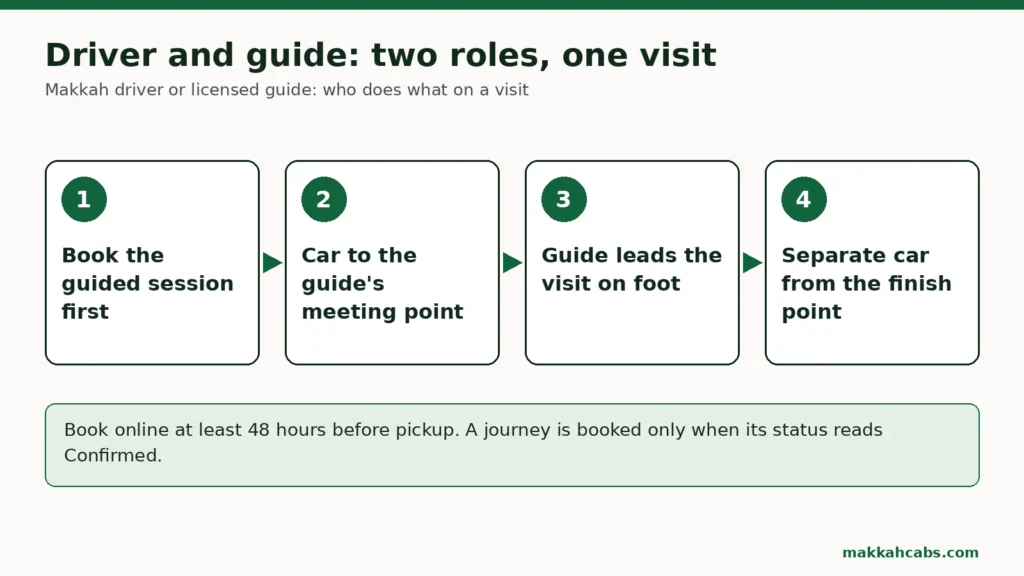
Private driver vs tour guide in Makkah: two roles
It helps to start with a plain division of labour:
- The driver is responsible for the journey: collecting the party at the pickup place, driving safely to the destination and any stops in the order you booked, and dropping everyone off.
- The guide is responsible for the content of the visit: where to go on foot at the site, what the site is, its history, and keeping their group together during the guided part.
- You, or one lead contact in your party, are responsible for making the two fit: booking the journeys, telling the guide where you will arrive, and deciding when you need collecting.
Problems start when those lines blur: a family books a car, assumes the driver will “show them around”, and is dropped at the destination exactly as booked. Our short explanation of how Makkah Cabs works sets out what a booking covers, and it is worth reading before you combine it with anything else.
What your Makkah Cabs driver is booked to do
A Makkah Cabs booking is built from a small set of facts: one pickup place, one destination, a pickup date and time in Saudi local time, the passengers (adults, children and infants), and the large and cabin bags. You can add up to eight stops along the way, in journey order. That is the whole of what the driver has been asked to deliver.
A few consequences follow from that:
- The driver is not booked as a guide. Some drivers know the city well and some speak several languages, but neither is part of what you have booked, and you should not plan a visit around it.
- A there-and-back outing is two journeys. The planner requires the pickup and the destination to be different, so the outward trip and the return are booked separately, each with its own time. Our piece on the return agreement explains why the return deserves the same attention as the outward leg.
- The car does not automatically stay with you. Each vehicle class has an included waiting allowance at pickup, but the booking is not a car on standby for the day. If you want the vehicle to wait while you are with a guide, ask the booking team before you pay and get the answer in writing. We look at this in more detail in can the vehicle stay with our group.
- You will know who is coming. Once a driver is assigned, their name appears on the booking in your account, so you can pass it to anyone who needs to recognise the car.
What a licensed tour guide is in Saudi Arabia
The Ministry of Tourism issues a tourist guide licence that allows the holder to guide and assist tourists around Saudi Arabia. The Ministry’s page lists the basic conditions: the applicant must be a Saudi national, at least 18, without health issues that limit the service, and must pass the courses, tests and interviews the Ministry approves.
The Ministry’s Tourist Guiding Regulations are the rulebook. A few points in them matter to a visitor planning a day out:
- Guiding needs a licence. The regulations state that tourist guiding may not be practised without a licence, after a licence has expired or been cancelled, or while it is suspended.
- The licence is visible. A licensed guide is required to wear the licence badge while providing the service. The Ministry’s services guide adds that it is worn on the chest and may only be used by the licence holder.
- Information must be accurate. Among the quality requirements, the guide must make sure the information given to tourists is accurate, and must speak the languages required for the service.
- Safety comes first. The regulations list safety obligations, including following the instructions of the competent authorities and telling tourists the rules of conduct that apply.
- The guide should not be the driver. One of those safety obligations is to avoid driving a means of transport while practising tourist guiding.
The Ministry’s services guide also describes different licence categories, including guides for a specific specialty, guides for an approved tourist route, and site guides who work at a particular approved site. It notes that guiding is normally provided through the programmes of a licensed travel and tourism service provider, with site guides as the exception.
Why the guide should not also be your driver
That last point answers the question behind this article. Nobody can give a party full attention as a guide while driving in Makkah traffic, and the regulations recognise it. If someone offers to be both your driver and your guide, treat it as a reason to ask more questions. The natural arrangement is the opposite: the driver brings the party to where the guided part begins and collects them from where it ends, and in between the guide leads.
Religious guidance is a separate matter
Many visitors want to know how to perform an act of worship correctly, or whether something is recommended or best avoided. Those are religious questions, and neither a transfer driver nor a tourist guide is the right person to answer them. For anything to do with Umrah, Ihram or the rites, speak to a qualified scholar you trust and use the official guidance on Nusuk, which describes itself as the official platform for Hajj and Umrah under the Ministry of Hajj and Umrah. A guide can tell you what a place is and why it is known. A driver can get you there. Neither should be asked for a ruling.
Which arrangement fits what you want
Use this table to match what your party is hoping for with who provides it and how you set it up.
| What you want from the day | Who provides it | How you arrange it |
|---|---|---|
| Get from the hotel to a site and back | Makkah Cabs driver | Two journeys in the planner: outward and return, each with its own time |
| An explanation of a site while you walk round it | A licensed guide, or the site’s own guided experience | Book directly with the site or through a licensed travel and tourism provider |
| A full programme with guide and group transport included | The programme’s organiser | Book the programme; you may not need a private car at all |
| Several short stops on the way somewhere | Makkah Cabs driver | Add stops to one journey, in the order you will visit them |
| Answers about worship and the rites | A qualified scholar, Nusuk | Ask before the visit, not in the car |
| Someone to look after an older relative all day | Not a driver or a guide | Arrange a companion within your own party |
The row that surprises people is the third one. Some organised experiences already include transport. The Nusuk booking site, for example, lists a museum experience in Makkah that includes a professional tour guide and group bus transport from a meeting point in the city. If you book something like that, check where its meeting point is. You may need only a short journey to reach it, or none at all.
Where guided options come from
In practice, hiring a licensed guide in Makkah happens in one of three ways.
The site runs its own guiding. Some venues offer guided sessions. Check the venue’s official page for languages and whether to book ahead; your transport then only needs to deliver you to the entrance the venue names.
A licensed provider runs a programme. A travel and tourism provider licensed by the Ministry organises a programme with a licensed guide. Their confirmation should tell you where the programme starts, where it ends and whether it includes transport. If it does not, you book the journeys to the start and from the end.
A site guide at one location. A site guide works at a particular approved site, and you meet them there. The car’s job is to get you to that point and collect you from the finish.
Whichever route you take, keep the guide’s confirmation and the transport booking as two documents. Our article on keeping two confirmations for a visit explains the habit using a Hira example, but the principle applies to any guided outing.
Does the guide travel in your car?
Sometimes a guide will ask to meet you at your hotel and travel with you. That is possible, but it changes the booking, because the guide is a passenger.
- Count the guide as a seat. The planner only shows vehicle classes that pass the capacity check for the party and its bags. A family of four plus a guide is five people, which rules out an Economy car. Our guide on counting the people joining a visit walks through this.
- Decide it before you book. Only the pickup time can be changed online. The number of passengers, the vehicle, the pickup place and the destination cannot. If you book for four and then add a guide, you need the booking team, or a new booking with a cancellation request for the old one.
- Think about the return. A guide who rides out with you may not ride back. If their session ends at the site and they leave independently, the return booking may need fewer seats than the outward one. Book each journey for the people who will actually be in it. For most visits it is simpler for the guide to meet you at the site.
Meeting points that everyone can find
The drop-off and the guide’s meeting point should be the same place, described in the same words. Before the day:
- Ask the guide or provider for the exact meeting point in writing, with a map pin and, if possible, the name in Arabic.
- Put that description in the booking notes for the outward journey.
- Ask where the guided part finishes. It is not always where it started.
- Use the finishing point, not the starting point, as the pickup place for the return journey.
Around the Haram and in busy parts of central Makkah, where a vehicle can stop is managed on the day by the authorities, and we do not promise a particular entrance or kerb. For pickups from your hotel, agree a findable meeting place with the driver and be ready to send a live location. The same applies at the end of the visit. If the guide’s finish point is inside a large complex, walk to a point the driver can reach and send the location from there.
One more rule keeps the day clear: only the lead contact on the booking asks for transport changes, and only through the booking team. A helpful guide may suggest asking the driver to come to another gate, but the driver works from the booking as it stands.
A worked example: the Rahman family
Samira Rahman is in Makkah with her husband, her two adult sons and her mother. They are staying near the Clock Tower. Samira’s mother would enjoy an explanation of the exhibits at a cultural site but cannot manage a long day. The family wants a guided session, then lunch back at the hotel.
Step one: the guide. Samira books a guided session through a licensed provider. The confirmation gives a meeting point at the venue entrance, a start time and an end time. It does not include transport.
Step two: the outward journey. Using the planner, Samira books a journey from the hotel to the venue for five adults. She sets the pickup early enough to allow for traffic, walking from the drop-off to the meeting point, and her mother’s pace. She adds the meeting point description to the booking notes. She books more than 48 hours ahead, because online bookings need at least that much notice.
Step three: the return. The guide’s confirmation says the session finishes at the same entrance. Samira books a second journey from there to the hotel. She does not set the pickup at the guide’s end time. She adds a margin for questions at the end, a toilet stop and the walk back to the pickup point.
Step four: the check. Both payments show as provisional requests. Samira waits until each journey reads Confirmed before telling the family the plan is fixed.
On the day, the guide warns that the session will run long. Samira requests a new return time in her account. It shows as pending until the booking team approves it; once approved, the £5 rescheduling fee, converted into the booking currency, is added to the cash paid to the driver. She tells the family only after the approval appears.
For a sense of scale, a comparable trip from the Clock Tower to the Hira Cultural District is about 13 km by road, and about 11 km on the way back. Distances differ by direction because of one-way systems, which is one more reason to book the two legs separately.
Timing the return around a guided session
People rarely walk out at the exact moment a guided session ends. Build the return pickup from:
- the guide’s stated finish time;
- time for questions, photographs and a final look round;
- the walk from the finish point to the pickup point, at the pace of the slowest person;
- a margin on any day you expect the city to be busy.
If unsure, set the return a little later rather than earlier. Changing it costs a £5 rescheduling fee if approved, and approval is not guaranteed.
If plans change
Because the guide and the car are two arrangements, a change to one does not change the other. Check both.
- The guide cancels or moves the session. Your car booking is still in place. If you still want to go, keep the journeys. If the new session is at a different time, request new pickup times for both journeys, outward first. If you no longer need the journeys, remember that bookings are subject to our cancellation terms (free cancellation with a full refund up to 48 hours before pickup; inside 48 hours the deposit element of the price is kept) when the customer cancels. Contact the booking team before you do anything.
- The provider changes the meeting point. A different pickup place or destination is not a time change and cannot be done online. Contact the booking team, or book the new journey and request cancellation of the old one, bearing in mind the refund rule above.
- We or the transport partner cannot supply the journey. If we or the partner cancel, or cannot supply the journey and you do not accept a suitable alternative, you receive a full refund for the affected journey. The cancellation and refund policy is the reference. Settle the guide’s session before paying for transport.
A checklist for a guided outing with a Makkah Cabs car
- Decide whether you want a guide, a car, or both, and write down what each is for.
- Book the guided session first. Ask the guide to confirm their Ministry of Tourism licence, the language, the group size, and the meeting point, finish point and times in writing.
- Check whether the session includes transport. If it does, you may need no car, or only a short journey to the meeting point.
- Decide whether the guide will travel in your car. If yes, count them as a passenger.
- Book the outward journey at least 48 hours ahead, with the meeting point described in the notes.
- Book the return as a separate journey from the finish point, with a margin after the session ends.
- Wait for both journeys to read Confirmed, which normally happens within 1 to 12 hours of payment.
- Share the driver’s name, the meeting points and the lead contact’s number with the party.
- Keep religious questions for a qualified scholar and the official Nusuk guidance.
- If anything changes, contact the booking team first, before cancelling anything yourself.
Once you know where the guided part of your day begins and ends, the transport is the easy piece. Enter the pickup, the meeting point and your party in the Makkah Cabs planner, book the outward and return journeys separately, and leave the guiding to the guide.