
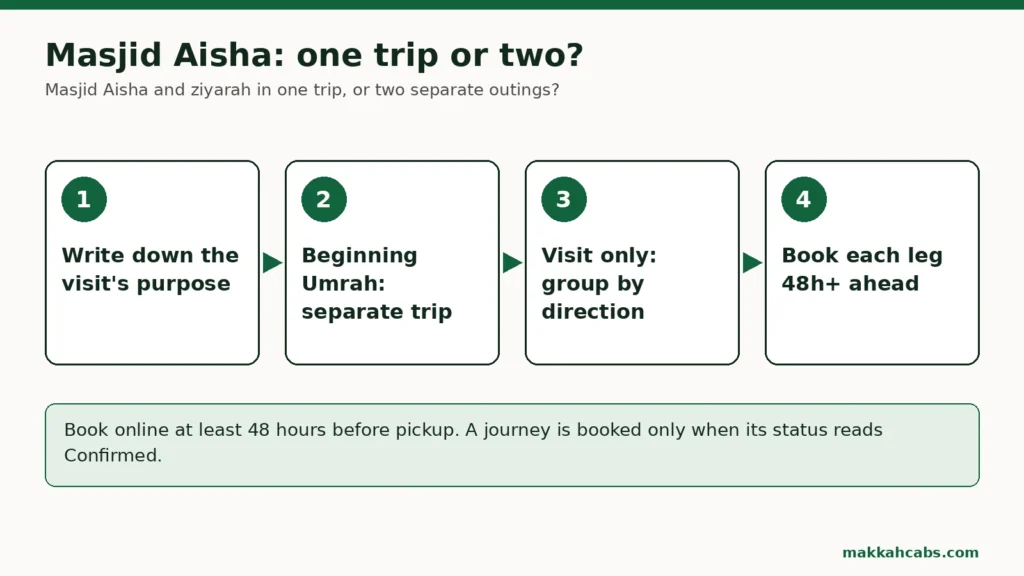
Masjid Aisha and ziyarah in one trip can work, but only when the visit to the mosque and the other stops have compatible purposes, fit in the same part of the day, and are booked as a chain of separate journeys with a clear end point. When the Masjid Aisha visit is the main reason for going out, especially if the group is going there to begin a further Umrah, a separate trip to Masjid Aisha is usually the calmer choice: a direct outward journey, a direct return, and the sightseeing on another day.
This guide is for anyone planning time in Makkah who wants to visit Masjid al-Taneem, also known as Masjid Aisha, and is wondering whether to fold it into a wider outing with places such as Hira Cultural District. It sets out what the mosque is and where it sits, why the purpose of the visit comes first, the three ways to structure the day, how to order stops when you do combine them, what the booking rules mean for each option, and a worked example of a family deciding both ways. It does not give religious guidance. Questions about Umrah, ihram or what to do at the mosque belong with a qualified scholar and the official Nusuk platform.
What Masjid al-Taneem is and where it sits
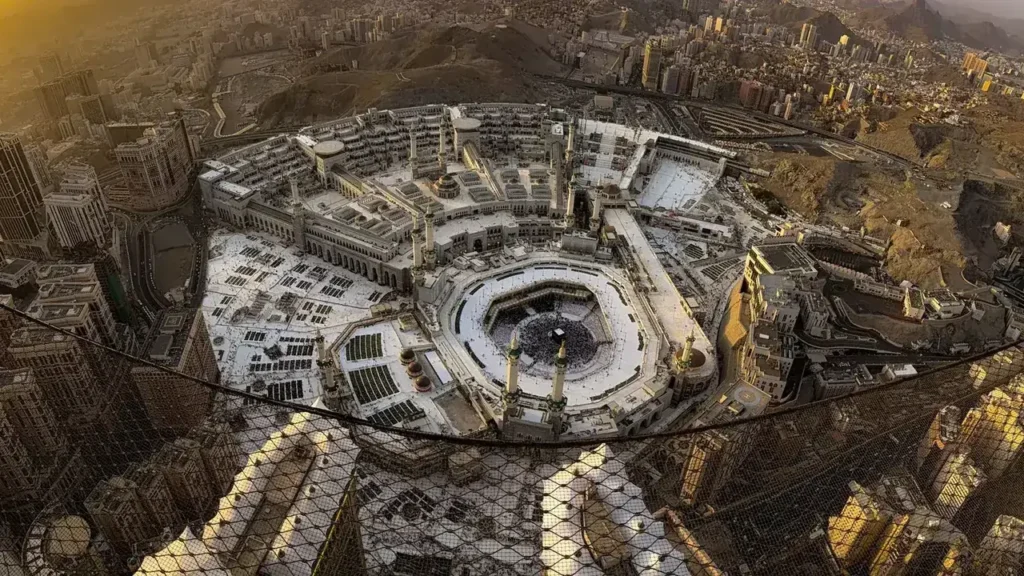
Saudipedia describes Masjid al-Taneem as standing on the northwestern side of Makkah, 7.5 km north of the Grand Mosque, and records that it is also known as Masjid Aisha and as Masjid Umrah. It describes the mosque as a place where pilgrims enter ihram for Umrah, and lists parking areas for buses, taxis and private cars, shaded courtyards, restrooms, water coolers and shops selling ihram garments and Umrah supplies.
The Saudi Press Agency’s report on Al-Taneem Mosque places it on the Makkah-Madinah Expressway, says it can hold up to 15,000 worshippers, and notes a steady stream of visitors throughout the year, rising significantly in the Hajj and Umrah seasons.
On our live route checks, Masjid Aisha was about 13 km by road from the Clock Tower area, and about 19 km on the way back, because the road layout differs by direction. Both Masjid Aisha and Hira Cultural District appear in the Makkah Cabs planner’s popular locations. If you are unsure you have the right mosque, our guide to finding Masjid Aisha and the right pickup point covers names, spellings and locations.
Start with the purpose of the visit
Two families can put “Masjid Aisha” on their list for quite different reasons, and the reason decides the transport.
A visit that begins a further Umrah
Saudipedia’s description makes clear that many visitors go to the mosque to enter ihram for Umrah. If that is your purpose, the visit is not really a sightseeing stop. It is the start of an act of worship that continues back at the Grand Mosque. We do not give rulings on how that should be arranged, and you should ask a qualified scholar about anything that affects your plans for the day. From a transport point of view, though, the shape is usually clear: the group leaves the mosque with somewhere specific to go next, and a return to the Haram area or the hotel is the natural end of the journey.
A visit to see the mosque
Some families want to see the mosque, pray there, or show it to relatives, without it being linked to an Umrah. Then the mosque can sit alongside other places more easily, and the choice between one trip and two is a matter of time, energy and route.
A mixed group
Often a group contains both: one or two people beginning an Umrah, and others who have come along. Plan for the stricter purpose. If anyone in the car is heading straight back to the Grand Mosque afterwards, the day should not be built around them sitting through two more sightseeing stops.
A separate trip to Masjid Aisha
A separate trip to Masjid Aisha is two journeys: hotel to the mosque, and the mosque back to the hotel or to the Haram area. It is the simplest structure, and for most visits with a religious purpose it is the one we would suggest.
Its advantages are practical:
- The return is predictable. There is only one place to be collected from, and one place to go.
- Nobody is rushed. No later stop is pulling the group away early.
- The vehicle fits the party. Only the people going to the mosque are counted.
- Sightseeing gets its own day. Hira Cultural District or other places can be planned as their own outing, at a time that suits them.
The main question in a separate trip is the return: whether the car waits under agreed terms or collects you later. Our guide to a Masjid Aisha taxi there and back compares the two. If the group may finish at different times, see our note on regrouping a family at Masjid Aisha.
Combining Taneem with other stops
Combining Taneem with other stops, or planning Masjid Aisha and ziyarah in one trip, is worth considering when the mosque visit is not the start of an Umrah, or when only a short visit is intended and everyone in the car is content with the longer day.
How a combined day is booked
In the Makkah Cabs planner, a stop is a point on a journey where people get in or out. It is not time for the car to wait while you visit. A combined day is therefore normally a chain of journeys, each with its own pickup time:
- hotel to the first site;
- first site to the second site;
- second site back to the hotel.
Every journey needs at least 48 hours’ notice before its pickup time, and each has a minimum booking value equivalent to £40. Payment secures a provisional request; the booking team updates the status, usually within 1 to 12 hours, and each journey is booked only when it reads Confirmed. If you want one vehicle to stay with the group between sites, that is a specific arrangement to agree with the booking team in writing.
Which sites pair well
Direction matters more than fame. Saudipedia places Masjid al-Taneem north of the Grand Mosque and Jabal al-Nour northeast, so the mosque and Hira Cultural District sit in the same broad part of the city. Sites to the south, such as Jabal Thawr, or out to the east, such as Mina and Arafat, pull the day in other directions. We have no live route check between the mosque and Hira Cultural District, so read the distance in the route summary before you pay. Our guide to building a Makkah ziyarah itinerary explains how to group sites by direction.
Ordering the stops
When you do combine them, the order follows the purpose:
- If anyone is beginning an Umrah at the mosque, it is usually simplest to make the mosque the last stop, so the final journey goes from Masjid Aisha straight back towards the Haram or the hotel. Ask your scholar if the order matters to you for any other reason.
- If the mosque visit is a visit only, put the stop with fixed hours first. The exhibitions at Hira Cultural District, for example, have set opening hours, and on Fridays they open only in the afternoon.
- Either way, end the day where the next thing starts: the hotel, the Haram area, or a meal with relatives.
For the mechanics of stop order in a single journey, see our guide to putting Makkah visit stops in the right order.
Masjid Aisha and ziyarah in one trip or two: a comparison
| Question | Mosque on its own | Mosque combined with other sites |
|---|---|---|
| Best when | The mosque visit is the main purpose, especially to begin an Umrah | The mosque is one visit among several, with no Umrah beginning there |
| Journeys to book | Two: out and back | Usually three or more, one per leg |
| Timing risk | Low: one return to plan | Higher: each overrun pushes later pickups |
| Vehicle | Sized for those going to the mosque | Sized for the fullest leg of the day |
| Energy | A shorter outing | A longer day, harder for older relatives and children |
| Heat | Less time outdoors | More time moving between sites |
| If plans change | One return time to adjust | Several pickup times may need to move |
Neither is automatically better. The comparison is about which fits the group’s actual purpose and stamina.
Dropping someone at Masjid Aisha on the way
A third structure sits between the two. A journey to another site can include Masjid Aisha as a stop where one or two people get out, while the rest carry on. The person dropped at the mosque then needs their own way back, usually a separate journey booked from the mosque at a time that suits them.
This works well when only one member of the group is going to the mosque, for example to begin an Umrah, and the others are heading for Hira Cultural District anyway. It keeps the mosque visit unhurried for the person who needs it, and avoids everyone else sitting in the car. What it does not do is give anyone waiting time at the mosque: the stop is only for getting out. Put the drop-off early in the journey if the mosque is on the way, and check the route summary to see whether it really is.
Planning Masjid Aisha and ziyarah in one trip for a larger group
Larger parties make the one-trip-or-two decision harder, because the vehicle has to suit the fullest leg of the day and the group has more people to regroup at each site.
Enter every traveller, including children and infants, and the bags and equipment you will carry. The planner shows only vehicle classes that pass the capacity check for what you enter. On a combined day, the same vehicle class may not suit every leg: a relative who joins only for the mosque visit, or two people who go straight back to the Haram afterwards, change the count. Search each journey with its own passengers.
If the group is too large for one vehicle, it may be better to run the mosque visit and the sightseeing as separate trips with different people, rather than moving two vehicles through three sites together. Where you do use two vehicles, each needs its own lead person and its own pickup point at every site.
What to carry on a combined day
A combined day keeps the group away from the hotel for longer, so the day bag matters more than on a short trip.
- Water and shade. Enough water for everyone, and hats or umbrellas for time outdoors between sites.
- Phones and chargers. At least two charged phones with the booking details for every journey.
- Tickets. If Hira Cultural District is on the list, the exhibition tickets, held separately from the transport bookings.
- Anything needed at the mosque. Saudipedia notes that the mosque has shops selling ihram garments and Umrah supplies, but do not rely on buying what you need there; pack it. What is needed for an Umrah is a question for your scholar.
- Medicines and light layers. For older relatives in particular, since air-conditioned rooms and cars can feel cold after the heat.
Our note on personal items during a Taneem stop covers keeping belongings organised when the group gets in and out of the car.
Timing, heat and prayer times
A combined day is longer, and in Makkah that usually means more time in the heat. The Ministry of Health’s summer heat guidance advises reducing direct exposure to sunlight, planning outdoor activities carefully with rests in the shade, and drinking fluids before you feel thirsty. It lists older adults, infants and children among those most at risk. For a mixed group, that often tips the decision towards two shorter trips.
Prayer times also shape the day. Many families plan outings around them, and each stop may take longer than expected if the group stays for a prayer. Build that into the pickup times rather than hoping it will fit.
Changes after booking
Plans change. The rules are the same for a separate trip or a combined day, but a combined day has more journeys to keep aligned.
- Only the pickup time can be changed online. On a paid booking, “Request a new pickup time” in your account asks for a new time before the current one. An approved new time carries a £5 rescheduling fee, converted into your booking currency and added to the cash paid to the driver at pickup; a rejected request costs nothing.
- If one stop overruns in a combined day, check every later journey. Moving one pickup time without the others can leave a car waiting at the next site before you arrive.
- A different pickup place, destination, passenger count or vehicle needs the booking team, or a new booking plus a cancellation request.
- Bookings are subject to our cancellation terms (free cancellation with a full refund up to 48 hours before pickup; inside 48 hours the deposit element of the price is kept) if you cancel. If we or our transport partner cancel, or cannot supply the journey, you receive a full refund for the affected journey. The cancellation and refund policy sets this out.
Our guide to changing a Masjid Aisha return pickup time covers what to do on the day if the return needs to move.
Worked example: one family, two decisions
Hamza and his wife Sana are staying near the Clock Tower with Sana’s parents, Rashid and Nasreen, and their son Ayaan, who is twelve. Rashid wants to go to Masjid Aisha to enter ihram for a further Umrah. The rest of the family would like to see Hira Cultural District.
First idea. Hamza sketches one trip: hotel to Hira Cultural District, then to Masjid Aisha, then back to the Haram area. It looks efficient on the map.
Checking the purpose. Talking it through, the family realises Rashid would spend the afternoon at the exhibitions before beginning his Umrah, in the heat, and then want to go straight to the Grand Mosque. Nasreen tires quickly. Rashid says he would rather ask his local scholar how to plan his Umrah than fit it around sightseeing.
Decision. They split the plan across two days.
- Day one: the mosque on its own. Hamza books hotel to Masjid Aisha for Rashid and himself, and a return from the mosque to the Haram area at a time Rashid is comfortable with. Two passengers, small bags.
- Day two: Hira Cultural District for all five. Hotel to the district in the morning, and a return in the afternoon, with Nasreen’s pace in mind.
Booking. More than 48 hours before day one, Hamza books all four journeys, checks each route summary and adds a note on each saying who is travelling. All four read Confirmed the same evening.
What made it work. The family let the purpose of the mosque visit decide the structure, rather than the map.
Your one-trip-or-two checklist
- Write down why each person wants to visit Masjid Aisha.
- If anyone is beginning an Umrah there, ask a qualified scholar about anything that affects the day, and lean towards a separate trip.
- List the other places the group wants, and check which direction each lies in.
- Decide: a separate trip, or a combined day with the mosque placed by purpose.
- Book each leg as its own journey, at least 48 hours ahead, with every passenger counted.
- Size the vehicle for the fullest leg.
- Allow for heat, prayer times and the slowest member of the party in every pickup time.
- Check that every journey reads Confirmed.
- If one pickup time moves, review every later journey the same day.
When you have decided, choose your hotel and Masjid Aisha, or your first site, in the Makkah Cabs planner, and add each further leg at the time your group has agreed.