
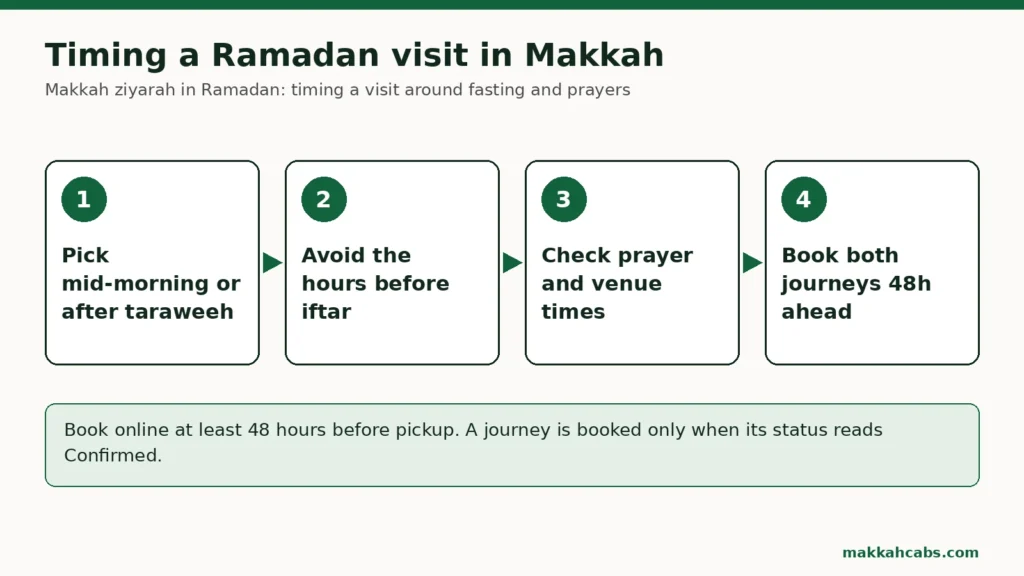
A Makkah ziyarah in Ramadan works best when the outing is built around the shape of the fasting day rather than squeezed into it. For most families that means one of two windows: a short morning outing after the party has rested following the night prayers, or a ziyarah after iftar and taraweeh, when the day’s fast is over and the heat has gone. The hours just before sunset are the ones to avoid, because nobody wants to be in a vehicle when it is time to break the fast. Book well ahead, because online bookings need at least 48 hours’ notice and Ramadan is one of the busiest periods of the year in Makkah.
This guide is for families and small groups staying in Makkah during Ramadan who want to fit in a visit, whether to Hira Cultural District, Masjid Aisha at Al-Taneem or another place, without wearing out fasting relatives or missing prayers at the Haram. It looks at how a Ramadan day is structured, which time windows suit an outing, how the last ten nights change things, how to book the two journeys of a there-and-back visit, and what to agree with the driver. It does not give guidance on worship or on the religious standing of any site. For those questions, speak to a qualified scholar and use the official Nusuk guidance.
How a Ramadan day changes a Makkah visit
Outside Ramadan, the natural time for a visit is a mid-morning or late-afternoon slot on a rested day. In Ramadan the day turns round.
- Before dawn is suhoor, the pre-dawn meal, followed by the Fajr prayer. Many people sleep after it.
- The daytime is fasting. Energy falls through the afternoon, and in the warmer months the heat adds to it.
- Sunset brings iftar at the time of the Maghrib prayer. For many pilgrims, breaking the fast at or near the Haram is one of the highlights of the stay.
- The evening brings Isha and then taraweeh, the night prayers of Ramadan, which can run late.
- The last ten nights add further night prayer, and many people spend long hours at the Haram.
The exact times of Fajr, Maghrib and Isha move a little each day. Check them against the official Umm al-Qura calendar for Makkah, and ask your hotel or group organiser what time taraweeh is expected to finish, rather than relying on a timetable copied from a previous year.
Ramadan outing in Makkah: which time windows work
A Ramadan outing in Makkah is really a choice of window. The table below is a planning aid, not a rule. Families differ, and a party of young adults will manage windows that would exhaust grandparents.
| Window | Suits an outing? | Why |
|---|---|---|
| Straight after Fajr | Rarely | Most fasting travellers need sleep after suhoor and Fajr |
| Mid-morning | Often | Rested, cooler than the afternoon, and the fast is still young |
| Early afternoon | Sometimes | Possible for a short visit, but heat and fasting fatigue build |
| The two or three hours before Maghrib | Poor | Risk of breaking the fast in a vehicle, and busy roads near the centre |
| Between iftar and Isha | Rarely | Usually too short once people have eaten and prayed |
| After taraweeh | Often | The fast is over, the heat has dropped, and some venues open late |
| The last ten nights | Rarely | Many families prefer to stay close to the Haram at night |
Two windows stand out: mid-morning and after taraweeh. Everything else is either too short, too hot or too close to iftar.
The pre-iftar trap
The most common mistake is a mid-afternoon visit that runs late. A family leaves at two o’clock, spends longer at the visit than planned, and finds itself heading back towards the centre of Makkah as the whole city moves towards iftar. Nobody can promise how long any road journey will take at that hour, and we do not quote journey times. If the return pickup is booked for late afternoon, put a generous gap between it and Maghrib, or choose another window.
Makkah ziyarah in Ramadan with older relatives
Older relatives change the calculation more than anyone else. A parent who fasts, prays taraweeh and walks to and from the Haram each day has little left for an outing, and the mid-morning window is often the only realistic one. Plan a Makkah ziyarah in Ramadan for an older traveller as a short visit with plenty of sitting, a vehicle chosen for easy boarding, and a return booked early enough that they can rest before iftar. If anyone has a medical condition, the decision to fast is a matter for their doctor and a qualified scholar, not for the transport plan; but the plan should allow for a relative who tires suddenly and needs to come back early.
Ziyarah after iftar: how to plan the evening
A ziyarah after iftar suits families who want the fast behind them and the day’s heat gone. In practice it usually means after taraweeh rather than directly after iftar, because the gap between breaking the fast and Isha is short and most people will want to pray.
Some things to settle in advance:
Opening times. Check the venue’s own times for the evening you have in mind. Hira Cultural District publishes its hours on its experiences page: the district and the path to the Cave of Hira are listed as open around the clock, while the museums and exhibitions are listed from 7:30 AM to 11:30 PM Saturday to Wednesday, 7:30 AM to 1:00 AM on Thursday, and 3:30 PM to 1:00 AM on Friday. Those are the general hours on the day we read them; the page does not list separate Ramadan hours, so check again before your visit in case they change for the month. If you arrive after the museums close, you will see only the outside of the district.
How late is late enough. If taraweeh at the Haram finishes late, a pickup booked too early will either wait or leave. Choose a pickup time that allows for the walk from the Haram to your hotel or meeting point, then add a margin.
Energy. A night outing after a full day of fasting and long prayers is tiring even for fit adults. Keep it short. One meaningful place is better than three rushed ones. Our guide to choosing one meaningful Makkah stop is especially relevant in Ramadan.
Children. Children who have been awake for suhoor will be asleep by late evening. A family with young children may find mid-morning more realistic than a late night.
For a visit to Hira specifically, our guide to a considered visit to Hira Cultural District covers what the district offers and how to plan the pickup.
Distances from central Makkah for common visits
Distances below are from our live route checks and are road distances, which differ by direction because of one-way systems and junctions. We do not quote journey times, which vary widely, especially in Ramadan.
| Journey | About |
|---|---|
| Clock Royal Tower to Hira Cultural District | 13 km |
| Hira Cultural District to Clock Royal Tower | 11 km |
| Clock Royal Tower to Masjid Aisha (Al-Taneem) | 13 km |
| Masjid Aisha (Al-Taneem) to Clock Royal Tower | 19 km |
| Clock Royal Tower to Hilton Jabal Omar | 1.5 km |
If your hotel is elsewhere in Makkah, sometimes written Mecca, type it into the planner and check the distance shown in the route summary.
How crowded Makkah is in Ramadan
Ramadan brings very large numbers of pilgrims and worshippers to Makkah. The Saudi Press Agency reported that the Grand Mosque received more than 904,000 Umrah performers on the fourth day of Ramadan in 1447 AH. It also reported that the city’s public transport system, including the shuttle service to and from the Grand Mosque and the Makkah bus network, carried more than 31 million beneficiaries in the first third of Ramadan, with over 2,300 buses taking part and peak times noted during the month.
For the last ten days, the General Authority for the Care of the Two Holy Mosques described, in a Saudi Press Agency report, a comprehensive operational plan for the final ten days of Ramadan, including real-time crowd monitoring and guidance towards less congested areas.
The practical lessons for a visit are straightforward:
- Roads near the centre are often busiest around prayer times. Where any vehicle may stop near the Haram is managed on the day by the authorities. We cannot promise a pickup at a particular entrance or at your hotel’s door. Agree a meeting point and send the driver a live location.
- Walking takes longer. Allow time to walk from the Haram to the meeting point through crowds, particularly for older relatives.
- Demand for vehicles is high. Book early rather than hoping to arrange something on the day.
Our guide to choosing between a hotel frontage and an agreed meeting place explains how to pick a point the driver can reach.
The last ten nights
The last ten nights of Ramadan are, for many pilgrims, the heart of the month. Many families choose to spend as much of those nights at the Haram as they can. Anyone performing Umrah also needs a permit, which the Ministry of Hajj and Umrah’s Umrah and Visit Guide says must be obtained through the Nusuk application before heading to the Masjid al-Haram, so check the details of your own permit in the app and fit any outing around it. Whether and how to divide time between worship and a visit is a personal and religious question. We do not advise on it; ask a qualified scholar if you are unsure.
From a transport point of view, the advice is simple. If a visit matters to your family, plan it for the first twenty days of the month. If it must fall in the last ten, choose mid-morning, keep it short, and book well ahead. Our guide to two shorter Makkah outings instead of one long one may help if the family wants more than one place but has little energy for a long day.
Booking a Ramadan ziyarah: the rules that bite harder
The booking rules are the same all year, but Ramadan makes some of them matter more.
48 hours’ notice. Online bookings need at least 48 hours’ notice before pickup. A search inside that window returns “This journey must be booked at least 48 hours in advance.” In Ramadan, when plans shift with the prayer times and the family’s energy, it is tempting to wait and decide on the day. You cannot book online that late, so choose the day and window before, not after.
A there-and-back visit is two journeys. The pickup and destination must differ, so an outing from your hotel to Hira and back is two journeys, each booked with its own time. Book the return time from the venue with care. If you are unsure whether to keep a vehicle waiting or book a separate return, our guide to a waiting car or a separate return pickup sets out the choice, using Masjid Aisha as the example.
Waiting. Free waiting counts from the booked pickup time. For an Economy car it is 15 minutes, then SAR 1.50 per minute; for Business and Executive, a VIP van (Staria) or a family van (H1) it is 30 minutes, then SAR 2.00 per minute; for a Premium SUV it is 45 minutes, then SAR 2.50 per minute. Extra waiting can be added at checkout in 15-minute steps up to 2 hours. For a late-night pickup from a venue, where one relative is always last to the vehicle, 15 or 30 minutes of extra waiting is a sensible buffer. Never assume the driver will wait beyond what is booked.
Payment and status. Makkah Cabs takes full payment online. Payment secures a provisional request; the booking team updates the status within 1 to 12 hours, and the journey is booked only when it reads Confirmed. Each journey has a minimum booking value equivalent to £40.
Changes and cancellations. Only the pickup time can be changed online. An approved new time carries a £5 rescheduling fee, converted into the booking currency and added to the cash paid to the driver at pickup. Bookings are subject to our cancellation terms (free cancellation with a full refund up to 48 hours before pickup; inside 48 hours the deposit element of the price is kept) if the customer cancels; if we or the transport partner cancel or cannot supply the journey, you receive a full refund for the affected journey. So pick a window you are confident the family will manage, rather than an ambitious one you may abandon.
A worked example: the Rahmans’ Hira visit after taraweeh
Farida Rahman and her husband Karim are in Makkah for the middle of Ramadan with Karim’s mother, Zainab, and their two teenage sons. They are staying near the Clock Royal Tower and want to visit Hira Cultural District.
Choosing the window. Zainab tires quickly by mid-afternoon while fasting, so an afternoon visit is out. The family also wants to break the fast near the Haram and pray taraweeh there. They choose a Wednesday night in the second ten days, after taraweeh, when the museums are listed as open until 11:30 PM.
Checking the details. Farida checks the Hira Cultural District website again three days before, to see whether the hours have changed for Ramadan. She checks the day’s Isha time and asks the hotel when taraweeh usually finishes.
Booking the outward journey. Five passengers, no large bags, two small day bags. The search shows the classes that fit, and she chooses a Hyundai Staria, which has 30 minutes’ free waiting. She books the pickup from an agreed meeting point near the hotel, leaving time for the walk back from the Haram, and adds 15 minutes of extra waiting because Zainab walks slowly through crowds.
Booking the return. A separate journey from Hira Cultural District back to the hotel area, about 11 km. She sets a pickup time that leaves the family roughly an hour at the district before the museums close.
Booking early. Farida books both journeys four days ahead, comfortably more than the 48 hours’ notice required, and waits for both to read Confirmed.
On the night. Taraweeh runs a little later than expected. The extra waiting covers it. At Hira, the family sees one exhibition, walks slowly around the district, and is back at the hotel before midnight. Zainab says it was the right amount.
Keeping the whole party together
Ramadan outings often involve relatives from more than one hotel, or friends who met at the Haram. The more people, the more the timing matters.
- Agree one return deadline. Our guide to agreeing one return deadline together shows how to avoid a vehicle waiting for one person while everyone else sits in it.
- Decide who speaks to the driver. One person with a working phone.
- Share a live location. Crowds and closures near the centre can make a meeting point harder to reach than it looked.
Checklist for a Makkah ziyarah in Ramadan
- Decide whether the visit belongs in the first twenty days or the last ten nights.
- Choose the window: mid-morning or after taraweeh are usually the best.
- Check the day’s prayer times on the official Umm al-Qura calendar and ask when taraweeh usually ends.
- Check the venue’s own opening times for that day, allowing for Ramadan changes.
- Agree a meeting point near your hotel rather than relying on the hotel door.
- Book the outward and return journeys separately, each with its own time.
- Add extra waiting where one relative is likely to be slow.
- Book at least 48 hours ahead, earlier in Ramadan, and wait for Confirmed.
- Keep the visit short, with one meaningful place rather than several.
- For any religious question about the visit, ask a qualified scholar and consult Nusuk.
Plan your Ramadan visit with Makkah Cabs
A Makkah ziyarah in Ramadan is easiest when the window is chosen first and the booking follows. Enter your hotel, the place you want to visit and your party in the Makkah Cabs planner, book the outward and return journeys with the times that suit your fasting day, and add the waiting your family will need.