
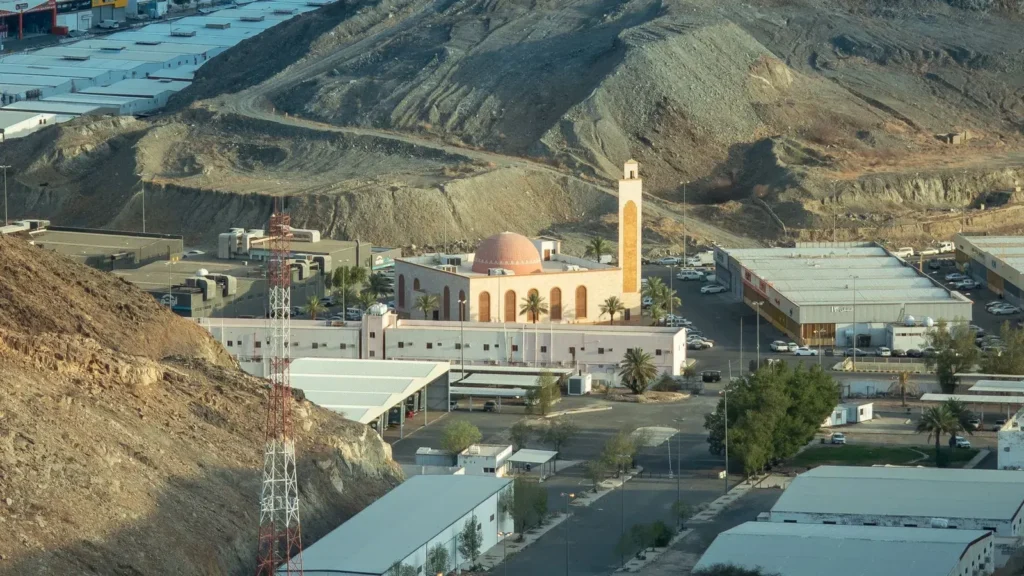
Many Makkah ziyarah sites from outside are what most families actually see: mountains such as Jabal al-Nour and Jabal Thawr are usually viewed from below, and an active cemetery such as Al-Ma’la is a place people pass or stop near rather than tour. Other places are buildings you enter, often with tickets and opening hours, such as the museums of Hira Cultural District. The difference matters for transport. An outside view is usually a short stop on a route; a place you go into usually means a drop-off and a separate return journey at a time you choose in advance.
This guide is for the family member who is turning a list of ziyarah names into a plan for a day out from a hotel in Makkah (Mecca). It groups well-known sites by what a visit usually involves, explains how to judge the time needed at each ziyarah site without inventing numbers, and shows how that choice changes the way you book. Details about each place come from official Saudi sources, and where those sources are silent, we say so and suggest you check. For religious questions about any site, speak to a qualified scholar and follow the official Nusuk guidance.
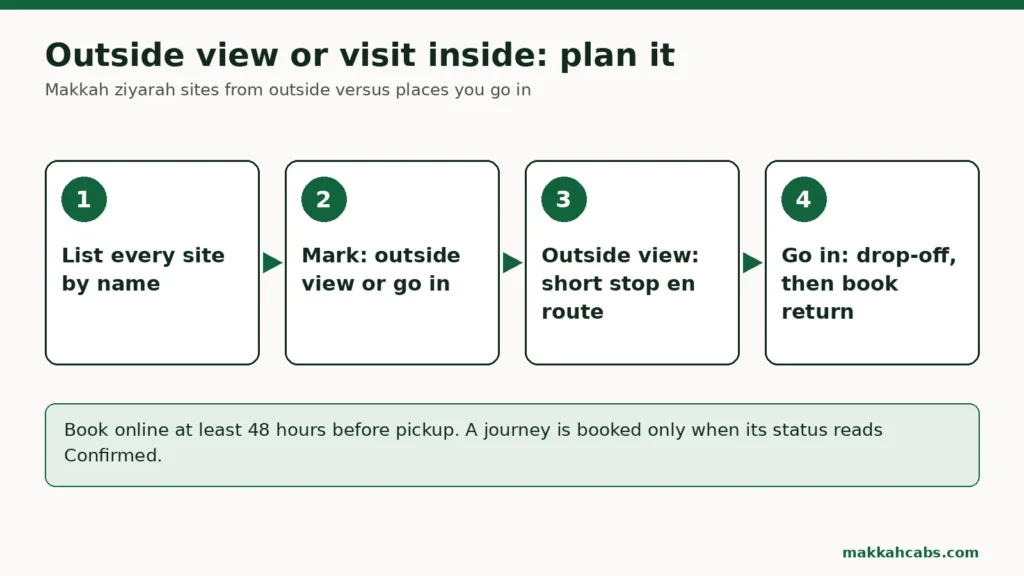
Why the outside-or-inside question comes first
A place name in a ziyarah list does not tell the driver, or the planner, what you mean to do there. “Jabal al-Nour” could mean a look at the mountain from the road, a walk around Hira Cultural District at its foot, a visit to its exhibitions, or the climb to the cave. Each of those is a different day.
The Makkah Cabs planner books journeys: one pickup, one destination, up to 8 stops in order, a date and a time. It does not book time at a site. So before you search, decide for each place whether you will:
- view it from outside, staying close to the vehicle or getting out briefly;
- go in, meaning you leave the vehicle for a visit of real length; or
- skip it this time.
That single decision determines whether a place becomes a stop inside one journey, or the end of one journey and the start of another. Our guide to essential and optional Makkah stops helps with the “skip it” column.
Makkah ziyarah sites from outside: the mountains and the cemetery
These are the places most often seen from outside. The facts below come from official sources; access details on the ground can change, so treat them as background, not instructions.
Jabal al-Nour and the cave of Hira
Saudipedia’s entry on Jabal al-Nour places the mountain about 4 km north-east of the Grand Mosque and gives its height as 642 m above sea level. The cave of Hira is near the top. The same entry describes the slope becoming steep from an elevation of 380 m, and the cave itself as narrow, fitting only a few people at a time.
For most families, Jabal al-Nour is something seen from below, often from Hira Cultural District at its foot. The climb is a separate decision that depends on health, heat and time, and it turns a short viewing into a long visit. Our guide to Hira Cultural District by taxi without the climb covers the district-only plan in detail.
Jabal Thawr
According to Saudipedia’s page on the Jabal Thawr Cultural District, the mountain lies south of the Grand Mosque, about 4 km away, and rises 760 m above sea level. The page describes it as easy at the base and rugged at the summit, with difficult paths, and notes that the cave is just below the peak. It also describes a cultural district project supervised by the Royal Commission for Makkah City and Holy Sites, including a visitor reception centre and a Hijrah Exhibition. The page does not say whether those facilities are open, so check their status locally before building a plan around them. Without that confirmation, treat Jabal Thawr as a place viewed from outside.
Al-Ma’la cemetery
Saudipedia’s list of Islamic historical sites in Makkah places Al-Ma’la cemetery at the base of Jabal al-Sayyidah in the al-Hajun neighbourhood, north of the Grand Mosque. Its separate entry on the cemetery describes it as a historic cemetery that continues to receive funerals and burials. That is the practical point for planning: it is a working cemetery, not an attraction. Many visitors stop nearby; any visit should follow the arrangements and instructions in place on the day. Questions about what is appropriate there are for a scholar, not for us.
Which Makkah sites have entry: museums and exhibitions
The Royal Commission for Makkah City and Holy Sites lists a group of what it calls enrichment landmarks on its Makkah landmarks page. These are the places you go into, and they are the ones where timing needs most thought.
Hira Cultural District
The district’s official experiences page lists the Revelation Exhibition, the Holy Quran Museum and the path to the cave of Hira, with further attractions marked as coming soon. Tickets are bought through the district’s own ticketing, and the museums publish opening hours that differ by day of the week. Check the page close to your visit.
The Exhibition of the Two Holy Mosques Architecture
The Royal Commission describes this as a museum established in 1999, focused on the Two Holy Mosques and how their architecture has developed. Check current visiting arrangements before you plan a drop-off.
King Abdulaziz Complex for Holy Kaaba Kiswa
The Royal Commission lists the Kiswa complex among its landmarks, and Visit Saudi presents it as a place to learn the history of the Kiswa and the stages of its production. Neither page we read sets out visiting arrangements, so confirm how and when visits can be made before you book transport.
Museums in the Clock Royal Tower
The Royal Commission also lists the centres and museums of the Clock Royal Tower, including an astronomy museum over four floors. For guests staying in or near the tower, this is a visit that may need no vehicle at all.
Places between the two: mosques and the holy sites
Some places on ziyarah lists are neither a view nor a ticketed attraction.
- Mosques such as Masjid al-Jinn, Masjid al-Bay’ah near Jamrat al-Aqabah, and Masjid Aisha at Al-Taneem appear on the Royal Commission’s heritage list. Whether and when to go in for prayer is your own religious decision. For transport, a mosque visit that includes prayer is a “go in” visit, and the prayer time fixes much of your timing.
- Mina and Arafat are open landscapes rather than buildings with admission, and the Royal Commission’s list includes landmarks there such as Jabal al-Rahmah and Masjid al-Namira. Check current access conditions with official sources before planning a visit, particularly around the Hajj season.
For Masjid Aisha in particular, our guide to a Masjid Aisha taxi there and back covers the return options.
Outside view or visit inside: a comparison
| Site | Usually from outside or inside? | What decides your time there | Typical transport structure |
|---|---|---|---|
| Jabal al-Nour | Outside, unless climbing | Whether anyone climbs; heat | Stop, or drop-off at Hira Cultural District |
| Hira Cultural District | Inside (exhibitions) or outside (walk) | Ticket slots, opening hours, pace | Drop-off and separate return |
| Jabal Thawr | Outside, unless facilities confirmed open | Local status of the cultural district | Short stop within a journey |
| Al-Ma’la cemetery | Outside, or brief visit on foot | Arrangements on the day | Short stop, meeting point agreed |
| Museums (Architecture, Kiswa, Clock Tower) | Inside | Opening arrangements, booking if required | Drop-off and separate return |
| Mosques | Inside if praying | Prayer time | Drop-off and return, or stop if not entering |
| Mina and Arafat | Outside | Season and access conditions | Stops within a journey, if accessible |
This table describes typical choices for Makkah ziyarah sites from outside and inside, not rules. What matters is that you decide which column your family is in before you search.
Time needed at each ziyarah site: how to estimate it without guessing
We do not publish durations for ziyarah sites, and you should be wary of anyone who gives a single figure for every family. The time needed at each ziyarah site depends on the site and on your group. You can still estimate it sensibly by building it up from parts.
For a view from outside
- getting out of the vehicle and back in, which takes longer with children, older relatives or a wheelchair;
- walking from where the car can stop to where the view is, since where vehicles may stop is managed on the day;
- photographs and a moment of reflection;
- regrouping if anyone wandered off.
For a visit inside
- walking from the drop-off to the entrance;
- any ticket or security check;
- the visit itself, which the venue may be able to describe;
- prayer, rest, the toilet and a drink, especially in heat;
- walking back to the agreed meeting point.
Add these up honestly, then add a margin. The Saudi Ministry of Health’s summer heat guidance lists older adults and children among those most at risk and advises resting in shaded areas and scheduling outdoor activities carefully, so a family with grandparents should allow more time, not less.
Checking which Makkah sites have entry before you travel
Lists shared between families are often old, and a place that was only a view a few years ago may now have a visitor centre, while a museum on someone’s list may have changed its arrangements. Before you settle which Makkah sites have entry and which do not, check each “go in” place yourself.
- Start with the official source. For Hira Cultural District that is the district’s own site. For landmarks listed by the Royal Commission, start with its page and follow any official link to the venue.
- Check the day, not just the place. Opening arrangements can differ by day of the week, and the day of your outing is the one that matters.
- Check how tickets work. If a ticket has a time slot, your drop-off time follows from it, not the other way round.
- Ask your hotel if you are unsure. Reception staff can often tell you what guests have found recently. Our article on asking your Makkah hotel reception to help with a booked pickup explains what hotel staff can and cannot do for a transport booking.
If you cannot confirm that a place is open to visitors on your day, plan it as an outside view. It is easier to extend a short stop into a longer visit on another day than to discover at the door that the visit you built the day around is not possible.
How the choice changes the booking
Once you have sorted the list, the booking structure follows.
A day of mostly outside views
Build one journey from your hotel with short stops in the order you will visit them, ending at a destination that differs from the pickup. A stop is a point on the route, not a period of waiting, so keep stops short and describe them in the booking notes. The planner allows up to 8. If you finish somewhere other than the hotel, book the journey back as its own journey. Our article on the order of stops on a multi-stop Makkah visit helps you sequence them.
A day built around one place you go into
End the first journey at that place. Book a second journey from there at a pickup time based on your estimate plus margin. The included waiting allowance at that pickup, which varies by vehicle class and is not currently shown on the search results, absorbs small delays only. Ask the booking team to confirm it in writing if it matters.
A mix of both
Put the outside views as stops on the way to the main visit, then book the return. Avoid planning outside stops after a long museum visit, when energy is lowest.
Rules that apply to every journey
Online bookings need at least 48 hours’ notice. Each journey has a minimum booking value equivalent to £40. Paying secures a provisional request, which the booking team updates within 1 to 12 hours, and the journey is booked only when it reads Confirmed.
What to write in the booking notes for each kind of stop
The booking notes are where you tell the booking team and the driver what each place means for your family. Short, plain lines work best. Here is how the notes might look for a mix of Makkah ziyarah sites from outside and one visit inside:
- “Stop 1, Jabal Thawr: view from the road only, nobody leaving the car for long.”
- “Stop 2, near Al-Ma’la: two adults will step out briefly, the others stay together.”
- “Destination, Hira Cultural District: family has tickets for the exhibition. Return booked separately.”
- “Lead contact: first name and phone number, available on WhatsApp.”
Do not write gate numbers or a spot where you expect the car to stop, because where vehicles may stop is managed on the day. Instead, agree a meeting point in words and be ready to send a live location. If anyone has limited mobility, add the wheelchair requirement in the search itself so it is confirmed for the vehicle, and mention in the notes who will help. Our guide to choosing the Makkah hotel pickup point shows how to describe a meeting place clearly.
A worked example: the Rahimi family’s two kinds of stop
Farid and Leila Rahimi are in Makkah with their two teenagers and Leila’s father, who is fit but dislikes long walks in the sun. Their list reads: Jabal Thawr, Jabal al-Nour, Hira Cultural District, and “the cemetery”.
Farid sorts the list. Jabal Thawr is an outside view, since he cannot confirm that the cultural district facilities there are open. Al-Ma’la is a short stop near the cemetery, with the family agreeing that Leila’s father will decide on the day whether to walk. Jabal al-Nour will be seen from Hira Cultural District, where the family has bought tickets for the Revelation Exhibition.
He books two journeys, five days ahead. The first starts at the hotel, stops briefly for the view of Jabal Thawr and near Al-Ma’la, and ends at Hira Cultural District. The second runs from the district back to the hotel, at a time based on the ticket slot, the exhibition, a rest in the shade and the walk back, plus a margin for his father-in-law.
In the booking notes he writes one line per stop: what the family will do there and that nobody will be long. On the day, the outside stops are quick, the exhibition runs as planned, and the family reaches the meeting point before the return pickup.
If you change your mind at a site
It happens: a family plans only to look at the mountain, then decides to go into the exhibition. That turns a short stop into a long visit.
- If the vehicle was booked for a short stop, the driver cannot simply wait an unknown length of time. Waiting during a visit is not a product you can select; it needs the booking team’s written agreement.
- Only the time of a booked journey can be changed online. From your Makkah Cabs account you can request a new pickup time before the pickup; an approved change carries a £5 fee, converted into the booking currency and added to the cash paid to the driver.
- A different pickup place or destination needs the booking team, or a new booking plus a cancellation request. Bookings are subject to our cancellation terms (free cancellation with a full refund up to 48 hours before pickup; inside 48 hours the deposit element of the price is kept) if the customer cancels; the cancellation and refund policy has the details.
The easiest way to avoid this is to decide in advance, and if in doubt, to plan the longer visit.
Checklist: turning a ziyarah list into bookings
- Write every site on the list, with its name as it appears in the planner.
- Mark each one: outside view, go in, or skip.
- For each “go in”, check opening arrangements and tickets on the official site.
- For each outside view, keep the stop short and describe it in the booking notes.
- Estimate the time needed at each ziyarah site from its parts, then add a margin.
- Allow more time for older relatives, children and anyone using a wheelchair.
- Put outside views before the main visit, not after it.
- End a journey where a long visit begins, and book the return as its own journey.
- Book every journey at least 48 hours ahead.
- Wait for each journey to read Confirmed.
- Refer religious questions to a qualified scholar and the official Nusuk guidance.
Knowing which places you will see and which you will enter turns a list of names into a day that works. When your list is sorted, open the Makkah Cabs planner and build the journeys in the order you will travel.
If you cancel, cancellation is free with a full refund up to 48 hours before pickup; inside 48 hours the deposit element of the price is kept, and your statutory rights are unaffected. If we or the transport provider cancel, you receive a full refund for the affected journey.