
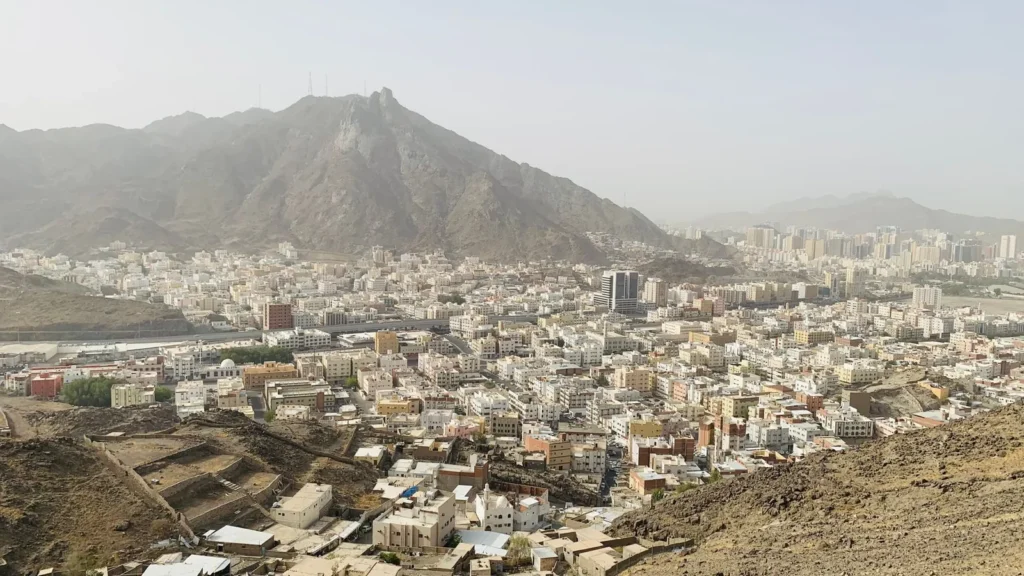
A Jabal Thawr taxi from Makkah works best as two separate journeys: one from your hotel to the foot of the mountain, south of the Grand Mosque, and a second from the mountain back to your hotel at a pickup time you choose in advance. Whether that return comes soon after you arrive or much later depends on one decision you should make before booking: is anyone in your party climbing towards the Cave of Thawr, or are you viewing the mountain from below?
This guide is for families and small groups staying in Makkah (Mecca) who want to include Jabal Thawr in their ziyarah. It explains where the mountain is and what official Saudi sources say about it, what is and is not confirmed about the cultural district at its base, the three kinds of visit families usually make, how to book the drop-off and the pickup, how waiting works, and how to plan when some people climb and others do not. It deals with transport and planning only. For the religious significance of the site or any act of worship there, please speak to a qualified scholar and follow the official Nusuk guidance.
Where Jabal Thawr is and what the Cave of Thawr is
The Royal Commission for Makkah City and Holy Sites describes Jabal Thawr as lying south of Makkah and lists it among the city’s landmarks. Saudipedia, the Saudi national encyclopaedia, places it south-east of the city and south of the Grand Mosque, and gives the mountain’s height as 760 metres above sea level. The official Nusuk Umrah platform also places it south of the Grand Mosque.
The cave near the summit is known as the Cave of Thawr, or Ghar Thawr. Saudipedia describes it as a hollow rock near the peak with two openings, one to the east and one to the west. Its historical importance comes from the Hijrah, the migration from Makkah to Madinah: Saudipedia and Nusuk both record that the Prophet Muhammad and his companion Abu Bakr sheltered in the cave, and Saudipedia notes that they stayed there for three nights. Both sources connect the event with verse 40 of Surah At-Tawbah.
Visitors use several spellings: Jabal Thawr, Jabal Thaur, Mount Thawr and Thawr mountain all refer to the same place. Choose one and use it in every message to your family and to the driver.
Jabal Thawr from Makkah: finding the right destination
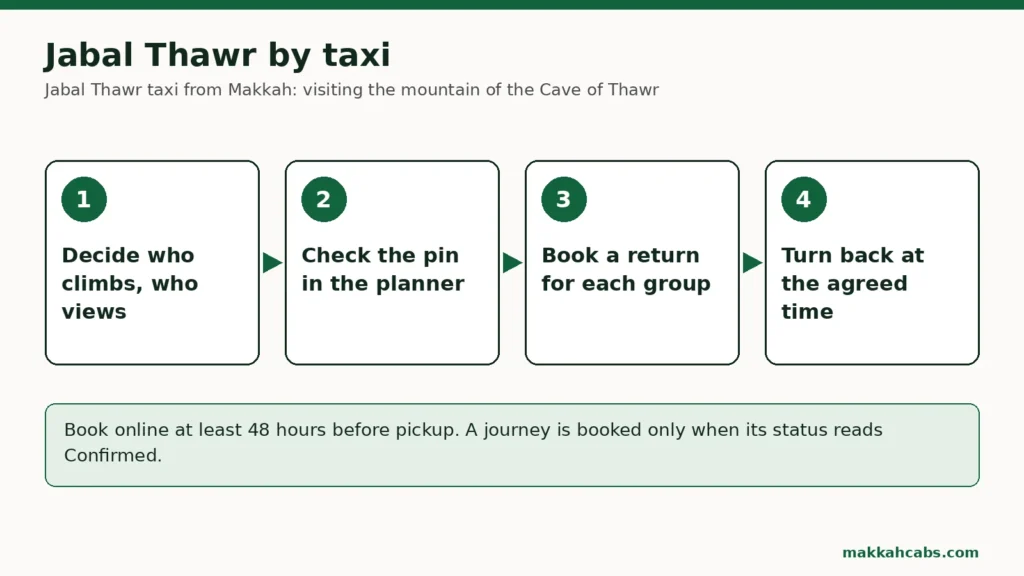
Getting to Jabal Thawr from Makkah starts with the destination. It is not one of the popular locations listed in the Makkah Cabs planner, so you will type it in. That makes the route summary important. Before you pay, check three things:
- The pin. Make sure it sits at the foot of the mountain where visitors arrive, not on a road on the far side of the ridge. A large mountain can have several possible pins.
- The name. Saudipedia notes that the Al-Hijrah neighbourhood is near the site, and the cultural district at the base carries the mountain’s name. Either can help you or the driver confirm the location.
- The distance. We do not have a live route check for Jabal Thawr, so we will not quote a figure. Read the distance shown in the planner for your own hotel; road distances in Makkah can differ in each direction because of one-way systems.
If the pin looks wrong, describe the arrival point you want in the booking notes, and confirm it with the driver once assigned. Where a vehicle may stop at the base is managed on the day, and we cannot promise a particular gate or kerb.
The Jabal Thawr Cultural District: what is confirmed
Saudipedia describes a Jabal Thawr Cultural District project supervised by the Royal Commission, covering more than 127,000 square metres, with a visitor reception centre and a Hijrah Exhibition that uses museum displays and modern technology to tell the story of the migration.
What the page does not say is when those facilities are open, whether tickets are needed, or which parts are complete. We could not find those details on any official page we read. So:
- if a visit to the Hijrah Exhibition is important to you, confirm its status and hours with the Royal Commission for Makkah City and Holy Sites before you book the car;
- if you cannot confirm it, plan the outing as a visit to the mountain, and treat anything open at the base as a bonus.
This matters for transport because an exhibition with hours becomes the fixed point of the day, in the same way a ticket does at Hira Cultural District. Our guide to a visit to Hira Cultural District shows how a district with confirmed hours shapes a plan; at Jabal Thawr, you will need to confirm those hours yourself first.
A Cave of Thawr visit: three kinds of plan
“Visiting Jabal Thawr” can mean very different days. Most families fall into one of three plans, and each needs a different return time.
| Plan | What it involves | Who it suits | Return pickup |
|---|---|---|---|
| View from below | Arriving at the base, looking at the mountain, photographs, a few minutes on foot | Older relatives, young children, anyone short of time or energy | Soon after arrival; free waiting may cover it |
| The base and district | Time at the foot of the mountain and any facilities you have confirmed are open | Families who want more than a photograph but no climb | A separate return at a time you set in advance |
| The climb | Walking up towards the Cave of Thawr and back down | Fit adults who have prepared for rough ground and heat | A separate, much later return, set with a margin |
For most families, a Cave of Thawr visit combines the first and third plans: most of the party views the mountain and returns, while one or two people climb. That is covered below under family plans.
What the official sources say about the climb
Saudipedia describes the mountain as easy at its base and rugged at its summit, with difficult paths, and places the cave near the peak. That is the extent of what we could verify. We could not find an official figure for the number of steps, the length of the path or the time a climb takes, and we will not guess.
What you can do is treat the climb as a serious walk on rough ground to a high point, and decide who is suited to it honestly. Anyone with a heart condition, breathing problems, knee or hip trouble, or who is pregnant, should take medical advice before attempting it.
Heat and timing
Makkah’s heat is the main risk on any climb. The Ministry of Health’s heat health advice says to drink plenty of fluids without waiting until you feel thirsty, to schedule outdoor activities carefully and rest in shaded areas, and to wear lightweight clothing rather than dark, heavy clothes. It names older adults, children, pregnant women and people with chronic conditions among those at higher risk, and lists heavy sweating, weakness, dizziness, headache and nausea among the signs of heat exhaustion.
For transport planning, that means two things. Choose an outward pickup time that puts the climb in a cooler part of the day, and set a firm turnaround time for climbers so that nobody is still going up when they should be coming down.
Booking a Jabal Thawr taxi: drop-off and pickup
The Makkah Cabs planner books journeys, each with one pickup place, one destination, a date and a time in Saudi local time, the passengers and any bags. Because the pickup and destination must differ, a Jabal Thawr taxi there and back is two journeys:
- Hotel to Jabal Thawr, with everyone who is going.
- Jabal Thawr to hotel, with everyone coming back at that time.
If different people are returning at different times, each return is its own journey with its own passenger count.
Every journey needs at least 48 hours’ notice before its pickup time. Payment secures a provisional request. The booking team updates the status, usually within 1 to 12 hours, and a journey is booked only when it reads Confirmed; check that both journeys have reached that status, not only the first. Makkah Cabs takes full payment online, and each journey has a minimum booking value equivalent to £40.
Use the booking notes. Say which spelling of the mountain you are using, where you would like to be dropped, whether anyone uses a walking stick or wheelchair, and, for the return, whether you expect to meet the driver at the same spot. The driver-assigned email gives you the vehicle registration and meeting instructions; once it arrives, agree the exact meeting point and share a live location. Our guide to a frontage or an agreed assembly point shows how to describe a meeting place clearly.
Can the driver wait while we climb?
Waiting is counted from the booked pickup time of each journey, not from when the car arrives. At the base of Jabal Thawr, that means the return journey’s pickup time. The free minutes and the rate after them depend on the vehicle class:
- Economy: 15 minutes free, then SAR 1.50 per minute.
- Business & Executive, Staria VIP van and H1 family van: 30 minutes free, then SAR 2.00 per minute.
- Minibus (Hiace or Coaster) and Coach: 30 minutes free, then SAR 2.50 per minute.
- Premium SUV (Tahoe or Yukon): 45 minutes free, then SAR 2.50 per minute.
- Luxury (S-Class): 60 minutes free, then SAR 4.00 per minute.
You can add extra waiting at checkout in 15-minute steps up to 2 hours, priced at the class’s per-minute rate, and the driver’s instructions will show the total. The driver cannot wait beyond what was booked.
For a view from below, the free waiting on a return booked shortly after arrival is often enough. For a climb, do not rely on waiting. Book the return for the time climbers expect to be back at the base, add a margin, and consider buying extra waiting on that journey. Our guide to whether the vehicle can stay with your group explains the difference between a waiting car and a separate return pickup.
Family plans when some climb and some do not
The most common Jabal Thawr outing is a mixed party. A grandparent and a young child will not climb; a teenager and a parent want to try. There are two ways to handle it.
One vehicle out, two returns
Everyone travels out together. The non-climbers view the mountain and return in the first return journey, booked soon after arrival. The climbers come back in a second return journey, booked for later. Each return is a separate booking with its own passengers, and each must meet the £40 minimum. This keeps the older and younger members out of the heat, and it gives climbers a car at the end without anyone waiting at the base for them.
Two vehicles from the start
If the two groups want to leave the hotel at different times, perhaps with climbers going earlier in the day, book them separately from the start. Our guide to one vehicle or two for your outing looks at when that is worth it.
Whichever you choose, give every climber a firm time to turn back, and make sure at least one climber has a charged phone with the return driver’s details. Our note on agreeing one return deadline helps make a finishing time stick.
Combining Jabal Thawr with other stops
A journey can include up to 8 stops, in the order you enter them. It is tempting to add Jabal Thawr to a longer ziyarah list, but official sources place it south of the Grand Mosque, while Jabal al-Nour and Hira Cultural District lie to the north-east. Crossing the city between them adds time and fatigue, and a climb at one end leaves little energy for the other.
In practice:
- A view from below fits as a short stop inside a longer journey, if the group truly means to stay close to the vehicle.
- A climb is its own outing, with its own day or half-day.
- A north and south plan is really two outings. Our guide to two shorter Makkah outings explains how to split one.
If you are still deciding which places belong on the list at all, our guide to Makkah ziyarah sites from outside versus places you go in sorts the common sites by the kind of visit they usually involve.
Worked example: a family of five with two climbers
Bilal and Samira Ahmed are in Makkah with their son Zayd, who is seventeen, their daughter Hana, who is six, and Samira’s mother, Khadija, who is seventy and uses a walking stick. Bilal and Zayd want to climb towards the Cave of Thawr. Samira, Hana and Khadija want to see the mountain and then rest at the hotel.
Deciding the plan. Samira checks with the Royal Commission whether the Hijrah Exhibition is open, but cannot get a confirmed answer before booking, so the family plans a mountain visit and treats anything open at the base as extra. Bilal and Zayd agree a turnaround time: wherever they are when it arrives, they come down.
Booking. Five days ahead, Bilal books three journeys in the planner. The outward journey takes all five in an H1 family van class vehicle, early enough to keep the climb in a cooler part of the day. The first return, for Samira, Hana and Khadija, is booked a short time after arrival; the free waiting on that class gives them 30 minutes from the booked pickup time. The second return, for Bilal and Zayd, is booked in an Economy class car for the time they expect to be back at the base, with 30 minutes of extra waiting added at checkout on top of the 15 free minutes. He adds a child seat for Hana on the journeys she takes and notes Khadija’s walking stick. All three journeys read Confirmed the next morning.
On the day. The family takes photographs together at the base. Samira shares a live location with the first return driver and helps Khadija into the car. Bilal and Zayd start up with water and turn back at the agreed time. When they reach the base, Bilal messages the second driver describing where they are standing and walks to the car within the booked waiting time.
What made it work. An honest decision about who climbs, a separate return for each group, extra waiting bought only where it was needed, and a turnaround time agreed before anyone started up.
Changes and cancellations
- A new time. Before the pickup time, use “Request a new pickup time” in your account. An approved new time carries a £5 rescheduling fee, converted into the booking currency and added to the cash paid to the driver at pickup. A rejected request costs nothing.
- Other changes. Only the time can be changed online. A different pickup place, destination, number of passengers or vehicle needs the booking team, or a new booking plus a cancellation request.
- Cancelling. Bookings are subject to our cancellation terms (free cancellation with a full refund up to 48 hours before pickup; inside 48 hours the deposit element of the price is kept) if you cancel. If we or our transport partner cancel, or cannot supply the journey, you receive a full refund for the affected journey. See the Makkah Cabs cancellation and refund policy.
That is why the climbing decision should be made before you book, not at the foot of the mountain. If a climber drops out, their later return may no longer be needed, and cancelling it is subject to our cancellation terms (free cancellation with a full refund up to 48 hours before pickup; inside 48 hours the deposit element of the price is kept).
Jabal Thawr checklist
- Decide, person by person, who will view from below and who will climb.
- Get medical advice for anyone with a health condition who wants to climb.
- If the Hijrah Exhibition matters, confirm its status with the Royal Commission first.
- Type Jabal Thawr in the planner and check the pin and the distance in the route summary.
- Book the outward journey and a separate return for each group, at least 48 hours ahead.
- Choose times that keep any climb in a cooler part of the day.
- Add extra waiting at checkout on a climbers’ return if timings are uncertain.
- Check that every journey reads Confirmed.
- Pack water, sun protection and charged phones, and agree a turnaround time.
- Share a live location with each driver and confirm the meeting point at the base.
When you know who is climbing and who is not, open the Makkah Cabs planner, enter your hotel and Jabal Thawr, and book your Jabal Thawr taxi journeys at least 48 hours ahead.