
Moving between Makkah hotels by taxi is usually a short drive with a lot of luggage, and adding a visit on the same day works best when you decide first where the suitcases will be while you are out. The distance is rarely the problem: on our live route check, the Clock Tower area to Hilton Jabal Omar measured about 1.5 km. The difficulty is that one day now contains a checkout, a check-in, a full load of bags and an outing, and each has its own rules and its own clock.
This guide is for families and small groups who are splitting their Makkah stay across two hotels, perhaps because of availability, budget or a wish to be closer to the Haram for the second half of the trip, and who also want to fit in a visit, such as Hira Cultural District or Masjid Aisha, on the day of the move. It compares the realistic ways to sequence the day, explains how each fits the way Makkah Cabs journeys are booked, and gives a worked example and a checklist. Questions about acts of worship on the day are for a qualified scholar; this is about transport and luggage.
Why a short hotel move still needs a vehicle
A hotel change inside central Makkah can look walkable on a map. In practice, most families find it is not, for three reasons.
First, luggage. By the middle of a trip, suitcases are full and often joined by extra bags of gifts, prayer mats and Zamzam water. Wheeling them along busy pavements and across junctions is slow and tiring.
Second, the streets themselves. Pedestrian areas near the Haram are crowded at many hours of the day, and vehicle access close to the mosque is managed by the authorities, so neither a walking route nor a driving route can be assumed to be the same as yesterday. Makkah Cabs does not promise where a car may stop near the Haram; those arrangements are managed on the day.
Third, the people. A move day often involves an older relative or young children who have already done a lot of walking. A vehicle takes the load off them as well as off the suitcases.
So treat the hotel move as a proper journey with its own booking: one pickup place, one destination, a pickup time in Saudi local time, and an honest count of passengers and large bags.
Two sets of hotel times frame the day
Before choosing a sequence, find the times that are fixed. Saudi Arabia’s Ministry of Tourism has said that tourist hospitality facilities must give guests at least 20 hours between check-in and check-out, with both times clearly stated in the reservation document, and that a late arrival does not change the check-out time listed. You can read the Ministry’s clarification of the 20-hour policy on the Saudi Press Agency.
For a move day, this means you should look at two documents:
- The first hotel’s reservation, for the check-out time you must meet.
- The second hotel’s reservation, for the check-in time from which your room is due.
The space between those two times is the part of the day you need to plan. If it is short, the move is the whole job and a visit may be better on another day. If it is long, a visit fits, but the suitcases need a home in the meantime.
Ask each hotel directly whether it can hold your bags: the first hotel after check-out, or the second before check-in. Do not assume either service exists or that early room access will be given because you arrive early. Record the answer, and the name of the person who gave it, alongside your booking details. Transport cannot solve a gap that the hotels have not agreed to cover.
Four ways to sequence the day
There are four practical ways to plan a visit on the day you change hotels. Each fits the booking system differently.
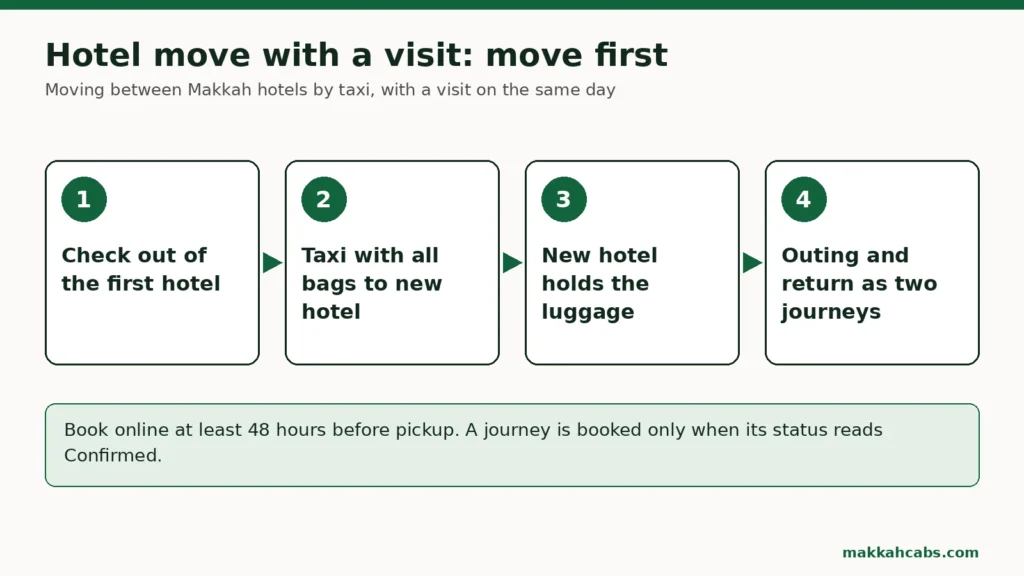
Sequence A: move first, visit from the new hotel
You check out, travel with all your luggage to the second hotel, leave the bags there (in your room if it is ready, or with the hotel’s agreement if not), and then take a separate outing from the new hotel and back.
This is usually the simplest to book. It is three journeys: old hotel to new hotel, new hotel to the visit, visit back to the new hotel. Each is an ordinary one-way journey. The heavy load travels only once, over the shortest distance.
It suits families whose second hotel will hold bags before check-in, and anyone who wants the move finished before the outing.
Sequence B: visit first, then move
You leave the luggage with the first hotel after check-out (with their agreement), go on the visit, come back to the first hotel, collect the bags and then move.
This is also three journeys: first hotel to the visit, visit back to the first hotel, first hotel to the second hotel. It suits a party whose second hotel cannot take bags early but whose first hotel will hold them. The drawback is that you return to the old hotel, then leave again, so the heavy part of the day comes last, when people are most tired.
Sequence C: visit first, collect bags on the way
A variation on Sequence B is a single journey from the visit to the second hotel with a stop at the first hotel to collect the luggage. The planner allows up to 8 stops in journey order, so the route itself can be built that way.
The question is what happens at that stop. A stop in a journey is a brief call on the way, not a period of waiting. Collecting several suitcases from a hotel’s luggage room can take longer than that. If you want this sequence, describe it in your booking note and ask the booking team to confirm in writing that the stop can include loading your bags. Our note on collecting bags after a Makkah visit explains how to make the collection visible in your request.
Sequence D: everything in one vehicle, bags on board
The fourth option is to check out, load all the bags, go to the visit with the luggage in the vehicle, and continue to the second hotel afterwards. It sounds efficient, but it means the car and your belongings wait for you throughout the visit.
That is a waiting arrangement, not a standard booking, and it has to be specifically agreed rather than assumed. The included waiting allowance, which varies by vehicle class, covers the ordinary minutes a party takes to reach the car at pickup, not the length of a visit. If you are considering it, read our note on whether a vehicle can stay with your group first. Even where a wait is agreed, do not leave passports, money, phones, medicines or anything of sentimental value in the vehicle; carry them with you.
Comparing the four sequences
| A: move first | B: visit first, return | C: visit first, collect on the way | D: bags on board | |
|---|---|---|---|---|
| Number of journeys | 3 | 3 | 2 (one with a stop) | Needs an agreed waiting arrangement |
| Who holds the bags during the visit | Second hotel | First hotel | First hotel | The vehicle |
| Heavy load travels | Once, at the start | Once, at the end | Once, at the end | Throughout the day |
| Main dependency | Second hotel accepts bags early | First hotel holds bags after check-out | Stop long enough to load bags, confirmed in writing | Waiting agreed in advance |
| Suits | Most families | Second hotel cannot take bags early | Parties wanting fewer journeys | Rare cases, after asking |
| Bookable yourself in the planner | Yes | Yes | Route yes; loading time to confirm | No, request it |
For most parties, Sequence A is the one to try first, and Sequence B the fallback. Sequences C and D need a conversation with the booking team before you pay.
A Makkah hotel change with luggage: choosing the vehicle
The vehicle for the hotel move is chosen for luggage, not for the short distance. Enter every passenger and every large bag in the search. Search results show only the vehicle classes that pass the capacity check for your party and luggage, so an honest count is the easiest way to avoid a car that cannot take everything.
For reference, examples of the classes offered (shown as class and example model “or similar”):
- Economy, such as a Toyota Camry class car: 4 seats, 2 large bags (3 in a Camry)
- Business and Executive: 4 seats, 3 large bags
- Hyundai Staria VIP van: 6 seats, 2 large bags
- Premium SUV, such as a Chevrolet Tahoe: 6 seats, 4 large bags
- GMC Yukon XL: 7 seats, 6 large bags
- Hyundai H1 family van: 7 seats, 6 large bags
- Toyota Hiace: 11 seats, 10 large bags
Our live capacity checks show how quickly luggage moves you up: four adults with four large cases see Premium SUV and larger only; five adults with five cases see seven-seat vehicles and larger only.
The outing on the same day is a different load. If the suitcases stay at a hotel, the visit may need only day bags, and a smaller class may fit. Search each journey with its own passengers and bags rather than copying the move-day numbers.
Timing the move around the hotels, not the clock
We do not quote journey times: in central Makkah they vary too widely by hour, season and day. Instead, build the day around the fixed points you already know.
- Start from the check-out time. Book the move, or the first journey of the day, so the whole party and all the bags are down and ready with a comfortable margin before check-out, not at the last minute.
- Allow for the lobby. Settling the bill, returning keys and bringing bags down in busy lifts can take longer than the drive itself.
- Leave a margin before the second check-in. If you arrive before your room is due, you will be waiting in a lobby with luggage unless the hotel has agreed to hold it.
- Keep the visit optional. If the morning runs late, it should be possible to drop the visit without upsetting the move.
If you realise in advance that a pickup time needs to change, you can use “Request a new pickup time” in your account for a paid booking before the pickup time. The request stays pending until the booking team approves it. An approved new time carries a £5 rescheduling fee, converted into your booking currency and added to the cash paid to the driver at pickup; a rejected request costs nothing. Only the time can be changed online. A different pickup hotel, destination, passenger count or vehicle needs the booking team, or a new booking plus a cancellation request.
Where the car meets you at each hotel
Each hotel on a move day has its own pickup or drop-off arrangements, and they may differ. Use the booking note at checkout to say which entrance or meeting place you intend to use at the first hotel, and describe the party and luggage so the driver knows what to look for. Share a live location from where you are standing once the driver’s name appears in your account.
At the second hotel, the drop-off is the destination you chose. If you want a particular entrance, say so in the note, but remember that where a car may stop near the Haram is managed on the day. Our article on restarting your visit plan after a move covers the next step: making sure later outings start from the new hotel rather than the old one.
Worked example: a move with a Hira visit
Saleem and Farah are travelling with Farah’s parents, Hanif and Rukhsana, both in their late sixties. They have spent four nights in a hotel near the Clock Tower and are moving to a hotel in the Jabal Omar area for three more. They also want to visit Hira Cultural District, at the foot of Mount Hira, which on our live route checks is about 13 km from the Clock Tower area, and about 11 km on the way back, because the road layout differs by direction.
What they check first. Farah reads both reservations. The first hotel’s check-out time is in the morning; the second hotel’s check-in time is in the afternoon. She emails both. The second hotel replies that it can hold bags for guests arriving before check-in. The first hotel says it can too, but that its luggage room is busy on weekend mornings.
What they choose. Sequence A. They will move first, leave the bags at the new hotel, then take an outing to Hira Cultural District from there.
What they book. Three journeys, all at least 48 hours ahead:
- First hotel to the new hotel: four adults, six large bags. The search shows seven-seat vehicles and larger; they choose a family van.
- New hotel to Hira Cultural District: four adults, day bags only. A smaller class appears, and they choose it.
- Hira Cultural District back to the new hotel, at a return time chosen with a generous margin.
Each journey meets the minimum booking value equivalent to £40 on its own. They pay, the bookings show as provisional, and within the 1 to 12 hours the booking team usually needs, all three read Confirmed.
On the day. Saleem brings the bags down early while the others finish breakfast. The van arrives, the bags go in, and the short drive is done well before lunch. The new hotel tags the luggage and holds it. The family rests in the lobby, then takes the outing. When they return, their room is ready and the bags are brought up.
What they avoided. They considered Sequence D, keeping the bags in one vehicle all day. Farah decided against it: it would have needed a waiting arrangement agreed in advance, and Rukhsana did not want her medicines and documents away from her during the visit.
If the plans change
Plans on a move day are more fragile than on an ordinary day, because two hotels are involved. Some points to keep in mind:
- If the second hotel changes, the destination of your move journey changes. That cannot be done online; contact the booking team first, because bookings are subject to our cancellation terms (free cancellation with a full refund up to 48 hours before pickup; inside 48 hours the deposit element of the price is kept) if you cancel.
- If the visit is dropped, you may no longer need the outing journeys. Speak to the booking team before cancelling anything, since customer cancellations are subject to our cancellation terms (free cancellation with a full refund up to 48 hours before pickup; inside 48 hours the deposit element of the price is kept). If we or our transport partner cancel, or cannot supply the journey, you receive a full refund for the affected journey. The cancellation and refund policy has the details.
- If the party size changes, the vehicle may no longer fit. Passenger numbers cannot be changed online.
For more on keeping a visit and a hotel commitment in step, see our note on fitting a visit around a hotel commitment. If your outing will finish somewhere other than your original hotel, our note on returning from a visit to another hotel explains how to set the destination correctly.
Moving-day checklist
- Read both hotel reservations and write down the check-out time at the first and the check-in time at the second.
- Ask each hotel whether it can hold bags, and when, and keep the reply.
- Choose a sequence: move first (A), visit first and return (B), collect bags on the way (C) or bags on board (D, only by agreement).
- Count every passenger and every large bag for the move, and search with those numbers.
- Search the outing separately with the day load only.
- Book every journey at least 48 hours ahead, and check that each reads Confirmed.
- Use the booking note to describe the pickup entrance, the party and any fallback meeting place.
- Keep passports, money, phones and medicines with you, never in a waiting vehicle.
- Bring the bags down early; the lobby often takes longer than the drive.
- If a time needs to change, request it in your account; for anything else, contact the booking team before cancelling.
To plan your own moving day, enter your first hotel and your new hotel in the Makkah Cabs planner with your full luggage count, then add the outing as its own journey.