
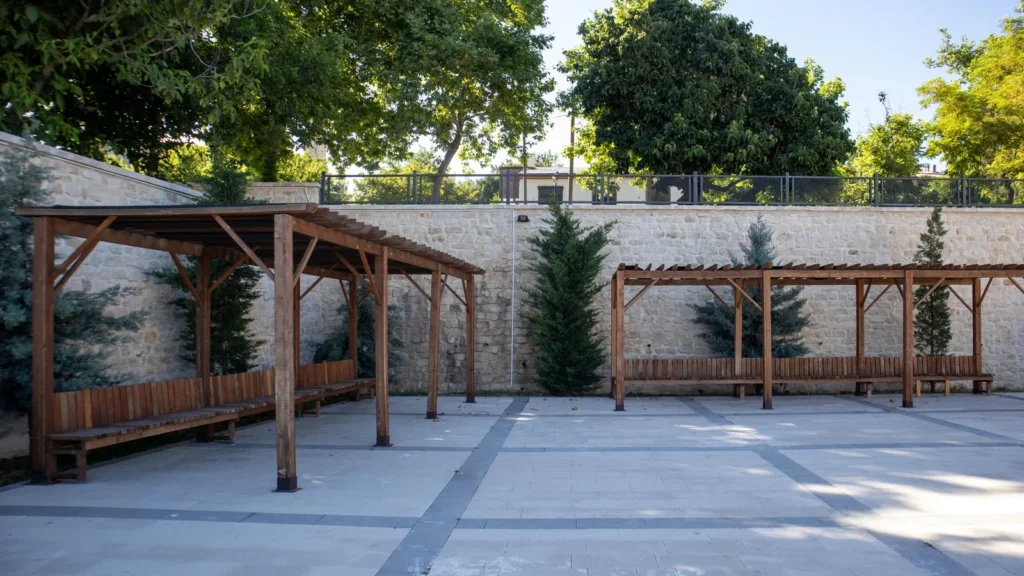
Food stops on a Makkah ziyarah work best when they are planned into the day as places and times, not added as a vague hope that the car will pull over somewhere. In practice that means one of three things: eating at a site that has its own cafés and restaurants, such as Hira Cultural District; ending one journey at a place to eat and booking a separate journey onwards; or eating at the hotel before or after the outing. Rest stops work the same way. A seated, shaded place at the site, chosen in advance, is far more reliable than expecting the vehicle to serve as a resting room.
This guide is for families and small groups doing ziyarah from a Makkah hotel, especially those travelling with older relatives, people who need regular meals with medication, or children who cannot go long without a snack. It covers how meals and rest affect the way you book journeys, what official sources say about food and seating at the main sites, how to plan rest for older pilgrims, and what we can and cannot promise about stopping on the way. It is practical planning advice only; questions about worship, fasting or the significance of any site belong with a qualified scholar and the official Nusuk guidance.
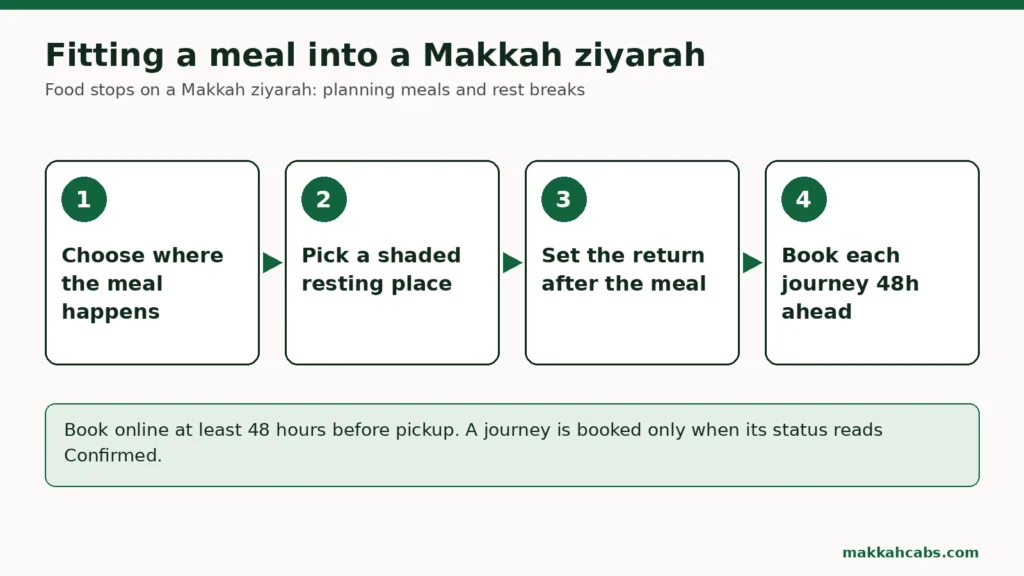
Why food stops on a Makkah ziyarah need planning
A ziyarah by taxi is built from journeys. Each journey has one pickup place, one destination and a pickup time in Saudi local time. You can add up to eight stops in journey order, but a stop is a point on the route, not a promise that the vehicle will wait there while the party eats. Waiting at a site is a separate question, and our guide on whether a Makkah taxi can wait during ziyarah explains why a there-and-back trip is usually two journeys.
So the useful question is not “can we stop for food?” but “where will we eat, and how does that change the journeys?” Once you answer that, the booking follows naturally.
There is a second reason to plan food stops on a Makkah ziyarah carefully. A hungry child or a tired grandparent changes the pace of the whole party. Families who plan a meal break during ziyarah tend to keep to their return time, because nobody is trying to squeeze in food at the last minute.
Three ways to fit a meal into the day
Eat at the site
Some sites have food on site. Hira Cultural District is the clearest example. Its official shops and services page lists cafés and restaurants inside the district, alongside shops that include a pharmacy and a supermarket. If you are visiting the district anyway, the simplest plan is to include the meal in the visit and set the return pickup after it.
This keeps the booking to two journeys: hotel to the site, and site to hotel. The only change is that the return time must allow for the meal as well as the visit.
End a journey at a place to eat
If the meal is somewhere else, such as a restaurant near another hotel or a relative’s hotel where you are joining family for lunch, treat it as a destination. Book the outward leg as hotel to site, then a separate journey from the site to the restaurant or hotel, and, if needed, a later journey back to your own hotel. Our note on ending a ziyarah at a different hotel covers how to name that destination precisely.
This structure gives the meal its own time without asking a driver to wait an unknown length.
Eat at the hotel, before or after
For short outings, the calmest plan is often a proper meal at the hotel before pickup, water and a snack during the outing, and a meal after the return. It suits families visiting a site with no known food on site, and it suits outings that fit between other commitments. Our guide to fitting a short ziyarah between commitments looks at working backwards from a fixed time.
Meal break during ziyarah: comparing the options
| Plan | How you book it | Suits | Watch out for |
|---|---|---|---|
| Meal at the site | Outward and return; return set after the meal | Hira Cultural District visits | Check what is open on your day |
| Meal at another place | Hotel to site; site to restaurant or hotel; later journey back if needed | Lunch with relatives, longer days | Each journey needs its own time and 48 hours’ notice |
| Meal at the hotel | Outward and return as normal | Short outings, older relatives | Carry water and snacks for the gap |
| “We will see on the day” | Nothing extra booked | Not recommended | A car cannot be booked online at short notice |
For most families, the first and third rows cover almost every outing. The second is useful when the meal is a social event in its own right.
What the main sites offer for food and rest
It is worth checking official sources for each place on your list, because some sites have plenty of facilities and others have little or nothing aimed at visitors.
Hira Cultural District
The district’s services and facilities page describes a visitor centre as the main hub for visitor services, and Hira Park as “a landscaped area within the district designed for rest and relaxation”, with shaded seating and greenery. It lists several cafés and restaurants. When we checked in September 2026, the district was listed as open 24 hours, with museums and exhibitions on set hours that differ on Fridays, when they opened in the afternoon. Cafés and shops may keep their own hours, so check on the day. Our guide to Hira Cultural District without the climb covers the visit itself.
Jabal Thawr Cultural District
Saudipedia’s entry on Jabal Thawr Cultural District describes a visitor reception centre and the Hijrah Exhibition, south of the Grand Mosque. We did not find official information on food there when we checked, so plan to eat before or after rather than relying on it.
Masjid Aisha (Al-Taneem) and outside views
Masjid Aisha, and mountains viewed from the roadside, are not places to plan a meal around. Treat them as short visits and put the meal at the hotel or at another destination.
Rest stops for elderly pilgrims
Rest stops for elderly pilgrims are about seating, shade and pace more than food. Many older relatives will already have walked a long way at the Haram in Makkah (Mecca) before any ziyarah, and a site visit on top of that can be more tiring than the family expects.
Choose the resting place before you arrive
At each site, decide where the older person will sit if they need a break. At Hira Cultural District, the shaded seating in Hira Park or a café table is an obvious choice. Agree it with the whole party, so that anyone who wanders off knows where to come back to.
Plan breaks by the clock, not by tiredness
Older relatives often say they are fine until they are not. A planned break every so often, whether or not anyone asks for it, is kinder than waiting for someone to admit they need to sit down.
The car is not a resting room
It is tempting to plan for a grandparent to rest in the vehicle while the others visit. We cannot promise that the car will stay at a site, or where it can stop, and a driver’s day often has other journeys in it. Plan a seated place at the site instead. If staying with the vehicle is essential, ask the booking team to confirm any waiting in writing before you pay.
Keep medicines and snacks with the person
Anyone who takes medication with food, or who needs to eat at regular times, should carry what they need in their own bag. Do not leave it with a relative who might be elsewhere in the site.
Our guide to ziyarah with elderly parents looks more widely at planning for different walking abilities.
Water, heat and timing
The Ministry of Health’s summer heat guidance advises drinking plenty of fluids without waiting to feel thirsty, avoiding sugary drinks, scheduling outdoor activities carefully and resting in shaded areas. It names older adults, infants and children among those at greater risk, and suggests consulting a doctor about the right amount of water for you.
For a ziyarah, that points to a few habits:
- carry water for everyone, and refill it where you can;
- plan outdoor parts of the visit for cooler hours;
- make the rest stop a shaded or indoor one;
- keep the meal break in the middle of the outing, not at the end when everyone is already tired.
Meal times also interact with prayer times and, in Ramadan, with the times people break their fast. Check prayer times on official sources, and take any question about worship or fasting to a qualified scholar. For transport, the practical point is to set pickup times that leave room for both.
Snacks, children and eating on the move
Not every break needs a meal. For many families, the most important food stops on a Makkah ziyarah are small ones: a drink after a walk in the sun, a snack for a child who has been patient through an exhibition, or something for a relative who needs to eat at set times.
What to carry
- water for every traveller, including those who say they are not thirsty;
- a simple snack for each child, packed so it does not spill;
- anything a diabetic or older relative needs between meals, carried by that person;
- wipes and a small bag for rubbish, so nothing is left behind in the vehicle or at the site.
Eating in the vehicle
Do not plan a meal in the car, and ask the booking team first if you are unsure what is acceptable. The driver may have other passengers after you, and a spilled drink on a seat helps nobody. If a passenger needs to eat something small during the ride for a medical reason, mention it in the booking notes so the driver is not surprised. For anything more than that, eat before you board or after you arrive.
Children who get hungry early
Children often need food sooner than adults expect, and a hungry child in an exhibition queue can end a visit early. It helps to give them a snack just before you go in, rather than waiting until they ask. If the family is planning food stops on a Makkah ziyarah with young children, put the meal earlier in the outing than you would for adults alone.
Setting up the journeys around a meal
Once you have chosen where to eat, the booking steps are the same as any outing.
- Pickup. Your hotel, from the planner’s popular locations or typed and checked in the route summary.
- Destination. The site, or the restaurant or hotel where the meal will be.
- Time. The pickup time in Saudi local time, at least 48 hours ahead.
- Passengers and bags. Everyone travelling, including children and infants, plus day bags, a cool bag if you carry one, and any pushchair or folding aid.
- Stops. Only real stops on the route, in order. If you want to collect a relative or drop someone at a hotel, a stop is right. A meal is usually better as a destination.
- Notes. A short line about the party, for example “two older passengers, one walks slowly; we will be eating at the district before the return”.
Each journey has a minimum booking value equivalent to £40. Payment secures a provisional request; the booking team updates the status, usually within 1 to 12 hours, and a journey is booked only when it reads Confirmed. Our guide to putting stops on a Makkah journey in the right order helps if your day has several.
Choosing the return time when the meal is at the site
The return time is where food plans usually go wrong. A family that books a return straight after the exhibition, then decides to eat, either rushes the meal or keeps the driver waiting.
Build the return time from three parts:
- the visit itself, based on what you plan to see;
- the meal, based on how your family eats, including ordering and a pause afterwards;
- a regrouping margin, so that everyone reaches the agreed pickup point together.
We do not quote visit or journey times, because they vary too much. Choose a return you are comfortable with, and if in doubt choose a later one: waiting in a café is easier than rushing an older relative. If the time needs to move after booking, use “Request a new pickup time” in your account before the pickup time. An approved new time carries a £5 rescheduling fee, converted into the booking currency and added to the cash paid to the driver at pickup. A rejected request costs nothing.
Worked example: the Qadri family’s afternoon with lunch
Idris and Mariam Qadri, both in their late sixties, are in Makkah with their daughter Samira and her son Bilal, who is nine. Idris takes medicine with meals and needs to eat at regular times. They want to see Hira Cultural District.
Choosing where to eat. Samira reads the district’s official pages and sees that it has cafés and restaurants and shaded seating in Hira Park. The family decides to visit the Revelation Exhibition first, then have lunch in the district, then rest in the park before going back.
Booking. Three days ahead, Samira searches the planner with three adults and one child, day bags only. She books the outward journey from the hotel to Hira Cultural District and a return from the district to the hotel. She sets the return time after the exhibition, lunch and a rest, with a margin. In the notes she writes: “Two older passengers, one walks slowly. We will eat at the district before the return.” Both journeys read Confirmed the same afternoon.
On the day. Idris carries his own medicine and a snack. After the exhibition, Mariam and Idris sit in the shade while Samira and Bilal order food. The family agrees that Samira is the only person who contacts the driver. They move to the agreed pickup point shortly before the return time.
What made it work. The meal was part of the plan from the start, the return time was built around it, and the resting place was chosen before anyone was tired.
When the day does not go to plan
- The café or restaurant is closed. Keep a fallback: a snack in your bag and a meal at the hotel. Our guide to a plan B when a ziyarah site is closed or busy shows how to keep an outing useful.
- Someone needs to leave early. A new journey cannot be booked online inside 48 hours. Decide in advance who would go back early and how.
- The meal becomes a separate outing. If a relative’s lunch becomes the main event, it may be better to split the day into two shorter trips. See our guide to two short Makkah ziyarah trips.
- Plans change after paying. Only the pickup time can be changed online. Place, destination, passengers or vehicle need the booking team, or a new booking plus a cancellation request. Bookings are subject to our cancellation terms (free cancellation with a full refund up to 48 hours before pickup; inside 48 hours the deposit element of the price is kept) if you cancel; if we or our transport partner cancel, or cannot supply the journey, you receive a full refund for the affected journey. See the cancellation and refund policy.
Food and rest checklist for a ziyarah
- List the sites and check each one’s official pages for food and seating.
- Decide where the meal happens: at the site, at another destination, or at the hotel.
- Choose a shaded or indoor resting place at each site for older relatives.
- Make sure anyone who takes medication with food carries it and a snack.
- Pack water for everyone and plan outdoor parts for cooler hours.
- Check prayer times on official sources and leave room for them.
- Book each journey at least 48 hours ahead, with the meal inside the return time.
- Add a short note about older passengers and the meal plan.
- Check that every journey reads Confirmed.
- Agree one transport contact and the return pickup point before you separate.
When you know where the meal and the rest will happen, choose your hotel and first site in the Makkah Cabs planner and set the return at a time that leaves room for both.