
A Hira visit with children and grandparents works best when you plan it as one shared outing with two or three smaller plans inside it, each with a named adult in charge. The grandparents might spend their time in the exhibitions and the shaded garden, the children need breaks, snacks and someone watching them, and perhaps one or two adults want to walk part of the path towards the Cave of Hira on Jabal al-Nour. All of that can fit into a single outward journey from your Makkah hotel to Hira Cultural District, as long as the return is decided before you leave and nobody is left minding everyone else by default.
This guide is for families travelling across three generations: parents organising the day, older relatives who walk slowly or tire in the heat, and children from babies to teenagers. It covers what the district offers each age group according to its official pages, how to divide responsibility so that no grandparent ends up as the only carer for lively children, how to set up the journeys and the vehicle, and how to choose between one return and two. It is practical transport and planning advice only. For anything about the religious meaning of the site or acts of worship there, speak to a qualified scholar and use the official Nusuk guidance.
Hira Cultural District and Jabal al-Nour in brief
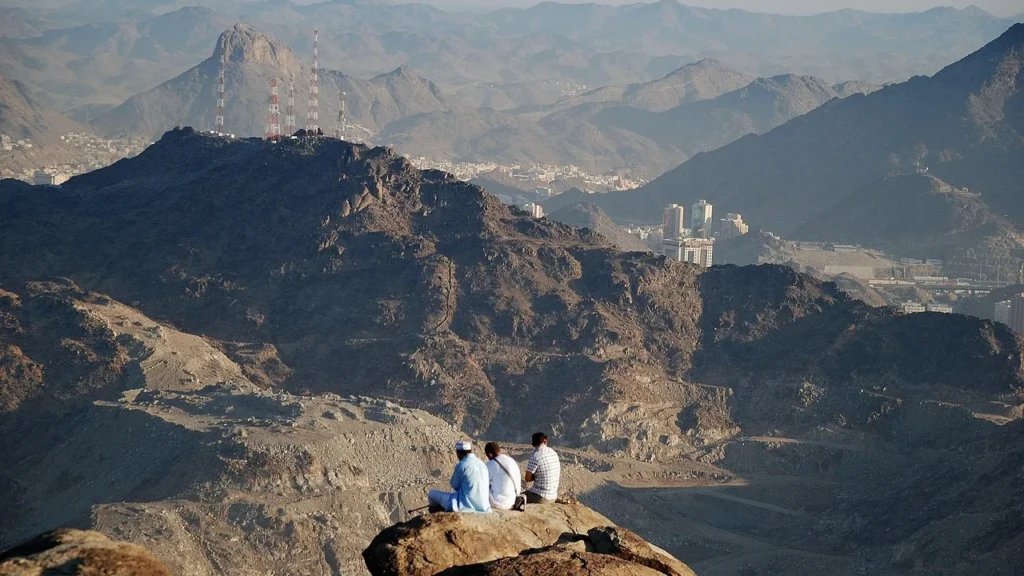
Saudipedia, the Saudi national encyclopaedia, places Jabal al-Nour about 4 km northeast of the Grand Mosque, rising to 642 m above sea level, with the Cave of Hira near the summit. It notes that the slope becomes steep partway up. Hira Cultural District sits at the foot of the mountain, and its official experiences page lists the Revelation Exhibition, the Holy Quran Museum and the path to the Cave of Hira, with a Saudi Coffee Museum and a cultural library marked as coming soon when we checked in September 2026.
For transport, the destination is the same whatever each person plans to do there: Hira Cultural District, which appears in the Makkah Cabs planner’s popular locations. On our live route check it was about 13 km by road from the Clock Tower area, and about 11 km on the way back, because the road layout differs by direction. Some people search for the mountain as Jabal Noor, Jabal an-Nur or Mount Hira; in the planner, choose the district rather than typing a mountain name.
What each generation can do at Hira
The main planning mistake on a Hira visit with children and older relatives is assuming everyone wants the same visit. It helps to look at the district through each person’s eyes before you talk about cars.
For grandparents and slower walkers
The district’s services and facilities page describes Hira Park as “a landscaped area within the district designed for rest and relaxation”, with shaded seating and greenery. The exhibitions and museum are indoor visits. There is a visitor centre, described as the main hub for visitor services, which is a sensible first stop to ask about the layout and anything a slower walker needs on the day.
For many older relatives, the meaningful part of the visit is seeing the mountain from below, sitting in the garden and taking in the exhibition at their own pace. That is a complete plan, and our guide to visiting Hira Cultural District without the climb covers it in detail.
For children
Children tend to do well with short blocks of activity and clear breaks. The same official page lists cafés and restaurants in the district, including ice cream outlets, and among the shops a pharmacy and a supermarket. That matters more than it sounds: a forgotten sun hat, plasters or a drink can often be dealt with on site rather than ending the outing early. Check what is open on the day rather than relying on a list.
Very young children are usually happiest with an exhibition visit kept short and time outside in the shade afterwards. Older children and teenagers may be genuinely interested in the museum displays, and some will want to join an adult on the path.
For adults who want to walk the path
The path to the Cave of Hira starts in the district. The official site lists the district and the path as open 24 hours. Saudipedia’s description of the steep upper section is reason enough to decide in advance who is walking, how far, and when they will turn back. We do not cover the climb itself here; our note on a one-way taxi to Jabal al-Nour looks at splitting a group between climbers and non-climbers.
The supervision map: who looks after whom
The single most useful thing a three-generation family can do is write down who is responsible for whom at each stage of the visit. We call this a supervision map. It takes five minutes and prevents the common failure where a parent sets off up the path and a grandparent is left with three children in the heat.
A simple supervision map has three columns: the stage of the day, each child or older relative, and the named adult responsible for them at that stage.
- Every child has one named adult at every stage. Not “the grandparents” or “whoever is around”, but one person.
- Every older relative who needs help has a companion. This might be the same adult who is watching a calm older child, but not the one chasing a toddler.
- Grandparents are not the default childminders. Some are delighted to take a grandchild to the garden. Others would rather rest. Ask them directly, and give them a way to change their mind.
- Climbers hand over before they leave. If a parent walks the path, their children are handed to a named adult in person, with the meeting place and time agreed.
When the map is done, it usually becomes clear whether the family can realistically split up at all. If it cannot, the answer is a shared visit with no climb, which is a perfectly good day.
Timing a Hira visit with children around the day
Timing affects the youngest and the oldest members of the party most. The Ministry of Health’s summer heat guidance names older adults, infants and children among the groups at greater risk, and advises scheduling outdoor activities carefully, resting in shaded areas and drinking fluids before you feel thirsty.
Three timing points matter for a family visit:
- Exhibition hours. When we checked, the official site gave museum and exhibition hours of 7:30 to 23:30 from Saturday to Wednesday, 7:30 to 01:00 on Thursday, and 15:30 to 01:00 on Friday. A Friday morning outing would reach the district before the exhibitions open. Check again before you book.
- Children’s routines. A nap, a meal time or an early bedtime is a fixed point in the day, just like an opening hour. Plan the return around it.
- Grandparents’ energy. Many older relatives also spend long hours at the Haram. An outing on a day they have already walked a great deal is harder than it looks on paper.
Journey times across Makkah vary widely, so we do not quote them. Leave a generous margin before anything fixed, such as a ticket time.
Setting up the journeys for three generations
A family visit to the district is normally at least two journeys: hotel to Hira Cultural District, and Hira Cultural District back to the hotel. The planner needs the pickup and destination of each journey to be different, so a there-and-back trip cannot be booked as one round trip.
Counting the party
Enter every traveller in the right box: adults, children and infants. Infants count, and their seat matters. Our note on counting passengers for a Makkah taxi explains how to enter a family accurately. Add the bags you will really carry: day bags, a pushchair, a folding wheelchair or walking frame. The planner shows only vehicle classes that pass the capacity check for the party and luggage you enter.
Child seats and mobility needs
Child seats (infant seat, child seat or booster) and a wheelchair requirement can be added in the search, and they are then confirmed for the vehicle. The Ministry of Health’s in-car child safety advice recommends keeping children properly restrained in the back seat. Seats take space, so a family that fits a vehicle on paper may need a larger class once two child seats are fitted. Our guide to a child seat in a Makkah taxi goes through the choices.
Notes that help the driver
Use the booking notes to describe the party in a sentence: for example, “Two grandparents, one walks slowly with a stick; three children, one in an infant seat; no climbing.” It tells the driver what to expect at pickup and helps everyone board calmly.
The booking rules
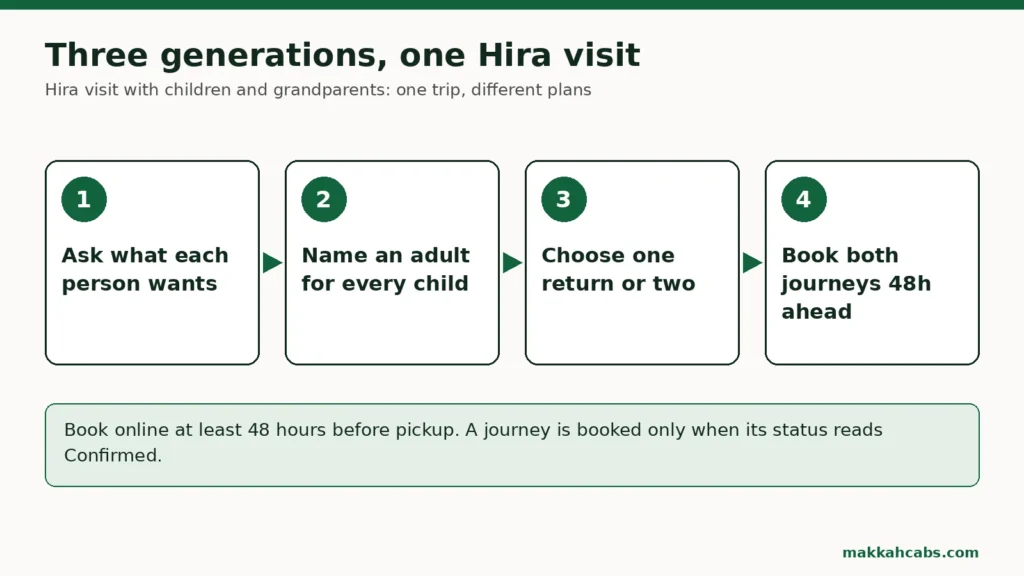
Every journey needs at least 48 hours’ notice before its pickup time, and each has a minimum booking value equivalent to £40. Payment secures a provisional request. The booking team updates the status, usually within 1 to 12 hours, and a journey is booked only when it reads Confirmed.
Family plans at Hira: one return or two
Most family plans at Hira come down to a single question: does everyone leave together, or do some leave earlier than others? The table sets out the usual options.
| Plan | What you book | Suits | Watch out for |
|---|---|---|---|
| Everyone together, no climb | Outward and one return, same passengers | Families with toddlers or frail grandparents | Return time must suit the most tired person |
| Everyone together, a short walk on the path for some | Outward and one return | Families where one or two adults want a brief walk | A firm turnaround time for walkers |
| Children and grandparents leave first | Outward for all; an earlier return for some; a later return for the rest | Families with a nap time or early bedtime | Two pickup times, two lead contacts, correct counts on each |
| Grandparents stay at the hotel | One journey for those going | Older relatives who would rather rest | Nobody should feel left out; ask, do not assume |
A smaller return party may fit a smaller vehicle class, so search each journey separately rather than copying the outward booking. If two returns are booked, each needs its own contact, its own passenger count and a clear note of who is on it. Our guide to group transport to Jabal al-Nour looks at running more than one vehicle for a larger party.
Jabal al-Nour with grandparents: what to decide in advance
Some grandparents have long wanted to see Jabal al-Nour, and for many the mountain itself, seen from the district, is the point of the visit. Planning a visit to Jabal al-Nour with grandparents is mostly about removing pressure.
Decide on the path before the day. If a grandparent “might try a little way”, plan the day as if they will not, with a comfortable alternative in the district. If they then feel well and want to walk a short distance with a companion, that is a bonus rather than a change to the transport.
Give them a companion, not a crowd. One adult who walks at their pace is better than the whole family waiting impatiently.
Plan a seated base. Agree one shaded seating area or café as the family base where grandparents can sit and where anyone who separates comes back to.
Keep their essentials with them. Medicines, water and a phone should travel with the grandparent, not in the bag of a parent who has gone up the path.
Our wider guide to a Makkah ziyarah with elderly parents covers walking abilities across several sites.
Worked example: the Malik family’s afternoon at Hira
Tariq and Noor are staying near the Clock Tower with their three children, Adam (12), Hana (7) and baby Zayd (8 months), and Tariq’s parents, Hamid and Safia, who are in their seventies. Hamid walks with a stick. Adam and Tariq want to walk part of the path; everyone else wants the Revelation Exhibition, the garden and something cold to drink.
The supervision map. At dinner three days ahead, the family writes it out. On arrival: everyone together at the visitor centre. Exhibition: Noor has Zayd and Hana; Safia walks with Hamid. Path: Tariq and Adam only, with a turnaround time. Garden: Noor with Zayd; Hana stays with her grandmother, who asked to have her. Regroup: everyone at the same shaded seating area at an agreed time.
The return decision. Zayd’s bedtime is fixed and Hamid tires by early evening, so one shared return suits everyone. Tariq and Adam agree they will turn back in good time to reach the seating area before the regroup.
Booking. More than 48 hours ahead, Noor searches the planner with four adults, two children and one infant, day bags and a folding pushchair, and adds an infant seat and a booster. She chooses a seven-seat class that appears in the results. She books the outward journey from the hotel and a return from Hira Cultural District to the hotel, with the return time set after the planned regroup plus a margin. In the notes she writes: “Three generations, one grandparent walks slowly with a stick, infant seat and booster needed.” Both journeys read Confirmed the same day.
On the day. Before anyone separates, Noor sends the family chat the regroup place and time. Tariq and Adam turn back at the agreed time. The family is sitting together before the return car is due, and Noor, the named transport contact, is the only person who speaks to the driver.
What made it work. Named adults for every child at every stage, a grandparent who chose to look after Hana, and a return time built around the baby’s bedtime rather than the climbers’ hopes.
When plans change on the day
Children get tired, grandparents feel unwell, and a teenager may want to stay longer. Decide in advance what you will do.
- If someone needs to leave early, it is safer to plan a separate earlier journey in advance than to hope for a car on the day. Online bookings need 48 hours’ notice, so a return decided at the district cannot be booked online for that day. Our note on one person leaving a Makkah visit early sets out the options.
- If the booked return time no longer suits, use “Request a new pickup time” in your account before the pickup time. An approved new time carries a £5 rescheduling fee, converted into the booking currency and added to the cash paid to the driver at pickup. A rejected request costs nothing.
- Other changes need the booking team. Only the pickup time can be changed online. A different pickup place, destination, passenger count or vehicle needs the booking team, or a new booking plus a cancellation request.
- Any cancellation refund follows our cancellation terms (free cancellation with a full refund up to 48 hours before pickup; inside 48 hours the deposit element of the price is kept). Bookings are subject to our cancellation terms (free cancellation with a full refund up to 48 hours before pickup; inside 48 hours the deposit element of the price is kept) if you cancel. If we or our transport partner cancel, or cannot supply the journey, you receive a full refund for the affected journey. See the cancellation and refund policy.
We cannot promise that a car will wait for the length of your visit or stop at a particular spot. Agree the return collection point before you go in, and our guide to the Hira Cultural District pickup point explains how to settle it.
What to pack for three generations
A Hira visit with children is easier when each group carries its own essentials rather than relying on one bag.
- For grandparents: medicines, water, a light layer for air-conditioned rooms, a phone with the regroup place saved, and any walking aid.
- For children: water, snacks, a sun hat, wipes, a spare set of clothes for the youngest, and a small activity for the ride.
- For babies: feeds, nappies and anything needed for the infant seat, since the seat itself is confirmed with the vehicle.
- For walkers: extra water, a charged phone and the agreed turnaround time.
- For the transport contact: both booking references, the driver’s details once assigned, and the pickup point written in words.
Leave passports and valuables you do not need in the hotel safe.
Hira visit with children: your planning checklist
- Ask each person what they want from the visit, including the grandparents and older children.
- Draw up a supervision map: one named adult for every child and every older relative who needs help, at every stage.
- Decide who, if anyone, walks the path, with a firm turnaround time.
- Check the official site for exhibition hours on your day, especially a Friday.
- Choose one return or two, based on naps, bedtimes and the most tired person.
- Search the planner with every adult, child and infant, the day bags and any pushchair or walking aid.
- Add child seats and any wheelchair requirement in the search.
- Book every journey at least 48 hours ahead and check each reads Confirmed.
- Name one transport contact and agree the return pickup point before anyone goes in.
- Agree a shaded regroup place and a regroup time with a margin before the return.
When the family plan is clear, choose your hotel and Hira Cultural District in the Makkah Cabs planner, add the return at the time that suits your youngest and oldest travellers, and book at least 48 hours ahead.