
Group transport to Jabal al-Nour is simplest when the whole group travels to one destination, Hira Cultural District at the foot of the mountain, in the fewest vehicles that genuinely fit everyone and their bags, with one group leader, a written passenger list and a named meeting point inside the district for the return. For about eight to eleven people that usually means a Toyota Hiace class van; for up to nineteen, a Toyota Coaster class minibus; beyond that, a coach or a combination of vehicles. The vehicle is the easy part. What makes a group visit work is the headcount, the meeting point and one return time that everyone keeps.
This guide is for organised groups visiting Jabal al-Nour from Makkah hotels: an Umrah group that has some free time, a study circle or mosque group travelling together, friends who met on the trip, or an extended family large enough to behave like a group. It covers choosing between vans, a minibus and a coach, how to book and pay for a group, how to gather people at the hotel, how to choose a meeting point at Hira, and what happens when some members want to climb and others do not. It is about transport and organisation only. For the religious significance of the site or any act of worship, speak to a qualified scholar and use the official Nusuk guidance.
Where the group is going
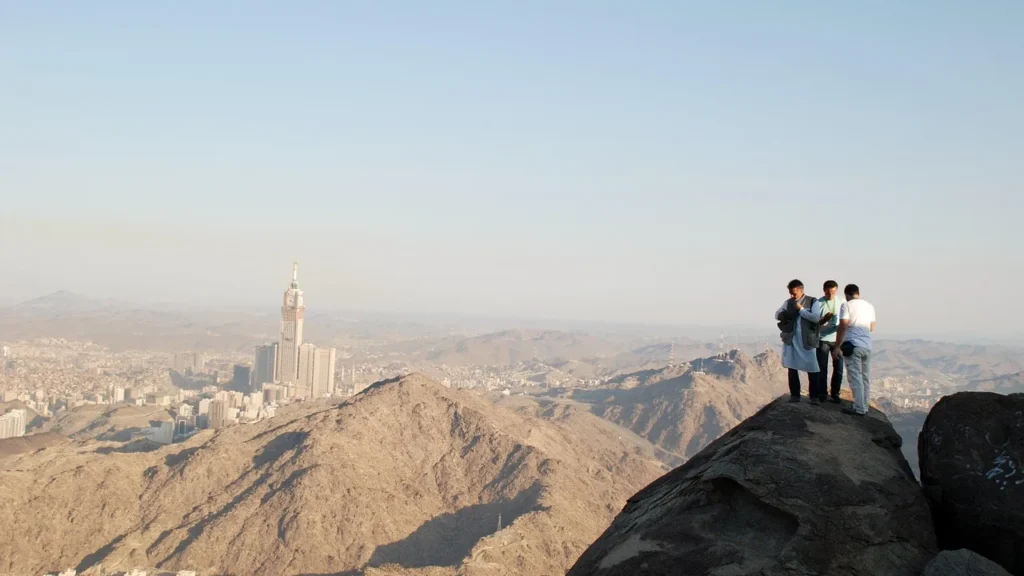
Saudipedia describes Jabal al-Nour as lying about 4 km northeast of the Grand Mosque, rising to 642 m above sea level, with the Cave of Hira near the summit and a slope that becomes steep partway up. Hira Cultural District sits at its foot. The district’s official experiences page lists the Revelation Exhibition, the Holy Quran Museum and the path to the Cave of Hira, which begins in the district. When we checked in September 2026 it gave the district and the path as open 24 hours, with the museums and exhibitions on set hours: 7:30 to 23:30 from Saturday to Wednesday, 7:30 to 01:00 on Thursday, and 15:30 to 01:00 on Friday.
For group transport, the destination to book is Hira Cultural District, which appears in the Makkah Cabs planner’s popular locations. On our live route check it was about 13 km by road from the Clock Tower area, and about 11 km on the way back. Group members may know the mountain as Jabal Noor, Jabal an-Nur or Mount Hira; use one name in all group messages so nobody is confused.
Choosing vehicles for a group
The planner shows vehicles as a class with an example model “or similar”, and it shows only the classes that pass the capacity check for the passengers and bags you enter. For a group day out, the bags are usually small, but a folding wheelchair, a pushchair or a box of water for the group all take space.
| Group size | Usual options | Seats and large bags per vehicle | Things to weigh |
|---|---|---|---|
| 7 or fewer | GMC Yukon XL class, or Hyundai H1 family van | 7 seats, 6 large bags | One vehicle, simple to manage |
| 8 to 11 | Toyota Hiace class | 11 seats, 10 large bags | One van keeps the group together |
| 12 to 19 | Toyota Coaster class minibus | 19 seats, 11 large bags | One minibus, one driver, one return |
| 20 to 53 | Coach, or a minibus plus vans | Coach 53 seats | One coach is one arrival; several vehicles give flexibility |
| Very large groups | Several coaches or minibuses | As above | Each vehicle needs its own leader and list |
A group that fits on paper may not fit comfortably once mobility aids, child seats or bags are added, so enter everything. Our guide to choosing a vehicle class for a Makkah outing explains the classes in more detail.
Minibus to Hira or several smaller vehicles?
For groups between about twelve and nineteen people, the main decision is whether to book one minibus to Hira or two smaller vans. Each approach suits a different kind of group.
When one minibus works best
- The group intends to arrive together, visit together and leave together.
- There is one natural leader who can manage the whole list.
- Nobody needs to leave early.
One vehicle means one arrival, one pickup and one conversation with one driver. It is easier to count people on and off, and nobody wonders which van someone is in.
When two or more vehicles work better
- Part of the group wants to climb and part does not, so they will leave at different times.
- The group is two natural halves, such as two families or two study circles, each with its own leader.
- Some members are staying at a different hotel.
Our guide to two vehicles for one Makkah outing looks at the trade-offs in detail. The key rule is simple: every vehicle is its own journey, with its own passenger count, its own contact and its own list.
Booking group transport to Jabal al-Nour
Journeys, not a round trip
The planner needs a different pickup and destination for each journey, so a visit is at least two journeys: hotel to Hira Cultural District, and Hira Cultural District back to the hotel. If you use several vehicles, each vehicle’s outward and return are separate journeys too.
Passengers and the group leader
Enter every traveller as adults, children or infants, and the bags they will carry. At checkout the customer’s mobile number is required. If you are booking for someone else, the traveller’s name, the traveller’s phone and an emergency contact are required, and there is an optional group leader phone field. For a group, use that field: it puts the person actually standing with the group on the day where the booking team and driver can find them.
One payer, a clear review
Makkah Cabs takes full payment online. For groups that pool money, the basket can email a secure review link so that another person, such as a group treasurer or a second organiser, can check the journeys before one person pays. Each journey has a minimum booking value equivalent to £40.
Notice and confirmation
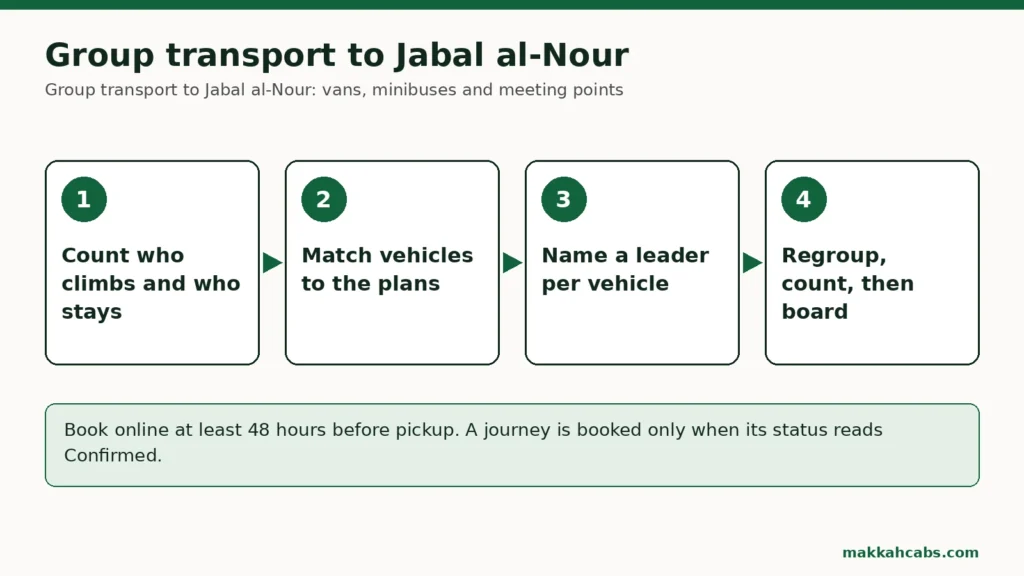
Every journey needs at least 48 hours’ notice before its pickup time. Payment secures a provisional request. The booking team updates the status, usually within 1 to 12 hours, and a journey is booked only when it reads Confirmed. For a large group, check that every journey in the basket has reached Confirmed, not just the first.
The group leader’s passenger sheet
Every vehicle in a group booking should have a one-page sheet held by its leader. It can live on a phone, but a printed copy helps when a battery runs low. It is the most useful single document in group transport to Jabal al-Nour, because it turns a crowd into a list.
A good sheet includes:
- the booking reference, the vehicle class and the pickup time for the outward and return journeys;
- the names of everyone on that vehicle, numbered, with a mobile number for each adult;
- which people are climbing and which are staying in the district;
- anyone who needs help boarding, a seat near the door, or a mobility aid loaded;
- the regroup place, the regroup time and the agreed vehicle pickup point;
- the driver’s name and vehicle registration, added once the driver-assigned email arrives.
Numbering the list matters. Calling out “one” to “nineteen” as people board is faster and more reliable than reading names aloud, and it shows at once who is missing.
Tickets, guides and other people in the vehicles
Group transport is only one of the things a leader is holding. Two others affect the vehicles directly.
Exhibition tickets
If the group is visiting the Revelation Exhibition or the museum, check the district’s official site for tickets and any entry time before you set the outward pickup time. Buying tickets and booking transport are separate confirmations, and a change to one does not change the other. Our guide to Hira Cultural District tickets and your taxi explains how to line the two up.
A licensed guide
Some groups bring a guide. A guide travelling with the group takes a seat, so include them in the passenger count for every journey they will be on. The driver’s job is the journey, not guiding. Our note on the difference between a Makkah driver and a licensed guide sets out who does what.
Gathering the group at the hotel
Groups lose more time at the start than anywhere else. A minibus cannot leave until the last person arrives, and a group spread across hotel lifts, breakfast and prayer can take a long time to assemble.
Four habits help:
- Set a gathering time before the pickup time. Tell the group to be in the lobby, or at an agreed place, well before the car is due.
- Use one named gathering place. A specific seating area in the lobby is better than “downstairs”.
- Count in, not out. The leader ticks names as people arrive, rather than asking who is missing.
- Agree the kerbside plan. Where a van, minibus or coach can stop at a hotel is managed on the day, so we cannot promise the entrance. Our guide to a Makkah hotel pickup point explains how to agree a meeting place and share a live location.
Meeting point for a group at Hira
A meeting point for a group at Hira has two jobs: bringing people back together inside the district, and getting everyone to the vehicle on time. It helps to treat them as two separate places.
The regroup place inside the district
Choose somewhere in the district that is easy to name and find, has shade or seating, and is away from the road. The district’s services include a visitor centre, described by the official site as the main hub for visitor services, and Hira Park, with shaded seating. Either can serve as a regroup place if the group agrees on a specific spot. Announce it before anyone separates, and repeat it in the group chat.
The vehicle pickup point
The place where a minibus or coach can collect a group is not necessarily the closest exit. It is managed on the day, and we cannot promise a particular spot. Agree the pickup point with the driver once assigned, describe it in words and with a live location, and walk the group from the regroup place to the pickup point together. Our guide to the Hira Cultural District pickup point goes through this step by step.
The group return time
Work backwards from the return pickup: the time to walk from the regroup place to the vehicle, the time to count everyone, and a margin. Then announce one regroup time and hold to it. Our note on setting one group return deadline explains how to make it stick.
Climbers and non-climbers in one group
In most groups, a few people want to walk the path towards the Cave of Hira and most do not. The group leader should know which is which before booking, because it changes the returns.
- Everyone returns together. The climbers agree a firm turnaround time that brings them back to the regroup place before the group return. This works for short walks, not for anyone who wants to reach the top without watching the clock.
- Two returns. One vehicle takes the non-climbers back at a set time; a second, booked separately, collects the climbers later. Each has its own list and contact.
- Climbers make their own way back. The climbers are not included in a booked return. This only suits confident adults with a real alternative.
The Pilgrim Experience Program reported in January 2026 that a new Makkah Bus route gives direct access to Hira Cultural District, as part of the transport system overseen by the Royal Commission for Makkah City and Holy Sites. For fit adults travelling light it may be a reasonable way back; check the current route and stops on official channels, and do not make it the plan for older or less mobile members. Our guide to a one-way taxi to Jabal al-Nour covers splitting a group between those who climb and those who return.
Heat, pace and the slowest member
Group transport to Jabal al-Nour moves at the speed of the slowest member, and in Makkah (Mecca) the heat slows everyone. The Ministry of Health’s summer heat guidance advises drinking plenty of fluids without waiting to feel thirsty, scheduling outdoor activities carefully and resting in shaded areas, and names older adults among those at greater risk. For a group leader that means planning outdoor parts for cooler hours, carrying water for the group, and choosing a regroup place in the shade.
Put anyone with limited mobility near the door of the vehicle, and let them board first on the way back. A group that waits for one person at the kerb is better than one person struggling to keep up.
Worked example: a study circle of twenty-four
Farida leads a study circle of twenty-four women, most in their fifties and sixties, staying at two neighbouring hotels near the Clock Tower. Six want to walk part of the path; eighteen want the exhibition and the museum. Two use walking sticks and one brings a folding wheelchair.
Choosing vehicles. A coach would carry everyone, but the climbers will finish later. Farida books a Toyota Coaster class minibus for the eighteen, with the wheelchair entered, and a seven-seat vehicle for the six climbers.
Booking. Four days ahead, she books four journeys: the minibus outward and return, and the seven-seater outward and a later return. She puts the name and phone of Rukhsana, her co-leader, as group leader on the climbers’ journeys, and her own number on the minibus journeys. Before paying, she emails the secure review link to the circle’s treasurer. All four journeys read Confirmed the next morning.
On the day. Everyone gathers in one hotel lobby at a set time, and Farida ticks names. At the district she announces the regroup place for the eighteen, a shaded seating area, and the time. Rukhsana’s six agree a turnaround time on the path. The minibus leaves with eighteen names ticked; Rukhsana’s group returns later in their own vehicle.
What made it work. Two vehicles matched to two plans, one leader per vehicle, and a written list for each.
Changes after booking
- Time only online. Use “Request a new pickup time” in your account before the pickup time. An approved new time carries a £5 rescheduling fee, converted into the booking currency and added to the cash paid to the driver at pickup; a rejected request costs nothing.
- Other changes need the booking team. Only the time can be changed online. Pickup place, destination, passenger numbers and vehicle need the booking team, or a new booking plus a cancellation request.
- Cancellations. Bookings are subject to our cancellation terms (free cancellation with a full refund up to 48 hours before pickup; inside 48 hours the deposit element of the price is kept) if you cancel. If we or our transport partner cancel, or cannot supply the journey, you receive a full refund for the affected journey. See the cancellation and refund policy.
Group leader checklist
- Confirm who is coming, and who wants to climb, before choosing vehicles.
- Choose the fewest vehicles that genuinely fit people, aids and bags.
- Name one leader for each vehicle and put their number in the group leader field.
- Book every outward and return journey at least 48 hours ahead.
- Send the secure review link to a second organiser before paying.
- Check that every journey reads Confirmed.
- Set a hotel gathering time before the pickup time, and count people in.
- Announce the regroup place inside the district and the regroup time.
- Agree the vehicle pickup point with each driver and share a live location.
- Count everyone onto each vehicle against its own list before leaving.
When the list and the vehicles are settled, choose your hotel and Hira Cultural District in the Makkah Cabs planner, enter every traveller, and book group transport to Jabal al-Nour at least 48 hours ahead.