
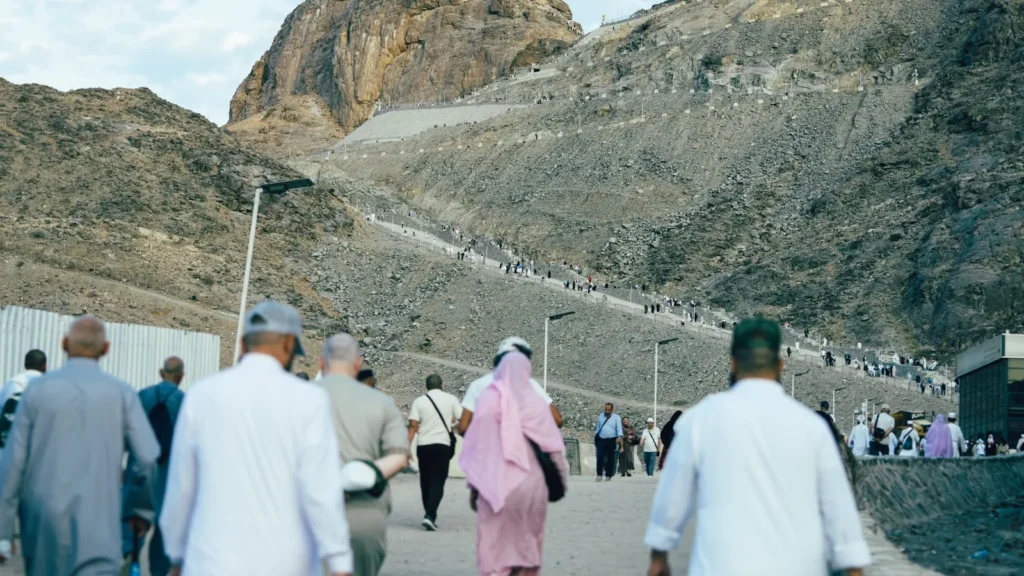
A one-way taxi to Jabal al-Nour makes sense when the way back is already settled some other way: a later journey booked separately, a relative collecting you, public transport you have checked, or part of the group staying on while the rest go back. In the Makkah Cabs planner, the place to book is Hira Cultural District, at the foot of the mountain, where the official path towards the Cave of Hira begins. What does not work is going one way and hoping to sort out the return on the day, because every online booking needs at least 48 hours’ notice.
This guide is for families and groups where not everyone wants the same thing from a visit to the mountain: some want to climb, some want the exhibitions below, some want to go back early, and some have other plans afterwards. It covers when a one-way journey is the right booking, how to split a group between those who climb and those who return, how to count passengers on each journey, the heat and safety points worth planning for, and what to do if you have already booked a return you may not need. For a visit that stays in the district without climbing, see our guide to Hira Cultural District by taxi.
Jabal al-Nour and Hira Cultural District: where you are going
Saudipedia’s entry on Jabal al-Nour places the mountain northeast of the Grand Mosque, about 4 km away, rising to 642 m above sea level. It describes the Cave of Hira as a narrow cave that fits only up to five people, and notes that the slope becomes steep partway up. Saudipedia’s entry on Hira Cultural District describes a paved path from the base as the only route to the cave, with information signs and rest stops.
Hira Cultural District sits at the foot of the mountain. Its official experiences page lists the Revelation Exhibition, the Holy Quran Museum and a path “that begins in the district and leads to the site of the first revelation”. It gives the district and the path as open 24 hours, with separate hours for the museums and exhibitions.
For transport, that means one practical thing: whether your party is climbing, visiting the exhibitions or both, the drop-off is the district. Hira Cultural District appears in the Makkah Cabs planner’s popular locations, so you do not need to search for the mountain under other spellings such as Jabal Noor or Jabal an-Nur. On our live route check, the district was about 13 km by road from the Clock Tower area.
This guide covers the transport, not the climb in detail or its religious significance. For anything about acts of worship or the standing of a visit, speak to a qualified scholar and use the official Nusuk platform.
When a one-way taxi to Jabal al-Nour is the right booking
A return journey is the default for most families, because it gives a fixed time and a known car. A one-way booking is better when a fixed return time would be a guess, or when the way back is genuinely covered by something else.
Situations where one-way fits
- Climbers who cannot predict their finish. People climb at very different speeds, stop to rest and may spend time at the top. A booked return at a set time can leave climbers rushing or a car waiting.
- A separate onward plan. The party is going on to another place afterwards, such as a relative’s hotel or another visit, and that journey is booked on its own.
- Someone else collecting. A relative with their own car, or a group organiser, will collect the party.
- Public transport back. The party is comfortable using the Makkah Bus and has checked the current service.
- Part of the group returning, part staying. The group arrives together and leaves separately, which usually means one shared outward journey and a return for only some of the party.
Situations where one-way is a poor choice
- older relatives, young children or anyone who would struggle if the return took longer to arrange than expected;
- late visits, when fewer options may be practical;
- any plan where the way back is “we will find something”.
Evening plans deserve a second look. The official site lists the path as open 24 hours, and some visitors prefer to climb after dark to avoid the heat. A one-way journey in the evening means the way back happens at night, when a tired party is less keen to experiment. If the return falls after midnight, remember that any journey you book for it carries the next calendar date.
Jabal al-Nour without a return booking: what you give up
Going to Jabal al-Nour without a return booking is a trade, and a one-way taxi to Jabal al-Nour is only as good as the plan for getting back. You gain flexibility over when you leave. You give up the certainty of a set time and a vehicle that is already arranged.
Three points make that trade sharper than it first looks.
You cannot book a return on the spot. Every Makkah Cabs journey needs at least 48 hours’ notice before its pickup time. A return you decide you want once you are at the district cannot be booked online for that day.
Do not assume a car will be available. We cannot promise that other vehicles will be free or able to stop near the district at the moment you finish, and neither should your plan.
The return has to work for the most tired person. After a climb in heat, even fit adults may not want to wait long or walk far.
If none of the alternatives are firm, a booked return at a generous time is usually safer than no return at all. Our guide to agreeing a return arrangement sets out what that return should cover. If the finish time is the only worry, you can later ask to move the pickup time, which is covered below.
Booking a one-way taxi to Jabal al-Nour step by step
Booking a one-way taxi to Jabal al-Nour is the same as booking any single journey. The care goes into what you enter.
- Pickup. Your hotel, chosen from the planner’s popular locations or typed and checked in the route summary.
- Destination. Hira Cultural District, from the popular locations list under Makkah.
- Date and time. The pickup time at your hotel, in Saudi local time. It must be at least 48 hours ahead.
- Passengers and bags. Everyone travelling to the district, including children and infants, and whatever they carry: day bags, a pushchair, a folding wheelchair.
- Needs. Any child seat or wheelchair requirement, added in the search so it is confirmed for the vehicle.
- Notes. A short line saying the party is going one way and how many people are climbing, so nobody expects a return that does not exist.
Each journey has a minimum booking value equivalent to £40. Payment secures a provisional request; the booking team updates the status, usually within 1 to 12 hours, and the journey is booked only when it reads Confirmed.
Going on somewhere else after the mountain
Some parties go one way to Jabal al-Nour because the day continues elsewhere: lunch with relatives at another hotel, a second visit, or a hotel move. In that case the “return” is really a new journey from the district to a different destination, and it can be booked now, just like any other journey, at least 48 hours ahead.
The difference from a simple return is that the destination is not where you started. Enter the exact place, check it in the route summary and count only the people making that trip. If one person is leaving before everyone else, our note on one person leaving a Makkah visit early covers how to plan their separate journey.
Comparing the ways to handle the return
| Plan | What you book | Suits | Watch out for |
|---|---|---|---|
| Outward and return, everyone together | Two journeys, same passengers | Families staying together, with or without a climb | Return time must suit the slowest person |
| Shared outward, return for some | Outward for all; return for those going back early | Groups where some climb and some do not | Climbers need their own plan back |
| Shared outward, two returns | Outward for all; two returns at different times | Mixed groups who all want a car back | Two pickup points and two lead contacts |
| One-way, later journey elsewhere | Outward; a separate journey from the district to another destination | Parties going on to a relative or another visit | Book the later journey at least 48 hours ahead |
| One-way, own way back | Outward only | Confident adults with a checked alternative | No booked car if the alternative falls through |
For most split groups, the second and third rows are the useful ones, and they depend on getting the passenger count right for each journey.
Splitting the group at Hira
Splitting the group at Hira works when everyone knows, before arriving, who is going where and how each person gets back. The mistake to avoid is deciding at the foot of the path.
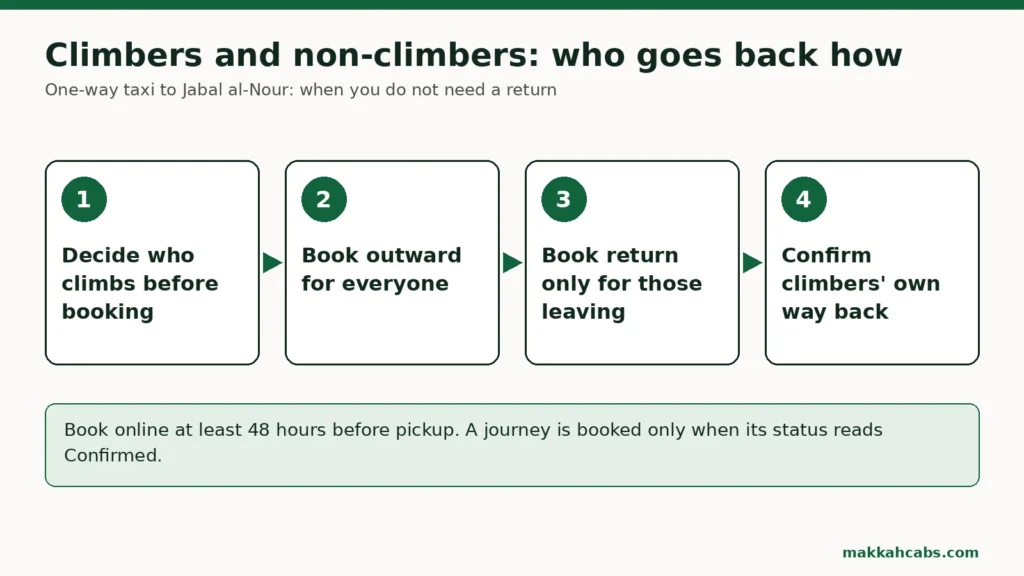
Decide who climbs before you book
Ask each adult directly whether they intend to climb. Children should go with the adults responsible for them. An older relative who “might try a little way” should be planned as not climbing, with a pleasant alternative in the district, so they are never left without a way back.
Count passengers journey by journey
Each journey is booked with its own passengers: adults, children and infants, plus bags. The planner shows only vehicle classes that pass the capacity check for what you enter. So:
- the outward journey counts everyone travelling to the district;
- a return for the non-climbers counts only them;
- a later return for the climbers, if booked, counts only them.
A smaller return party may fit a smaller vehicle class, so search each journey separately rather than copying the outward booking. Our note on counting everyone joining a Makkah visit explains how children and infants are entered.
Give each group a lead
Each part of the group needs one adult who holds its booking details and makes contact with its driver. If the climbers have no booked return, their lead is the person responsible for their own way back. Our note on taking two vehicles to Hira covers how two leads keep separate journeys straight.
Agree the meeting points
The non-climbers need a collection point for their return, agreed before the climbers set off. If the groups intend to meet again later, at the hotel or elsewhere, agree that too.
Climbing safely in Makkah’s heat
A climb in Makkah is hard work in most months. The Ministry of Health’s heat exhaustion advice lists heavy sweating, cool and pale skin, nausea or vomiting, muscle spasms, tiredness or weakness, dizziness or fainting, headache and a weak pulse among the symptoms. Its first-aid steps include moving the person to a cool place, loosening their clothes, applying cold compresses to the neck or armpits, spraying the body with water and encouraging them to drink cold water, and it advises seeking medical care if they vomit, symptoms are severe or symptoms last more than an hour.
For planning, that points to a few habits:
- climb at a cooler time of day where you can;
- carry more water than you think you need;
- agree a turnaround time, and keep to it;
- do not climb alone, and keep a charged phone with you;
- let the non-climbers wait indoors, in the exhibitions or a café, rather than outside.
These are not transport rules, but they affect transport: a climber who turns back early may want to join the non-climbers’ return, and that is much easier if the return is at a sensible time and has room.
If you have already booked a return
Sometimes the plan changes after the return is paid for. A climber decides to go, or a relative offers a lift. Think before cancelling.
Any cancellation refund follows our cancellation terms (free cancellation with a full refund up to 48 hours before pickup; inside 48 hours the deposit element of the price is kept). Makkah Cabs bookings are subject to our cancellation terms (free cancellation with a full refund up to 48 hours before pickup; inside 48 hours the deposit element of the price is kept) if you cancel. If we or our transport partner cancel, or cannot supply the journey, you receive a full refund for the affected journey. The cancellation and refund policy sets this out.
Moving the time is often better. If the issue is that the return is too early for the climbers, use “Request a new pickup time” in your account before the current pickup time. An approved new time carries a £5 rescheduling fee, converted into your booking currency and added to the cash paid to the driver at pickup; a rejected request costs nothing.
Other changes need the booking team. Only the pickup time can be changed online. A different pickup place, destination, passenger count or vehicle needs the booking team, or a new booking plus a cancellation request. Our earlier note on a Makkah visit ending at a different hotel covers the case where the return should go somewhere else.
Public transport as the way back
The Pilgrim Experience Program reported in January 2026 that a Makkah Bus route links the Grand Mosque to Hira Cultural District, operating under the Royal Commission for Makkah City and Holy Sites. For fit adults travelling light, it can be a reasonable way back after a climb. Check the current route and stop details on official channels before relying on it, and do not make it the only plan for older relatives or young children.
Worked example: two climbers, four going back
Omar, his brother Bilal, Omar’s wife Aisha, their daughter Maryam, who is eight, and Omar’s parents, Yunus and Khadija, are staying near the Clock Tower. Omar and Bilal want to climb Jabal al-Nour. The others want the Revelation Exhibition and tea in the district, then a rest at the hotel.
Deciding before booking. At dinner two nights ahead, the family agrees: everyone goes together; the brothers climb; the other four visit the exhibition and return to the hotel by car; the brothers make their own way back later.
The outward journey. Aisha books hotel to Hira Cultural District for six passengers, five adults and one child, with day bags. The search shows vehicle classes with room for six, and she chooses one.
The return for four. She books a separate journey from Hira Cultural District back to the hotel for four passengers, three adults and one child, at a time that suits Yunus and Khadija after the exhibition and tea. Because the party is smaller, she searches again and chooses a class that fits four.
The climbers’ plan. Omar checks the Makkah Bus details on official channels and agrees with Bilal a turnaround time on the climb. Aisha writes in the family chat: “Omar and Bilal: own way back, message when leaving the district.”
On the day. Everyone arrives together. Before the brothers set off, the family agrees where the return car will collect Aisha’s group. Both journeys had read Confirmed two days earlier. The return leaves on time with four passengers; the brothers reach the hotel later on the bus.
What made it work. The split was decided at dinner, not at the foot of the path, and each journey had its own correct passenger count.
Your one-way checklist
- Decide, as a group, who is climbing and who is not, before you book.
- Write down how each person gets back: booked return, later journey, relative, or bus.
- Book the outward journey to Hira Cultural District at least 48 hours ahead, counting everyone.
- Book a return for anyone who needs one, counting only those passengers.
- If climbers are going one way, check their alternative is real, not hoped for.
- Give each group a lead with its own booking details.
- Agree the return collection point before the climbers set off.
- Plan the climb around heat: timing, water, a turnaround time and a charged phone.
- If a paid return no longer fits, consider moving its time before cancelling it.
To set up the outward journey, and a return for anyone who needs one, choose your hotel and Hira Cultural District in the Makkah Cabs planner.