
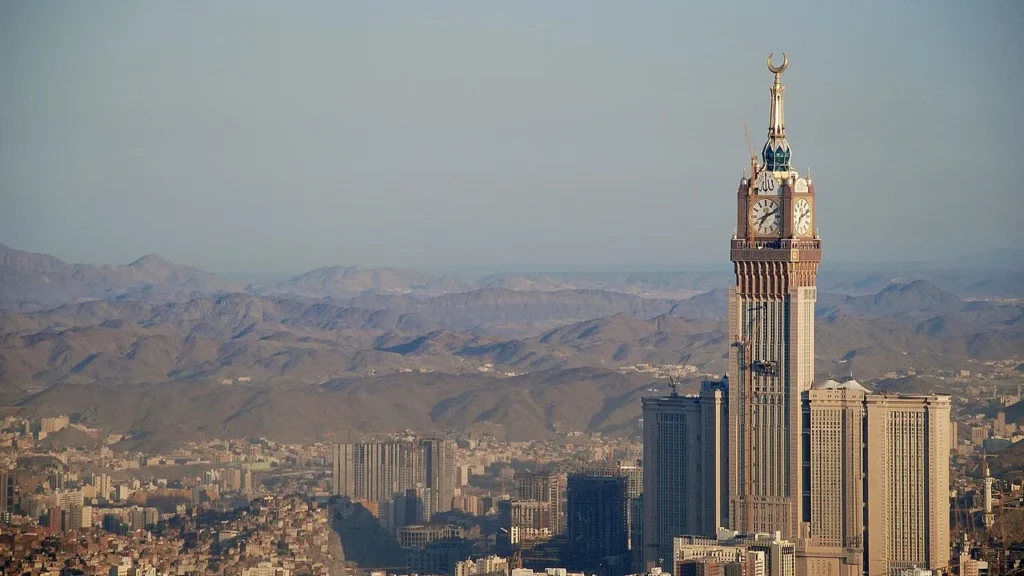
The Makkah viewpoints that work for visitors fall into three kinds: the skyline seen from above, which in practice means a high building next to the Grand Mosque such as the Clock Royal Tower; the historic mountains seen from below, from the cultural districts built at their foot, such as Hira Cultural District facing Jabal al-Nour; and the view from a summit, which only comes with a climb. For a ziyarah by taxi, the reliable photo stop is almost always at a place you are visiting anyway, where the car can drop you and collect you, not a roadside pull-in chosen on the day.
This guide is for families and small groups who want a few good photographs during a Makkah ziyarah, whether of the mountains, the city or each other, without turning the outing into a hunt for places the car cannot stop. It explains what official sources say about the main viewpoints, which ones need a car and which do not, how to add a photo stop to a booking, and how to respect the rules and the people around you. It is practical advice only; questions about the significance of any site or acts of worship there belong with a qualified scholar and the official Nusuk guidance.
Makkah viewpoints: three kinds of view
Before thinking about transport, decide which kind of view you are after. Each has different access, effort and timing.
| Kind of view | Examples from official sources | How you get there | Effort |
|---|---|---|---|
| The skyline from above | The Clock Royal Tower next to Al-Masjid Al-Haram | On foot from many central hotels | Low; tickets and hours from the venue |
| A mountain from below | Jabal al-Nour from Hira Cultural District; Jabal Thawr from its cultural district | Taxi to the district | Low; you walk inside the district |
| The city from a summit | Jabal al-Nour, reached by the path to the Cave of Hira | Taxi to the district, then a climb | High; steep in places |
| A view from the road | Glimpses of mountains between sites | Only from the vehicle | Not a planned stop |
For most families, the second row is the one that belongs in a ziyarah booking. The first often needs no car at all, and the third is a climb, not a photo stop.
Where to see the Makkah skyline
People asking where to see the Makkah skyline usually mean a view over the Grand Mosque and the towers around it. The Royal Commission for Makkah City and Holy Sites lists the Clock Royal Tower among Makkah’s landmarks, describing Abraj Al Bait as one of the most iconic modern landmarks in Makkah, located right next to Al-Masjid Al-Haram, and noting centres and museums in the tower, including a Center for Crescent Observation and Astronomy across four floors.
Visit Saudi’s page on the Clock Tower Museum describes it as an immersive journey linking science, time and faith, with a panoramic view overlooking Al-Masjid Al-Haram. Check tickets, opening hours and any conditions with the venue before you go, since we cannot confirm them.
For transport, the useful point is simple. If you are staying in one of the central hotels near the Haram, this view is usually a walk rather than a taxi ride. There is no need to book a car for it, and a car cannot take you up the tower. If you are staying further out, it may be a stop at the start or end of a day in the centre, but the journey is to the tower complex, not to a viewpoint.
Mountains seen from below: the cultural districts
The mountains associated with the early history of Islam are some of the most photographed places in Makkah (Mecca), and the cultural districts at their foot make them easy to see and photograph from level ground.
Jabal al-Nour from Hira Cultural District
Saudipedia places Jabal al-Nour about 4 km northeast of the Grand Mosque, rising to 642 m above sea level, with the Cave of Hira near the summit. Hira Cultural District sits at its foot. The district’s services and facilities page describes a Special Exhibitions Hall “located in a unique setting overlooking Mount Hira”, and Hira Park, a landscaped area with shaded seating and greenery.
That makes the district the natural place to photograph the mountain. You can take your time, sit in the shade between photographs, and combine the view with the Revelation Exhibition or the Holy Quran Museum. Hira Cultural District appears in the Makkah Cabs planner’s popular locations, and on our live route check it was about 13 km by road from the Clock Tower area. Our guide to Hira Cultural District without the climb covers the visit.
Jabal Thawr from its cultural district
Saudipedia describes Jabal Thawr Cultural District as lying south of the Grand Mosque, about 4 km away, with a visitor reception centre and the Hijrah Exhibition, and the cave near the mountain’s peak at 760 m above sea level. For photographs, it offers the same idea as Hira: a view of the mountain from a visitor site at its foot. Jabal Thawr is not in the planner’s popular locations, so type it and check the resolved place in the route summary before you pay.
The view from the summit of Jabal al-Nour
Saudipedia notes that from the summit of Jabal al-Nour one can view the city of Makkah, and that the slope becomes steep partway up. This is the most dramatic of the Makkah viewpoints, but it is the end of a demanding climb, not a photo stop. Anyone planning it should treat it as a separate plan, with water, a turnaround time and a way back, and the rest of the party should have their own plan in the district. Our note on a one-way taxi to Jabal al-Nour covers splitting a group between climbers and non-climbers.
A photo stop on a Makkah ziyarah: how it works in a booking
A photo stop on a Makkah ziyarah can be built into a booking in two ways, and the difference matters.
As a destination
If the photograph is at a place you are visiting, such as Hira Cultural District, the district is simply the destination. The photographs happen during your visit, and the return pickup is set afterwards. This is the most reliable way to get the picture you want, because you are on foot, in a visitor area, with time.
As a stop on the route
A journey can include up to eight stops in journey order. A stop is a point on the route where the car can set down or collect, and it is useful for picking up a relative or dropping someone at another hotel. It is not a promise that the car will pause at a roadside for photographs, or wait while the party walks to a better angle.
What we cannot promise
We cannot promise that a vehicle will stop on a main road, a hard shoulder or a junction because the view looks good. Where a car can stop safely and lawfully is decided on the day, and drivers must follow traffic rules and the directions of officials. If a particular place matters to you, name it in the booking notes and ask the booking team before you pay whether it can be included. Our guide to ordering the stops on a Makkah journey explains how stops work.
Combining two mountain views in one outing
Some families want photographs of both Jabal al-Nour and Jabal Thawr on the same day. According to Saudipedia, both are about 4 km from the Grand Mosque, but in different directions: Jabal al-Nour to the northeast and Jabal Thawr to the south. Visiting both means crossing the city between them, so it helps to plan the day as a chain of journeys rather than one long ride.
A typical structure looks like this:
- Hotel to Hira Cultural District, at the time you want to leave the hotel.
- Hira Cultural District to Jabal Thawr Cultural District, booked as its own journey, at the time you want to be collected from Hira.
- Jabal Thawr Cultural District back to the hotel, at the time you want to be collected there.
Each journey needs at least 48 hours’ notice and has its own pickup time, so the whole day must be decided in advance. Asking a car to wait at the first site while you take photographs, and then drive on, is a different request; our guide on whether a Makkah taxi can wait during ziyarah explains why separate journeys are usually more reliable.
If the day starts to look crowded, choose one mountain and do it well. A single visit with time for photographs, the exhibition and a rest is often a better day than two rushed ones, especially with older relatives. Our guide to a one-stop Makkah ziyarah helps choose.
Practical tips for a photo stop on a Makkah ziyarah
A few small habits make a photo stop on a Makkah ziyarah easier for everyone in the party.
- Charge phones before you leave. The transport contact’s phone matters more than anyone’s camera. If one phone is used for photographs, make sure it is not the one the driver will call.
- Keep equipment light. A phone or a small camera is easier than a bag of lenses in the heat, and it keeps the day bags within what you entered in the search.
- Check venue rules on tripods and equipment. Some visitor sites limit larger equipment. Ask at the visitor centre rather than assuming.
- Share photographs later, not on the path. Stopping to send pictures in a crowded area slows the whole group.
- Take the family photograph early. Everyone is freshest at the start of a visit, and it is the one picture most families want.
Photography with respect for rules and people
Viewpoints and sites in Makkah are working places of worship, heritage and daily life. A few principles keep photographs from causing problems.
- Follow the rules where you are. Rules on photography at the Two Holy Mosques and other sites are set by the authorities that manage them and can change. Follow signs and the instructions of staff and security on the day.
- Venue rules apply inside venues. Exhibitions and museums may set their own rules. A transport booking does not give permission to photograph anywhere.
- Ask before photographing people. Many visitors are in the middle of worship or with their families. Photograph places, not strangers.
- Keep it short in busy places. Stopping a group on a crowded path for a photograph blocks others.
- Put the phone down for the part that matters. Many families find that the visit itself, not the picture, is what they remember.
Timing the light and the heat
Photographers often want early morning or late afternoon light, which is also when Makkah is usually cooler. The Ministry of Health advises scheduling outdoor activities carefully and resting in shaded areas in hot weather, and names older adults and children among those at greater risk. We do not quote sunrise or sunset times; check them on the day from a reliable source.
Exhibition hours also shape the day. When we checked in September 2026, Hira Cultural District listed the district itself as open 24 hours, with museums and exhibitions opening at 7:30 on most days and in the afternoon on Fridays. A morning visit for the light on the mountain can be combined with the exhibition on most days, but not on a Friday morning. Check the official site again before you book.
Choosing Makkah viewpoints for your party
Match the viewpoint to the people in the car, not to the best photograph you have seen online.
- Older relatives: a view from level ground with seating, such as Hira Park, or a view from a building they can reach by lift.
- Young children: a short visit with shade, a snack and a picture of the mountain, rather than a long wait for perfect light.
- Keen photographers: a longer visit to one district with time to walk, rather than several rushed stops.
- Mixed groups: one destination with something for everyone, where the photographer can wander while others rest.
Our guide to Makkah ziyarah sites seen from outside versus places you go in helps decide which places to include, and our note on must-see and optional Makkah stops helps put them in order.
Worked example: the Hakim family’s photographs of Jabal al-Nour
Yusuf Hakim is a keen amateur photographer. He is in Makkah with his wife Amina, their son Ilyas, who is ten, and Amina’s mother, Zubaida, who walks slowly. Yusuf wants a photograph of Jabal al-Nour in the late afternoon; Amina and Zubaida want the Revelation Exhibition; Ilyas wants ice cream.
Choosing the viewpoint. Yusuf had imagined asking the driver to stop at the roadside for a view of the mountain. Reading the official pages, he realises that Hira Cultural District gives the same view from level ground, with shaded seating for Zubaida and exhibitions for Amina.
Booking. Three days ahead, Amina searches the planner with three adults and one child, day bags only. She books a journey from the hotel to Hira Cultural District in the afternoon and a return from the district in the evening, leaving time for the exhibition, photographs and a rest. In the notes she writes: “One older passenger who walks slowly. Visiting the district and exhibition only, no climb.” Both journeys read Confirmed that evening.
On the day. The family visits the exhibition first. Afterwards, Zubaida and Ilyas sit in the shade with an ice cream while Yusuf walks through the district for his photographs. Everyone meets at the agreed regroup place before the return time, and Amina, the transport contact, confirms the pickup point with the driver.
What made it work. The photograph was taken during a planned visit, not at an improvised roadside stop, and the rest of the family had their own reasons to enjoy the place.
Booking rules and changes
- Every journey needs at least 48 hours’ notice before the pickup time, and has a minimum booking value equivalent to £40.
- Payment secures a provisional request. The booking team updates the status, usually within 1 to 12 hours, and a journey is booked only when it reads Confirmed.
- Only the pickup time can be changed online, through “Request a new pickup time”. An approved new time carries a £5 rescheduling fee, converted into the booking currency and added to the cash paid to the driver at pickup; a rejected request costs nothing.
- Adding or removing a stop, or changing the destination, needs the booking team, or a new booking plus a cancellation request.
- Bookings are subject to our cancellation terms (free cancellation with a full refund up to 48 hours before pickup; inside 48 hours the deposit element of the price is kept) if you cancel. If we or our transport partner cancel, or cannot supply the journey, you receive a full refund for the affected journey. See the cancellation and refund policy.
Photo stop checklist
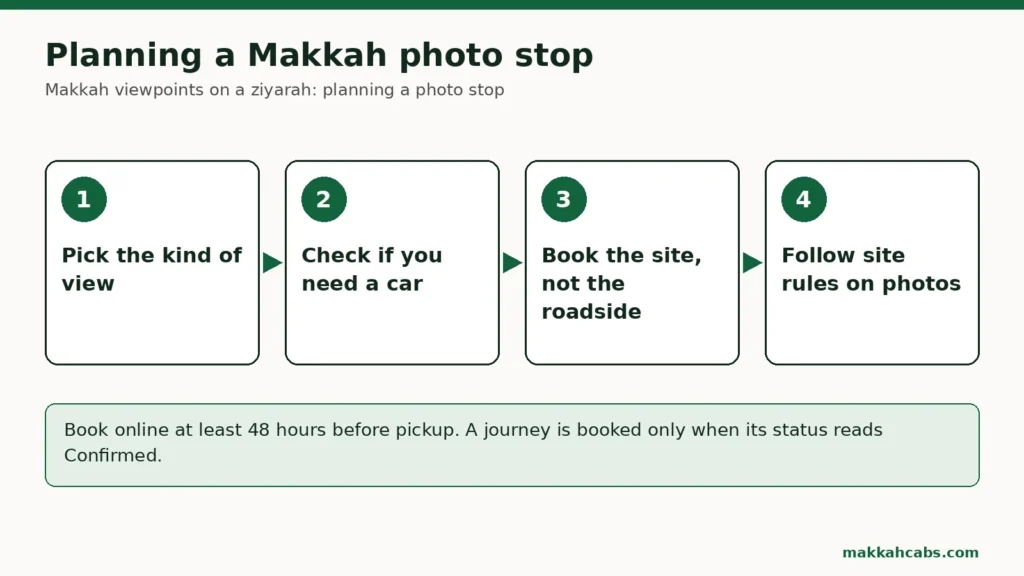
- Decide which kind of view you want: skyline from above, mountain from below, or summit.
- Check whether it needs a car at all, or is a walk from your hotel.
- Choose a viewpoint at a place you are visiting, where the car can drop you and collect you.
- Check venue hours and any photography rules on official sites.
- Match the viewpoint to the slowest and youngest members of the party.
- Book the journeys at least 48 hours ahead and check each reads Confirmed.
- Name any specific stop in the booking notes and ask before paying if it matters.
- Plan for the light and the heat, with water and shade.
- Follow signs and staff instructions, and ask before photographing people.
- Agree the regroup place and return pickup point before anyone wanders off.
When you have chosen your view, pick your hotel and Hira Cultural District, or another destination you have checked, in the Makkah Cabs planner and set the return at a time that leaves room for the photographs.