
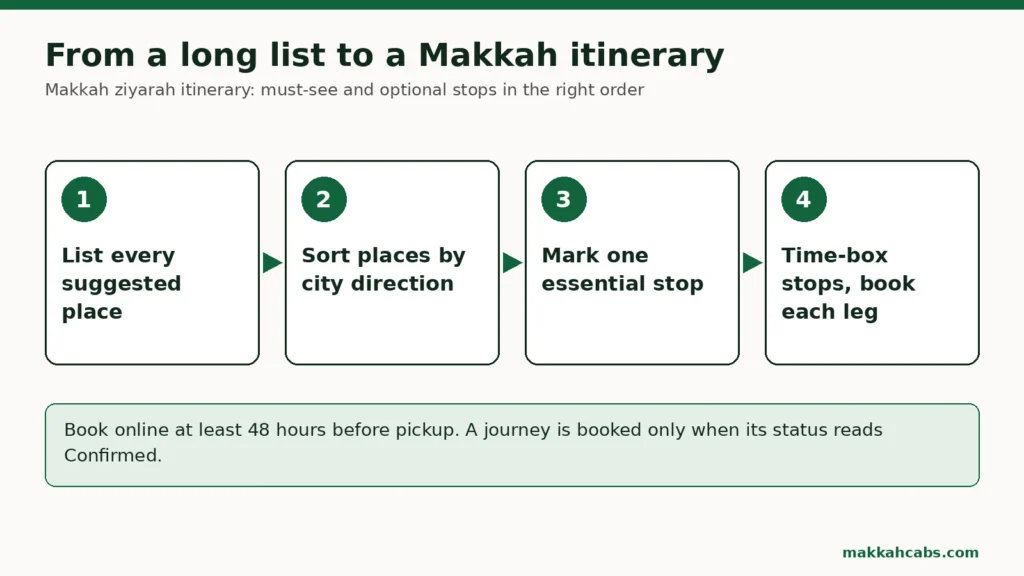
A good Makkah ziyarah itinerary starts with a short list, not a long one. Pick one or two places the whole party genuinely wants to see, mark everything else as optional, group the sites by the side of the city they sit on, and give each place a realistic time allowance before you book any transport. Most families find that two or three sites, ordered by direction rather than by fame, make a better outing than six places squeezed into one afternoon.
This guide is for the person in the family or group who ends up drawing up the plan: deciding which places go on the list, which can be dropped, and how the list turns into bookable journeys with Makkah Cabs. It covers the main sites visitors ask about, how they fall into directional clusters around the city, how to decide what is essential, how to time-box each stop, and how the final list becomes a set of journeys. It does not cover the religious significance of any site or what to do there. For that, speak to a qualified scholar and use the official Nusuk platform, which the Ministry of Hajj and Umrah supervises.
Why the list matters more than the route
Most planning effort goes into the order of stops, and our guide to putting the stops of a multi-stop Makkah visit in the right order covers that. But a Makkah ziyarah itinerary is only as good as its list. Seven entries, three of which one relative saw on a video, cannot be ordered into a calm afternoon.
The real decisions sit in the list: which places the group would hate to miss, which are there only because they are nearby, which involve going inside or a ticket or a climb, and who in the party can manage what, in what heat. Once those answers are written down, the order usually becomes obvious.
The places most Makkah ziyarah lists include
Families tend to draw from the same group of sites. The facts below come from Saudipedia, the Saudi national encyclopaedia, and from the official site of Hira Cultural District. Distances in official descriptions are usually measured from the Grand Mosque and are not road distances; where we have our own route checks, we give those separately.
Jabal al-Nour and Hira Cultural District. Saudipedia places Jabal al-Nour northeast of the Grand Mosque, about 4 km away, with the Cave of Hira near its summit. Hira Cultural District sits at the foot of the mountain. Its official website lists the Revelation Exhibition, the Holy Quran Museum and the path to the Cave of Hira as its current experiences. On our live route check, the district was about 13 km by road from the Clock Tower area, and about 11 km on the way back.
Jabal Thawr. Saudipedia describes the Jabal Thawr Cultural District as southeast of Makkah and south of the Grand Mosque, approximately 4 km away, with the mountain rising 760 m above sea level and the Cave of Thawr at the top. It lists a visitor reception centre and a Hijrah Exhibition among the district’s components. We have no live route check for Jabal Thawr, so read the distance in the route summary before you pay.
Masjid al-Taneem (Masjid Aisha). Saudipedia places the mosque on the northwestern side of Makkah, 7.5 km north of the Grand Mosque. Our route check from the Clock Tower area came to about 13 km, and about 19 km on the way back, because the road layout differs by direction.
Mina, Muzdalifah and Arafat. Saudipedia’s page on the holy sites places Muzdalifah between Mina and Arafat, and Arafat about twenty km from the Grand Mosque. It describes Arafat as active only during the days of Hajj, with no buildings or residents apart from several government facilities, and its page on Mina says the site remains uninhabited except during the Hajj season. Visitors going outside Hajj should expect wide, largely empty areas, not a place with a visitor centre. Check current access before you book, and do not plan a leisure outing to the holy sites around the Hajj period.
For any other place, find an official description of what it is and where it is, then put it into a cluster.
Grouping a Makkah ziyarah itinerary by direction
The single most useful step is to sort the list by which side of the city each place sits on. Going back and forth across Makkah is what makes an outing long and tiring.
| Cluster | Places in it | What the visit usually involves | Planning note |
|---|---|---|---|
| North and northeast | Hira Cultural District, Jabal al-Nour, Masjid al-Taneem | Exhibitions and museum with tickets; a climb for those who choose it; a mosque visit | Hira and Taneem are in the same broad direction, but check the road route between them |
| South | Jabal Thawr and its cultural district | Viewing the mountain; a climb for those who choose it; exhibition where open | Pairs poorly with the north cluster in one short outing |
| East | Mina, Muzdalifah, Arafat | Largely viewing open areas from nearby | Ties naturally together because the three sit in a line |
| Central | Your hotel, the Clock Tower area | Start and finish | Every outing begins and ends here unless you are moving hotel |
Two points follow. One cluster per half-day is usually enough, and a list that mixes north and south, or north and east, is really two outings. Our note on splitting a Makkah plan into two shorter outings explains how to handle that.
Deciding what is essential and what is optional
Once each place has a cluster, give it a label. Ask each adult one question: “If we only managed one place, which would it be?” The answers show you the essential stops quickly.
Essential stops
An essential stop is one the outing is built around. The return time, the vehicle and the order all work around it. Usually it is one place, sometimes two in the same cluster. It is essential if:
- more than one person in the group has named it as their reason for going;
- it involves something with fixed hours or a ticket, such as the exhibitions at Hira Cultural District;
- missing it would mean arranging a whole second outing anyway.
Optional stops on a Makkah tour
Optional stops on a Makkah tour are places you would be happy to see if the essential stop goes well and people still have energy. Treat them honestly. An optional stop is one the group is genuinely willing to drop on the day without anyone feeling cheated. If one household is quietly relying on it, it is not optional, and it should be discussed before you book.
Write a reason next to each one: “only if the children are still fresh” or “only if the museum finishes early”. The reason tells everyone what the stop is for.
Stops to leave off
Some places belong on another day or not at all: a site in a different cluster, a climb nobody in the party can manage, or somewhere with access you have not been able to check. Leaving them off is a decision, not a failure. Our guide to choosing one meaningful Makkah stop is useful if the list keeps growing.
Time-boxing each stop
A time box is the amount of time the group agrees to spend at a place before moving on. It is not a prediction; it is a limit you set yourselves. We do not quote journey times, because road conditions in Makkah vary too much, but you can and should decide how long you want at each site.
Use three kinds of box:
- A short look. A stop where the group mostly views a place from outside. The box is short, and the main risk is that it quietly grows.
- A visit with entry. Exhibitions and museums, where people go inside, move at different speeds and may want a meal or a rest afterwards. The box is longer and should include time to regroup.
- A climb. Going up Jabal al-Nour or Jabal Thawr is a separate activity with its own physical demands and heat risk, and it should never be squeezed into a short box. Decide in advance who is climbing and treat it as its own plan.
For entry visits, check the official opening hours before you choose a box. The official Hira Cultural District experiences page lists the district and the path to the cave as open 24 hours, and separate hours for the museums and exhibitions that differ by day, with a later opening on Fridays. If your essential stop has an opening time, it becomes the fixed point the rest of the itinerary works around.
Add up the boxes, plus a regrouping margin wherever the party separates. If the total already feels long before any travel is counted, drop an optional stop now, not on the day.
Planning a half-day ziyarah
Planning a half-day ziyarah is mainly about restraint: one cluster, one essential stop, one or two optional ones at most, and a firm finish time. Heat, prayer times, meals and the energy of the oldest and youngest travellers all push the same way.
A workable half-day shape looks like this:
- Start at the hotel with everyone gathered, bags and tickets ready.
- Essential stop first, especially if it has an opening time or a ticket.
- Optional stop second, in the same cluster, only if the group still wants it.
- Return to the hotel, or to wherever the group needs to be next.
Putting the essential stop first protects it. If anything overruns, it is the optional stop that gives way, not the main reason for the outing.
Timing within the day is a matter for the group. The Ministry of Health’s summer heat guidance advises reducing direct exposure to sunlight, scheduling outdoor activities carefully with rests in shaded areas, drinking plenty of fluids before you feel thirsty, and never leaving children in cars. It lists older adults, infants, children and people with chronic conditions among those at higher risk. That points strongly towards shorter outdoor boxes and indoor stops at the hottest part of the day.
Turning the list into journeys
A Makkah ziyarah itinerary becomes a booking only when each part is turned into a journey.
How the planner treats stops
Each Makkah Cabs journey has one pickup place, one destination, a pickup time and the passengers and luggage. You can add up to eight stops in journey order, but a stop is a point along the way where people get in or out. It is not a period when the car waits while you visit a site. The pickup and destination must also be different, so a there-and-back trip is always two journeys.
Three ways to structure an itinerary
A chain of one-way journeys. Hotel to the essential stop; essential stop to the optional stop; optional stop back to the hotel. Each leg is booked with its own pickup time, which is the end of the time box before it. This gives certainty and suits outings where each visit has a clear finish.
Outward and return only. Hotel to the essential stop and back, with no second site. Often the best plan for a half-day.
A car that stays with the group. Some families want the vehicle to remain with them between sites. That is a specific arrangement that has to be agreed with the booking team in writing, not assumed from a booking. Our note on whether a vehicle can stay with your group explains the difference.
The booking rules that apply to every leg
Every journey needs at least 48 hours’ notice before its pickup time, and each has a minimum booking value equivalent to £40, which matters when a short leg links two nearby sites. Payment secures a provisional request; the booking team updates the status, usually within 1 to 12 hours, and each journey is booked only when it reads Confirmed. Makkah Cabs takes full payment online.
Worked example: turning seven ideas into one afternoon
Rukhsana is organising an afternoon for her husband Idris, her mother Halima, who is in her seventies, and their two sons, aged nine and thirteen. They are staying near the Clock Tower. Between them, the family has suggested seven places: Hira Cultural District, climbing Jabal al-Nour, Masjid al-Taneem, Jabal Thawr, Mina, Arafat and a café Idris read about.
Sorting by cluster. Rukhsana draws the table. Hira, Jabal al-Nour and Taneem go in the north. Jabal Thawr goes in the south. Mina and Arafat go in the east. The café turns out to be inside Hira Cultural District, so it joins the Hira stop.
Finding the essential stop. She asks everyone which one place matters most. Halima and both boys choose the Revelation Exhibition at Hira Cultural District. Idris would like to climb, but agrees that is for another day with just the two older boys.
Labelling the rest. Taneem becomes optional for this outing, since the family already plans a separate visit there later in the week. Jabal Thawr and the east cluster go on a list for a second outing. The climb is left off.
Time boxes. Rukhsana checks the district’s website: the outing is on a Tuesday, so the exhibitions are open. The family agree a generous box for the exhibition, the museum and tea at the café, with a regrouping margin because Halima walks slowly.
Booking. More than 48 hours ahead, she books two journeys in the Makkah Cabs planner: hotel to Hira Cultural District, and Hira Cultural District back to the hotel at the end of the time box. She enters five passengers and day bags only, and notes that one passenger walks slowly. Both journeys read Confirmed that evening.
What changed. Seven ideas became one afternoon and a short list for another day, and the essential stop was protected.
When an optional stop does not fit on the day
Even a good list meets real conditions: a queue, a closure, a tired child, a longer visit than expected. Decide in advance what happens, so nobody has to negotiate in the heat.
Agree a simple rule, for example: “If we leave the essential stop after our agreed time, we skip the optional stop.” Write it in the family message. Because your later journeys have fixed pickup times, dropping a stop is easier than adding one. If the essential stop itself is unavailable, our note on what to do when a requested Makkah stop is unavailable sets out a plan B.
Only the pickup time can be changed online. On a paid booking, “Request a new pickup time” in your account asks for a new time before the pickup time. An approved new time carries a £5 rescheduling fee, converted into your booking currency and added to the cash paid to the driver at pickup; a rejected request costs nothing. A different pickup place, destination, passenger count or vehicle needs the booking team, or a new booking plus a cancellation request. Bookings are subject to our cancellation terms (free cancellation with a full refund up to 48 hours before pickup; inside 48 hours the deposit element of the price is kept) if you cancel; if we or our transport partner cancel or cannot supply the journey, you receive a full refund for the affected journey. The cancellation and refund policy sets this out in full.
Choosing the vehicle for the whole itinerary
The vehicle has to suit the fullest leg of the day, including any relative who joins part-way. Enter every traveller, including children and infants, and the bags and equipment you will actually carry: day bags, a pushchair, a folding wheelchair. The planner shows only vehicle classes that pass the capacity check for what you enter. Our guide to choosing between a car and a van for a Makkah outing covers the classes and what each holds.
A note on significance and guidance
The places on most lists matter to visitors for religious and historical reasons. A Makkah ziyarah itinerary from us stays with the practical side: where places are, how long you want there and how to get between them. What to do at each site, and whether a visit has any religious standing, are questions for a qualified scholar and for the official Nusuk platform, which also includes information on places to explore in Makkah.
Your ziyarah itinerary checklist
- Write down every place anyone in the group has suggested.
- Find an official description of each: what it is, where it is and whether it has opening hours or tickets.
- Sort each place into a cluster: north, south, east or central.
- Ask everyone which one place matters most, and mark the essential stop.
- Label the rest as optional, with a reason, or move them to another day.
- Keep to one cluster for a half-day outing.
- Set a time box for each stop, plus a regrouping margin, and check it against opening hours.
- Decide in advance which optional stop is dropped first if time runs short.
- Turn the list into journeys: outward and return, or a chain of one-way legs.
- Enter every traveller and all equipment, book at least 48 hours ahead and check each journey reads Confirmed.
- Send the family one message with the order, the time boxes and the pickup times.
When your list is settled, enter your hotel and your essential stop in the Makkah Cabs planner, then add the next leg of your itinerary at the time your group has agreed.