
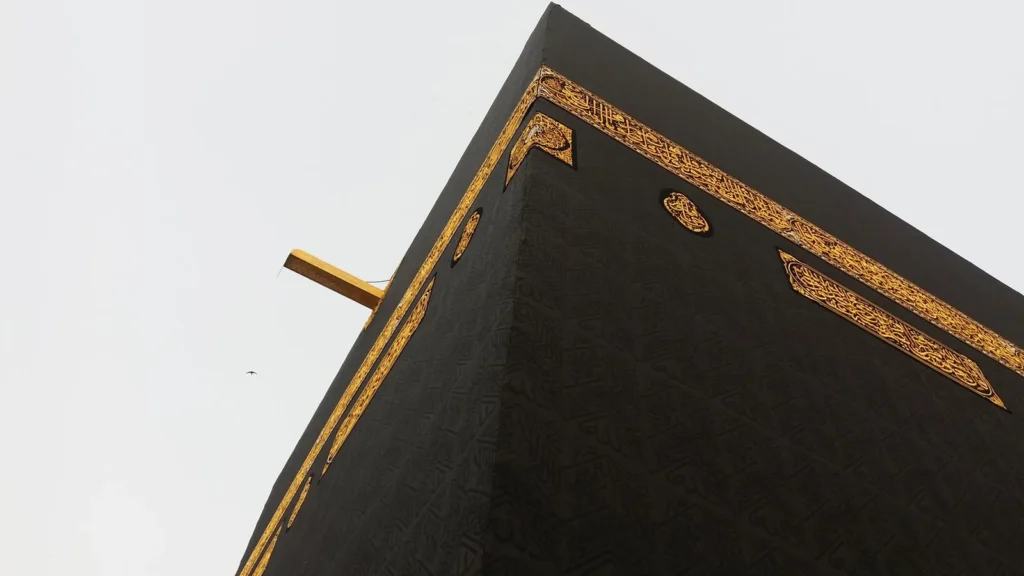
A Kiswa factory Makkah visit means a trip to the King Abdulaziz Complex for the Holy Kaaba Kiswa in the Umm al-Joud district, where the black silk cloth that covers the Kaaba is woven, embroidered and sewn. Official Saudi sources describe the complex as a place where visitors learn the history of the Kiswa and the stages of its making. The key to a smooth trip is order: confirm your visit with the complex first, then book transport there and back around that confirmed time.
This guide is for families and small groups staying in a Makkah (Mecca) hotel who would like to visit the Kiswa factory during their stay. It sets out what official sources say about the complex, what we could and could not verify about visiting arrangements, how to book the journeys once your visit is confirmed, how to time the day, and how to pair it with another museum visit. It is a transport and planning guide. Visiting arrangements at the complex are set by the complex and its supervising authority, not by us, and they can change, so always check the current position with them directly.
What is the Kiswa factory in Makkah?
The complex’s official name is the King Abdulaziz Complex for the Holy Kaaba Kiswa, though most visitors still call it the Kiswa factory or Kiswah factory. Saudipedia’s timeline of the complex traces its history:
| Year | Event recorded by Saudipedia |
|---|---|
| 1927 | King Abdulaziz orders a dedicated facility for producing the Kiswa in the Ajyad district of Makkah |
| 1962 | The facility moves to the Jarwal neighbourhood |
| 1965 | The first machine-made Kiswa is produced |
| 1972 | King Faisal orders a new Kiswa factory in the Umm al-Joud neighbourhood |
| 1977 | The Umm al-Joud factory is inaugurated with integrated production departments |
| 1993 | Supervision passes to the General Presidency for the Care of the Affairs of the Grand Mosque and the Prophet’s Mosque |
| 2017 | King Salman orders the factory renamed the King Abdulaziz Complex for the Holy Kaaba Kiswa |
So the place you are travelling to is in Umm al-Joud, not in Ajyad or Jarwal, even though older books and relatives’ memories may mention those districts.
What happens inside
A Saudi Press Agency feature published in January 2026, Holy Kaaba Kiswa Complex: Precision Craftsmanship and Living Islamic Heritage, lists the complex’s automated and hand-weaving, laboratory, embroidery, belt, dyeing, and tailoring and sewing departments. It describes production beginning with the selection of natural black silk, followed by embroidery in precious metal threads, and says the complex has become a centre of knowledge that acquaints visitors with the history of the Kiswa and the stages of its development.
Saudipedia’s entry on the Kiswa describes the complex as staffed by 220 artisans and technicians and records that, under a 2022 order, the Kiswa is replaced on the first day of Muharram each year.
Can you visit, and how does Kiswa factory booking work?
This is the question behind most searches for a Kiswa factory booking, and it is where we have to be careful.
Here is what official sources we read say:
- Visits happen. The Saudi Press Agency has reported many visits, including a 2024 group from the Custodian of the Two Holy Mosques Programme for Umrah and Visit whose guests, the agency says, toured the complex and took part in weaving fabric for the new Kiswa, and which it describes as a popular destination to learn about the manufacturing process and history of the Kiswa.
- Appointments have been part of the system. In 2019 the agency reported a campaign by the complex that included making appointment booking easier for visitors, alongside multilingual guidebooks, refreshments for guests, and artisans explaining the manufacturing steps.
- Visit Saudi lists it. The official tourism site presents the complex as a place to discover the history of the Kiswa and the stages of its production.
What we could not verify from an official page we were able to open: current visiting days and hours, the channel you use to request a visit today, whether individual families as well as groups can book, any age, dress or photography rules, and whether a fee applies. Unofficial websites give confident answers to all of these, but we are not repeating them, because a wrong detail could leave your family at a gate at the wrong time.
What to do instead: check the current visiting arrangements directly with the complex, or with its supervising authority for the affairs of the Grand Mosque and the Prophet’s Mosque, through their official channels. Your hotel’s guest services desk may also know the current process. Get a confirmation, in writing if possible, that shows the date and time of your visit.
Visit the Kiswa factory in the right order
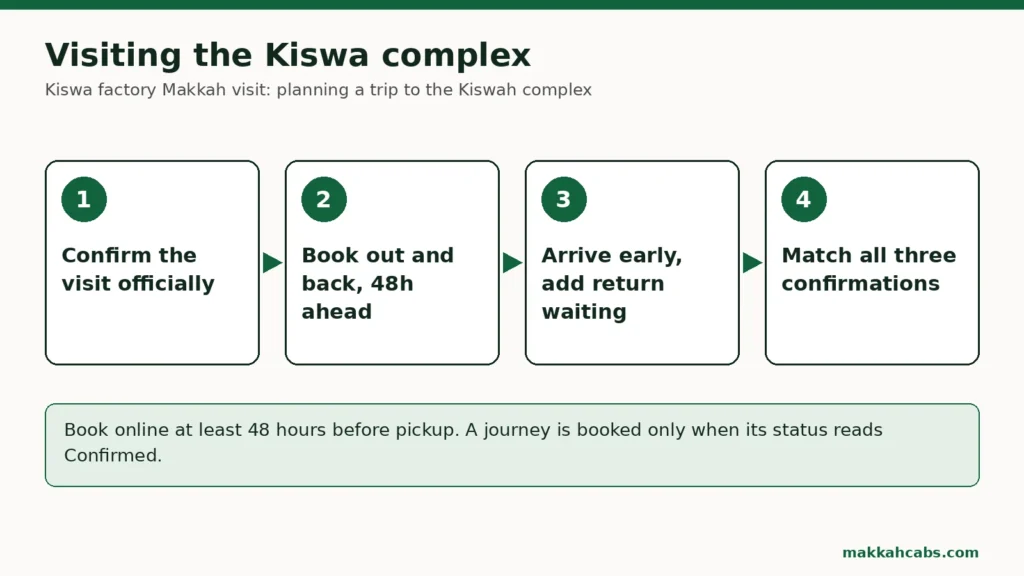
The order matters because of two booking rules. Online transport bookings need at least 48 hours’ notice, and bookings are subject to our cancellation terms (free cancellation with a full refund up to 48 hours before pickup; inside 48 hours the deposit element of the price is kept) if the customer cancels. If you book the car first and the visit is not confirmed, you may be left with a journey you no longer need.
| Your situation | What to do about transport |
|---|---|
| Visit confirmed for a date and time more than 48 hours away | Book both journeys now, around the confirmed time |
| Visit requested but not yet confirmed | Wait; do not book transport yet |
| Visit confirmed, but less than 48 hours away | Online booking is not available inside 48 hours; if you need our transport, ask the complex about a later date |
| Visit time changed by the complex after you booked | Request a new pickup time in your account (see below) |
| Visit cancelled by the complex | Your transport booking is separate; a customer cancellation is subject to our cancellation terms (free cancellation with a full refund up to 48 hours before pickup; inside 48 hours the deposit element of the price is kept), so read the policy before deciding |
Our guide to keeping two confirmations for a visit was written for Hira Cultural District, but the principle is the same: one confirmation for the visit, one for each journey, and all three checked against each other before the day.
Booking the journeys for a Kiswa factory Makkah trip
In the Makkah Cabs planner, a journey is one pickup place, one destination, a pickup date and time in Saudi local time, and the passengers and bags. The pickup and destination must differ, so going to the complex and coming back is two journeys.
- Journey one: your hotel to the King Abdulaziz Complex for the Holy Kaaba Kiswa, timed to arrive before your visit slot with a margin.
- Journey two: the complex back to your hotel, or on to your next stop, timed after your visit is expected to end.
The complex is not one of the planner’s listed popular locations, so type the full name and check the pin and distance in the route summary before you pay. We have not measured this route ourselves, so we do not quote a distance; read it in your summary. Add a booking note with the complex’s full name and “Umm al-Joud”, plus anything the driver should know, such as a slow walker or a wheelchair.
The usual rules apply to each journey:
- Notice: at least 48 hours before the pickup time.
- Minimum value: the equivalent of £40 per journey, shown as a “Minimum booking amount” line if a fare would be lower.
- Payment: full payment online on Makkah Cabs. Payment secures a provisional request; the status usually updates within 1 to 12 hours, and the journey is booked only when it reads Confirmed.
- Capacity: enter every adult, child and infant. Only vehicle classes that pass the capacity check are shown.
Arriving on time for a set slot
A fixed visit slot changes how you set the outward pickup. Work backwards: the slot time, minus a margin for finding the right entrance and any checks at the door, minus the journey itself, minus the time the slowest person needs to reach the car. Because we do not quote drive times and they vary, be generous. It is much better to wait in the car park than to arrive after your group has gone in.
If someone else, such as a relative or your group organiser, arranged the visit, make sure you have the exact confirmation they received. Our guide to a visit booked by a relative explains how to avoid gaps between their plan and your transport.
Setting the return and using waiting
We do not know how long a visit to the complex lasts, and your confirmation may not say. Ask when you confirm the visit. If you cannot find out, set the return with a margin you are comfortable with, and use waiting to cover uncertainty.
Free waiting counts from the booked pickup time. For example, Economy includes 15 minutes, then SAR 1.50 per minute; Business & Executive and the family vans include 30 minutes, then SAR 2.00 per minute; a Premium SUV includes 45 minutes, then SAR 2.50 per minute. Extra waiting can be added at checkout in 15-minute steps up to 2 hours (15, 30, 45, 60, 90 or 120 minutes), priced at the class’s rate, and the driver’s instructions show the total. Waiting beyond what was booked is not promised.
For a visit with a fixed start but an uncertain finish, 15 or 30 minutes of extra waiting on the return journey is often a sensible cushion. Our guide to planning a pickup before you go into an exhibition explains why the return should be arranged before you go in, not after.
Pairing the visit with the Two Holy Mosques Architecture Exhibition
Some families like to make a morning of museums. The Royal Commission for Makkah City and Holy Sites lists the Exhibition of the Two Holy Mosques Architecture among its Makkah landmarks, describing it as a museum in Makkah established in 1999 that focuses on the Two Holy Mosques and the development of their architecture. The same list includes the Kiswa complex.
If you want to see both, plan them as two confirmed visits:
- Confirm each one separately with the body that runs it. Different places can have different days and hours.
- Check the map. If the two are close, you might go from one to the other as a stop within a single journey. If not, book a journey between them.
- Keep the order fixed. Only the pickup time can be changed online, so decide which comes first before you book.
Our guide on places you go into versus places seen from outside explains why museum visits usually need a drop-off and a separate return.
Choosing a vehicle
A Kiswa factory Makkah trip rarely involves luggage, so seats are the main question. Economy and Business & Executive seat 4; the Hyundai Staria and Premium SUV seat 6; the GMC Yukon XL and Hyundai H1 seat 7; the Toyota Hiace seats 11 and the Toyota Coaster 19. Classes are shown as an example model “or similar”. Children count as passengers, and child seats and a wheelchair requirement can be added in the search and are then confirmed for the vehicle. Add them to both journeys.
A driver, not a guide
Your driver takes you to the complex and brings you back. The driver is not a guide, does not arrange entry, and cannot speak for the complex about what you will see inside. Any explanation of the Kiswa during your visit comes from the complex itself, which, as the 2019 report described, has used artisans and multilingual guidebooks to explain the work. Our note on why a driver and a guide are different sets out what to expect from each.
Meeting the car at the complex
We cannot promise where a vehicle may stop at the complex or at your hotel; that is managed on the day, and a working site may have its own arrangements for vehicles. You can make both pickups easy:
- Agree a meeting point with your party before you go in, so nobody has to decide it on the pavement afterwards. Our guide to choosing a hotel frontage or an agreed meeting point explains what makes a good one.
- Send a live location when you are ready for the return, rather than a description from memory.
- Check the registration. The driver-assigned email gives the vehicle registration, meeting and waiting instructions, and a link to view the vehicle photo securely in your account.
- Keep the confirmations to hand. Have the visit confirmation and both journey confirmations on at least two phones.
Your account shows the driver’s name once assigned and any cash due to the driver, in your booking currency. On Makkah Cabs you pay in full online, so usually nothing is due in person unless a pickup time change has been approved.
Worked example: two sisters and their mother
Zainab and Amira are travelling with their mother, Halima, who has wanted to see where the Kiswa is made since she was a girl. They are staying in Makkah for ten days.
Confirming the visit. On their second day, Amira asks at the hotel’s guest services desk how visits to the complex are arranged at the moment, and follows the process she is given. She receives a confirmation for a morning visit five days later.
Booking the journeys. With the visit confirmed well over 48 hours ahead, Zainab books two journeys in the planner: hotel to the King Abdulaziz Complex for the Holy Kaaba Kiswa, and back again. She types the full name, checks the pin in Umm al-Joud, and reads the distance in the route summary. Three adults fit Economy, but she chooses Business & Executive for a more comfortable ride for Halima, which includes 30 minutes of free waiting. She adds 15 minutes of extra waiting to the return, because nobody knows how long the visit will last. Her booking note gives the complex’s full name and says one passenger walks slowly.
Checking. Both journeys read Confirmed the same evening. Zainab puts the visit confirmation and both journey confirmations side by side and checks the date and times match.
The day. The outward car arrives with time to spare, and the family waits in the shade rather than rushing. After the visit, Amira sends a live location from the agreed meeting point, checks the registration from the driver-assigned email, and they are back at the hotel before the heat of the afternoon.
What made it work. The visit was confirmed before any transport was booked, and the return had a cushion because the length of the visit was unknown.
If plans change
- Only the pickup time can be changed online. “Request a new pickup time” in your account asks for a new time on a paid booking, before the current pickup time, and stays pending until approved. An approved change carries a £5 rescheduling fee, converted into the booking currency and added to the cash paid to the driver at pickup; a rejected request costs nothing.
- Place, destination, passengers and vehicle cannot be changed online; that needs the booking team, or a new booking plus a cancellation request.
- Cancellation. Bookings are subject to our cancellation terms (free cancellation with a full refund up to 48 hours before pickup; inside 48 hours the deposit element of the price is kept) if the customer cancels. If we or the transport partner cancel, or cannot supply the journey and no suitable alternative is accepted, you receive a full refund for the affected journey. The Makkah Cabs cancellation and refund policy has the details.
Your Kiswa factory Makkah checklist
- Check the current visiting arrangements with the complex or its supervising authority, or ask your hotel desk.
- Get a confirmation that shows the date and time of your visit.
- Only then book two journeys, out and back, at least 48 hours before the first pickup.
- Type the complex’s full name and check the pin in Umm al-Joud and the distance in the route summary.
- Set the outward pickup to arrive early for your slot.
- Set the return with a margin, and consider extra waiting on that journey.
- Enter every traveller, child seats and any wheelchair requirement on both journeys.
- If pairing with another museum, confirm that visit separately and fix the order.
- Check that the visit confirmation and both journeys match on date and time, and that both read Confirmed.
With your visit confirmed, open the Makkah Cabs planner, choose your hotel, type the King Abdulaziz Complex for the Holy Kaaba Kiswa and check the pin, then add the return at the time you have planned.