
A serviced apartment can give a family more control over a longer Makkah stay, while a hotel can remove some of the daily work. The useful comparison is not simply the number of bedrooms or the nightly price. It is whether the accommodation supports the way your party will eat, rest, wash clothes, reach the places it intends to visit and handle a problem.
Start with those routines, then compare two real properties for your dates. A listing described as an apartment may offer fewer facilities than you expect, and a hotel suite may provide some of the space you were seeking. Neither label establishes a kitchen, a staffed reception or an easy journey to the Grand Mosque. Confirm the actual room and service arrangement before committing.
Describe a normal day before choosing the accommodation
Ask the family to describe an ordinary day in Makkah, rather than only its arrival. Will everyone leave together, or will some people return earlier to rest? Do you want breakfast prepared in the accommodation? Will children need a quiet sleeping area while adults remain awake? These answers explain what additional space would actually achieve.
A separate sitting room may be valuable if different relatives keep different routines. It may matter less to a couple who will spend little time indoors and prefers meals prepared for them. Avoid paying for a facility because it appears impressive in photographs when it does not solve a need your own party has.
Decide who would do the work a more independent stay creates. Buying food, cleaning up and managing supplies do not disappear because an apartment has a kitchen. A family should agree whether these tasks are shared, optional or something it wants accommodation staff to handle through a confirmed service.
Keep the comparison respectful of different preferences. One traveller may enjoy preparing familiar meals, while another wants a break from domestic work. The right arrangement is one the party understands before travelling, rather than a cheaper booking that quietly assigns every household task to the same person.
Check the operator and the specific booking
The Ministry of Tourism’s tourist rights guidance tells visitors to verify a hospitality facility’s licence and check its facilities, charges and reservation policies. Use the operator’s real business name and address when making that enquiry. A familiar-looking photograph or an attractive description does not replace those checks.
Make sure the confirmation identifies the accommodation you selected, the dates, the room or apartment type and the agreed occupants. Ask for clarification if the listing name differs from the name in the payment document. The aim is to understand who supplies the stay and what you have purchased, without guessing that every name belongs to the same operator.
Keep a copy of the reservation information and the property’s contact details. The Ministry’s guidance also covers obtaining a reservation document showing services and relevant policies. You should be able to distinguish the accommodation booking from the separate transport record without searching through an unlabelled collection of messages.
Check a question with the property before interpreting a marketing label as a promise. Serviced, furnished, suite and family room do not answer every practical question about the individual unit. You need confirmation of the features that influenced your decision, particularly where a listing uses photographs from several room categories.
Count real beds, rooms and private space
Write down who is staying and which people will share a sleeping space. Then ask the property how the booked unit accommodates that exact party. A large floor area does not tell you the number of beds, whether a sofa is intended for sleeping or whether an additional bed has been accepted in the booking.
Look beyond the room count. Ask whether a bedroom has a closing door, whether the sitting area is also a sleeping area and where someone can rest during the day. For a longer stay, the difference between separate rooms and one large open room can affect the whole family’s routine.
Bathrooms also matter to the arrangement. Check the actual number and their relationship to the bedrooms, without assuming an apartment advertised for a family has several bathrooms. A bathroom accessible only through one bedroom may require a different sleeping allocation from a bathroom reached from a shared corridor.
Explain any requirement that depends on the layout, such as avoiding steps inside the unit or reaching the bathroom from a mobility aid. Ask about the specific accommodation rather than accepting a general statement that the building is suitable for families. Its answer should describe a feature or an available room, not leave you to interpret an icon.
A kitchenette is a starting point for questions
Confirm what you intend to prepare and which equipment is actually supplied. A place to make tea or keep a small snack is different from a kitchen capable of supporting the family’s usual meals. Ask about cooking equipment, the fridge, utensils and any restrictions that apply to the booked unit.
A hotel can sometimes offer a middle option. For example, Le Méridien Makkah’s official accommodation page describes a kitchenette in its Diplomatic Suite. That is a feature of a named category, not evidence that every room there includes one or that all the equipment your family wants is present.
Ask for a current description if a kitchen feature is essential to your choice. An image may show a counter but not explain whether you can cook on it. Avoid bringing equipment on the assumption that it is permitted; get the property’s instructions about what guests may use in their accommodation.
Plan a realistic first evening. You may arrive before buying supplies, and a kitchen with nothing in it does not solve dinner. Decide whether the initial meal will be arranged through the property, eaten elsewhere or prepared from items you already have. This small choice keeps the arrival from becoming an unplanned shopping expedition.
Think through groceries and meals over the whole stay
Separate regular essentials from an optional shopping outing. A family buying a few breakfast items has a different task from a group planning to cook most meals. Identify which purchases the actual facilities support, then decide how frequently someone would need to restock them.
Ask the property about nearby shops and any delivery procedure it allows. Confirm whether deliveries reach your unit, a reception desk or another agreed place. A shop appearing close on a map does not explain the pedestrian route or whether carrying a purchase back will be comfortable for the person responsible.
If you want a vehicle for a larger purchase, describe a specific journey and the load you expect to bring back. A normal transfer is not automatically a grocery-collection service or a vehicle waiting while you browse. Ask the booking team what can be agreed before building those assumptions into the stay.
Leave room for meals outside the accommodation if that suits the party. Self-catering does not oblige you to cook every day, and a hotel booking does not oblige you to eat every meal at its restaurant. Compare the routines you actually want, using a property’s current dining information where a meal arrangement is important.
Laundry and cleaning can change the value of extra space
For a longer visit, find out how clothes will be washed. Is there a machine inside the unit, an agreed guest facility, a paid laundry service or simply space where a machine appears in a photograph? Ask about the booked accommodation and the procedure that applies to your stay.
Check the cleaning arrangement with the same care. Do not assume the service pattern is identical in an apartment and a hotel, or that an independent unit is serviced every day. Ask what cleaning is included, how it is arranged and which requests would create an additional charge.
Consider when these tasks happen. Washing clothes is more useful if you can do it without disrupting somebody’s rest or occupying the only bathroom at a difficult time. If the layout makes the routine awkward, a confirmed staff service might be worth more to your party than owning the task yourselves.
Write the important answers alongside the price comparison. This makes it easier to see whether the apartment’s apparent saving depends on services you would still have to buy or work the family has not agreed to do. Use actual quoted charges rather than inventing a standard saving for one accommodation type.
Assess the building as well as the unit
The journey between the street and your room can influence a longer stay repeatedly. Ask about the entrance, lifts and any steps on the route. A spacious unit on an upper floor may still be inconvenient for a traveller if the route to it does not meet that person’s needs.
Identify whom guests contact for a building or accommodation problem. A staffed desk, a property manager reached by phone and a host using messages are different arrangements. Establish the procedure and its actual contact before relying on the accommodation as a dependable base.
Consider how the family will divide its access. If people leave and return separately, ask what keys or access arrangements are provided and what happens if someone cannot enter. Do not assume one organiser’s phone or one set of keys is a practical arrangement for several independent adults.
The Makkah hotel district guide helps assess the surrounding transport context. Use it after identifying the property. A district can inform the decision, but it cannot confirm the lift, entrance or services inside a particular building.
Budget for the everyday journeys you will actually make
Compare a normal day’s movement from each shortlisted property. How will your party reach its intended destination, and what happens if people return separately? Assess the complete journey, including the pedestrian section, rather than judging the accommodation by an advertised distance alone.
If a property advertises guest transport, obtain its current instructions. The hotel shuttle comparison explains the separate question of stops, boarding and return arrangements. A kitchen or extra bedroom does not establish a transport amenity, and one amenity should not be used as evidence of another.
List confirmed transport options rather than assuming a private car will be available whenever someone wants to leave. If particular journeys are essential, ask about them in advance with the actual party and destination. Keep optional outings outside the daily cost calculation until you decide you want them.
Two properties can be compared without deciding that one district is universally better. A family that values indoor space and independence may accept a more deliberate travel routine. Another may prefer less space and fewer daily arrangements. The choice depends on those people’s priorities and the real offers available.
Compare the total stay using the same assumptions
Put both options on an equal footing. Use the same dates and people, the same essential meals and the same journeys. Include only services you have established are included or priced, and mark any unanswered item as an enquiry rather than assigning it a convenient figure.
A cheap room quote and a more expensive apartment quote may cover different things. One might include a meal arrangement while the other requires buying supplies. One might offer the sleeping allocation the family needs while the other would require another room. Resolve those differences before deciding which provides better value.
Ask about deposits, modification and cancellation through the property’s actual booking channel. Keep that answer separate from transport terms. Changing the accommodation does not automatically change a paid vehicle booking, even if both purchases were made as part of the same family plan.
Include the value of convenience without pretending it has a fixed price. If preparing food and handling laundry would exhaust the organiser, a confirmed service may justify a higher accommodation cost. If the family enjoys an independent routine, suitable facilities may be worth choosing even without a large cash saving.
Account for relatives who stay for different dates
A longer booking can contain several smaller stays. If one household leaves before another, ask how the accommodation arrangement handles the occupants for each period. Do not assume a unit booked for the first party automatically fits relatives who join later, or that an unused bed changes the price.
Agree who remains responsible for the reservation when the original organiser leaves. The continuing guests need the property’s accepted contact and access arrangement, not only screenshots held on a departing relative’s phone. Discuss the final checkout and any accommodation payment still outstanding with the property directly.
Split transport planning by the people actually travelling on each date. The departing relatives’ airport journey and the continuing family’s grocery or outing trip are separate needs. A shared apartment does not require everyone to share the same departure, and a changed household routine need not disturb journeys that remain correct.
Two fictional families make different choices
In this fictional example, a family travelling with an older relative wants separate sleeping spaces and a place where one person can rest while others sit together. It compares a serviced apartment with a hotel offering enough rooms. The apartment has to meet the sleeping arrangement and building-access requirements before price becomes the deciding factor.
The family asks about the actual cooking equipment and decides it only wants to prepare simple breakfasts. It does not choose a larger kitchen for meals nobody wants to cook. It checks cleaning, laundry and a realistic journey towards the Grand Mosque, then agrees who will handle the modest restocking task.
A second fictional family prefers having breakfast prepared and staff available for routine requests. It spends little time together indoors and does not want to organise supplies. A hotel with the confirmed sleeping allocation suits it better, even though an apartment photograph shows more space.
Neither example establishes a property, price or service promise. The families reach different answers because their normal days differ. A useful comparison makes those differences visible rather than declaring apartments ideal for every long stay or hotels ideal for every visitor.
Turn the selected property into a clear transport address
Once you have chosen the accommodation, obtain its exact name and arrival address. Check whether the entrance used by guests differs from another entrance shown on the map. The arrival arrangement should come from the property; a transport booking cannot provide keys, guest registration or admission to the unit.
For a pickup during the stay, name the building and confirm the point your party can reach. The frontage or agreed meeting-place guide explains that practical distinction. Avoid using a nearby large hotel as a substitute address for an apartment merely because it is easier to find in a search.
Tell the provider about the actual passengers and bags for the particular journey. A restocking trip, a family outing and the final departure may have different loads. The car or van guide helps frame that enquiry without assuming one vehicle choice covers everything.
If the accommodation changes, check every affected pickup and destination with the booking team. Do not rely on a message to the host to update transport. Ask what needs changing and obtain confirmation before telling the family that the new address is settled across all its arrangements.
Make the choice easy to explain to the whole party
Before paying, explain the selected sleeping arrangement, the services included and the tasks the family will handle itself. Include the important daily transport decision. People should know what the accommodation offers and what still requires confirmation, rather than discovering the difference after they arrive.
Keep the decision based on verified facilities and a manageable routine. Extra space is valuable when it improves the stay; a hotel service is valuable when it removes work the party wants help with. Choose the arrangement that supports your actual days in Makkah.
When the property’s address and your travel needs are settled, use Makkah Cabs’ transfer planner for the journeys you intend to request. Confirm accommodation services with the property and transport scope with the booking team, keeping a clear record of each.
Official source information checked 27 September 2026. Facilities and reservation arrangements must be confirmed for the exact accommodation and dates.
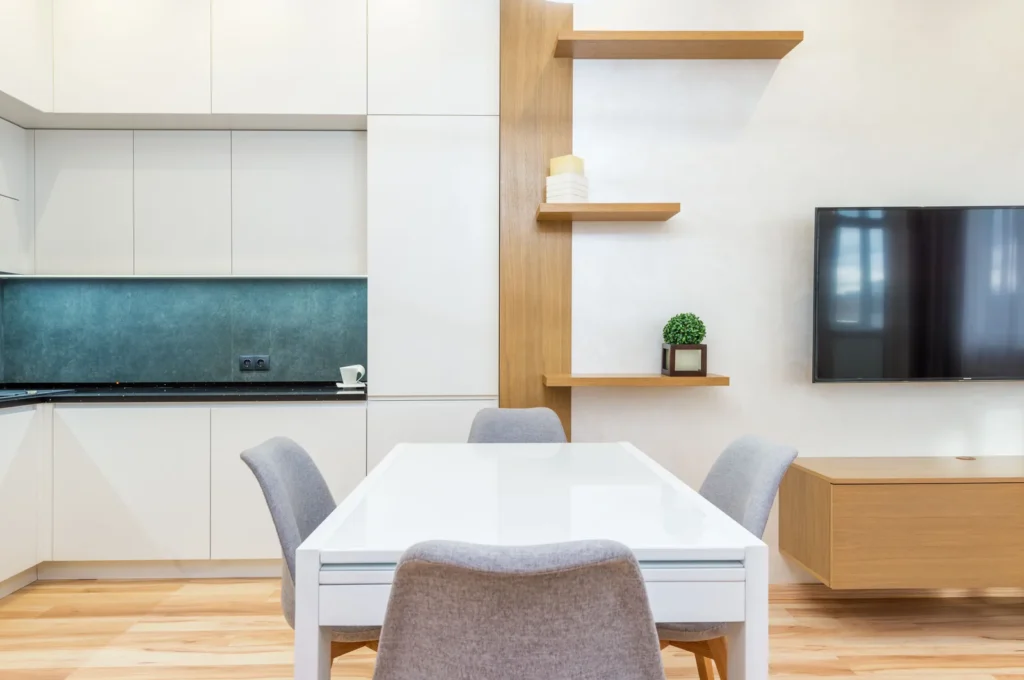
Generic kitchen and dining space, not a Makkah property or accommodation supplied by Makkah Cabs. Photo: Max Vakhtbovych / Pexels, under the Pexels licence.