
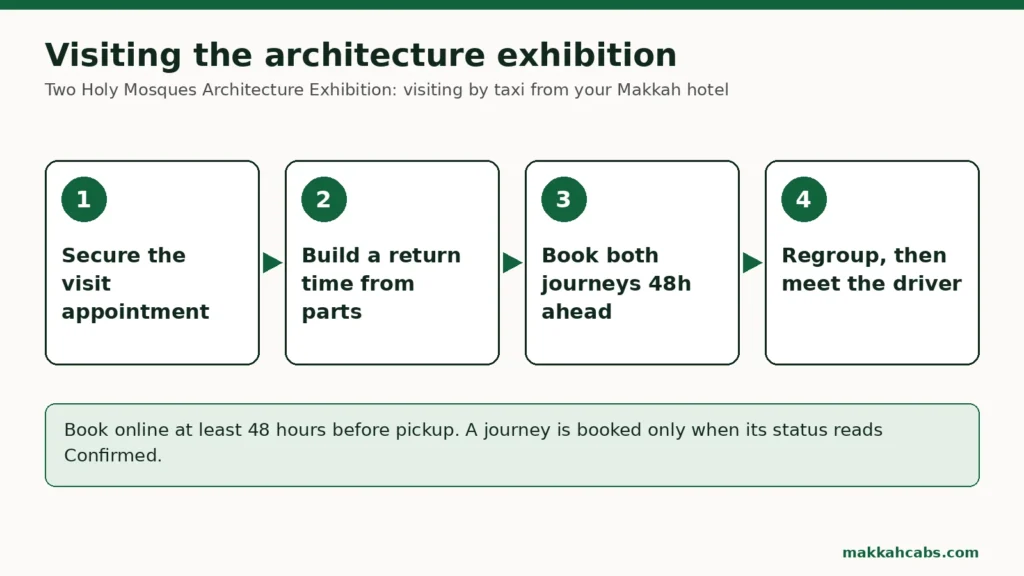
The Two Holy Mosques Architecture Exhibition is a museum in the Umm al-Joud district of Makkah, supervised by the General Authority for the Care of the Affairs of the Grand Mosque and the Prophet’s Mosque, with seven halls of historic pieces, photographs and manuscripts from the Grand Mosque and the Prophet’s Mosque. To visit by taxi, secure your visiting appointment first through the official channel, then book two separate journeys with Makkah Cabs: your hotel to the exhibition, and the exhibition back to your hotel at a time you choose in advance, each at least 48 hours ahead.
This guide is for families and small groups staying in Makkah (Mecca) who have heard of the exhibition, perhaps as “the museum near the Kiswa factory”, and want to fit it into a free morning or afternoon. It covers what the exhibition shows, according to official Saudi sources, how the appointment and the taxi fit together, how to choose a return time and how waiting works, and what we could not verify. It is about the visit and the transport. For any religious question about the objects on display or the places they come from, speak to a qualified scholar and use the official Nusuk guidance.
What is the Two Holy Mosques Architecture Exhibition?
Saudipedia, the Saudi national encyclopaedia, describes the Exhibition of the Two Holy Mosques Architecture as a museum inaugurated on 1 February 2000, during the reign of King Fahd bin Abdulaziz, covering about 1,200 square metres and arranged in seven halls. The Royal Commission for Makkah City and Holy Sites lists it among Makkah’s landmarks and gives 1999 as the year it was established, so the two sources differ by a year.
In June 2025 the Saudi Press Agency reported that the exhibition had been renewed with a full technical upgrade, a modern re-display of its historical pieces and new lighting, and that it was in a pilot operational phase with Saudi guides offering educational and guided services. The same report placed it in the Umm al-Joud district and named the General Authority for the Care of the Affairs of the Grand Mosque and the Prophet’s Mosque as the body behind it.
Some visitors call it the Haramain Museum or the Two Holy Mosques Museum, but these are informal names. In the planner, type the full official name and check the pin in the route summary before you pay.
What the halls show
Saudipedia’s descriptions of the seven halls are summarised below. The last column is our own planning note, not the museum’s.
| Hall | What official sources say it contains | Who often lingers here |
|---|---|---|
| Reception Hall | An overview of the architecture and expansion of the Two Holy Mosques | Everyone, briefly; a good place to agree a regroup spot |
| Grand Mosque Hall | Items from the Grand Mosque, including a teak staircase of the Kaaba dating from 1825 | Older relatives who remember earlier visits to the Haram |
| Kaaba Hall | Items related to the Kaaba | Most visitors; often the slowest hall |
| Hall of Photographs | Rare photographs of Makkah, Madinah and the holy sites | Photographers and anyone interested in how the cities changed |
| Manuscripts Hall | Rare copies of the Quran and manuscripts from the libraries of the Two Holy Mosques | Readers, students, calligraphy enthusiasts |
| Prophet’s Mosque Hall | Items and artefacts related to Madinah and the Prophet’s Mosque | Families who have come from, or are going on to, Madinah |
| Zamzam Hall | Tools that were used at the Zamzam well | Children, who often find the equipment easiest to picture |
Visit Saudi’s page on the exhibition also mentions the Kaaba’s staircase, rare artefacts and ancient manuscripts, and the Saudi Press Agency reported in June 2026 on a wooden platform on a marble base that once stood beside the Black Stone, where a soldier would stand to organise the movement of people performing tawaf. Displays can change, so treat any single object as something you may see, not something promised.
Why the order of the halls matters for timing
Because the halls run in sequence, a family spreads out as it moves through: the reader in the Manuscripts Hall can be two halls behind the child who went straight to the Zamzam tools. Agree a meeting place and a finishing time before you go in.
A Makkah museum near the Kiswa factory
Many people search for the exhibition as the Makkah museum near the Kiswa factory, and there is a reason. Saudipedia places the King Abdulaziz Complex for the Holy Kaaba Kiswa in the Umm al-Joud neighbourhood, the same district the Saudi Press Agency gives for the exhibition, and both come under the same General Authority. Saudipedia’s timeline of the complex records that it moved to Umm al-Joud in 1977, after earlier sites in Ajyad and Jarwal.
That shared neighbourhood does not make them one visit. The Royal Commission lists the complex as a landmark, Visit Saudi describes it as a place to learn the history of the Kiswa and the stages of its production, and in July 2026 the Saudi Press Agency reported a tour there by a group on the Custodian of the Two Holy Mosques’ guests programme. None of the official pages we read sets out public visiting hours or how an independent family arranges entry.
So treat the exhibition as the fixed point of the outing, and the Kiswa complex as a separate question for the General Authority. If a visit there is confirmed, it becomes its own destination with its own times; if not, the exhibition is a full visit on its own.
Appointments come before the taxi
The June 2025 Saudi Press Agency report said that visiting appointments for the exhibition could be reserved through the General Authority’s visits platform at visits.alharamain.gov.sa. We could not open that platform from outside Saudi Arabia while preparing this guide, so we cannot tell you which days or hours it offers, whether it asks for identity details, or whether it limits group sizes. Please check it directly, or ask the General Authority, before you book any transport.
The order matters because a taxi booking and a museum appointment are separate confirmations. Book the car first and miss the appointment you wanted, and you hold a journey you may not need; Makkah Cabs bookings are subject to our cancellation terms (free cancellation with a full refund up to 48 hours before pickup; inside 48 hours the deposit element of the price is kept) if you cancel. Secure the appointment first and you have the one time everything else is built around.
Keep both confirmations, and later the driver’s details, in one note on one phone. Our note on keeping two confirmations for a Hira visit explains the same habit for another ticketed Makkah visit, and it applies here in exactly the same way.
Getting there by taxi: two journeys, not one
The Makkah Cabs planner books journeys. Each journey has one pickup place, one destination, a date and a time in Saudi local time, the passengers and the bags. The pickup and destination must differ, so a visit to the exhibition and back is two journeys:
- Hotel to the exhibition, timed so you arrive with a comfortable margin before your appointment.
- Exhibition to hotel, timed for when you expect to be finished and back outside.
The exhibition is not one of the planner’s popular locations, so type it in and read the route summary carefully. We do not have a live route check for Umm al-Joud, so we will not quote a distance here. Check the distance shown in the planner for your own hotel before you pay.
Every journey needs at least 48 hours’ notice before its pickup time. Payment secures a provisional request; the booking team then updates the status, usually within 1 to 12 hours, and each journey is booked only when it reads Confirmed. Makkah Cabs takes full payment online, and each journey has a minimum booking value equivalent to £40. The planner shows only the vehicle classes that fit the party you enter, so include wheelchairs, walking frames and pushchairs; our guide to comparing Makkah visit vehicle options explains the classes.
Where a car may stop outside the exhibition is managed on the day, and we cannot promise a particular entrance or kerb. Once the driver is assigned, agree a meeting point in words and share a live location. Our guide to choosing a frontage or an agreed assembly point shows how to describe a meeting place so that it works the first time.
Choosing your return time
We do not publish how long a visit takes, and nobody can tell your family how long it will want in front of the Kaaba staircase or the manuscripts. You can still choose a sensible return time by building it up from parts:
- the time from arrival to your appointment, including any check at the door;
- the time you want in the halls, agreed as a limit rather than a guess;
- a regroup margin, because families spread out across seven halls;
- a few minutes to walk from the exit to wherever the car can stop.
Set the return pickup at the end of that total. Slightly late is better than too early, because an early pickup starts your free waiting while you are still inside.
How waiting works on the return pickup
Free waiting counts from the booked pickup time, not from when the car arrives or when you walk out. The allowance and the rate after it depend on the vehicle class, and these are the figures shown at checkout:
| Vehicle class | Free waiting from booked pickup time | Rate after the free minutes |
|---|---|---|
| Economy | 15 minutes | SAR 1.50 per minute |
| Business & Executive, Staria VIP van, H1 family van | 30 minutes | SAR 2.00 per minute |
| Minibus (Hiace or Coaster) and Coach | 30 minutes | SAR 2.50 per minute |
| Premium SUV (Tahoe or Yukon) | 45 minutes | SAR 2.50 per minute |
| Luxury (S-Class) | 60 minutes | SAR 4.00 per minute |
If you are unsure how long the family will take, you can add extra waiting at checkout in 15-minute steps, up to 2 hours, priced at the class’s per-minute rate. The driver’s instructions then show the total. The driver cannot wait beyond what was booked. Our guide to setting one return deadline for everyone helps turn that margin into a time the whole party keeps.
Combining the exhibition with other stops
A journey can include up to 8 stops, in the order you enter them, so you can pass another place on the way to or from Umm al-Joud. Be strict, though: an appointment at the Two Holy Mosques Architecture Exhibition is the anchor of the outing, not one item in a list.
Three combinations tend to work:
- Exhibition only. Hotel to exhibition, exhibition to hotel. The calmest plan, and the right one for older relatives or young children.
- Exhibition plus a short view from the car. One brief stop on the return journey at a place you only want to see from outside. Decide before you book which place, and accept that it may be dropped on the day.
- Exhibition plus a separately arranged Kiswa visit. Only if the General Authority has confirmed a visit for you. Then the exhibition-to-Kiswa leg becomes its own journey, timed to that confirmation.
Avoid adding a second place with its own tickets or opening hours on the same half-day. Two fixed times on one outing squeeze each other, and the second visit is usually the one that suffers. Our guide to choosing one meaningful Makkah stop is useful when the list keeps growing, and our guide to essential and optional Makkah stops helps sort what stays and what goes.
Who gets most from the Haramain architecture museum?
The Haramain architecture museum rewards people who have spent time in the Grand Mosque or the Prophet’s Mosque and want to understand how those buildings grew.
Older relatives
Older pilgrims who remember the Haram from a first visit decades ago often find the Hall of Photographs and the Grand Mosque Hall moving, and a museum is a gentler outing than a mountain or an open plain. Ask the exhibition in advance about wheelchairs, seating and lifts; we could not find these details on the official pages we read. If someone uses a folding wheelchair or walking frame, enter it in the search so the vehicle can carry it, and see our guide to describing a folding mobility aid for an outing.
Children
The Zamzam Hall’s tools and the models give younger visitors something concrete to look at. Keep the visit short for small children, agree a meeting point in the Reception Hall, and add a child seat in the search if a child needs one.
Readers and photographers
The Manuscripts Hall and the Hall of Photographs are the slowest halls for anyone who reads labels closely. If photography matters to someone in your party, ask the staff on arrival what is permitted. We could not find a published photography rule, and museums often have different rules for different objects.
A worked example: three generations and one morning
Tariq and Nadia Hussain, a couple from Leicester, are in Makkah with their two children, aged nine and twelve, and Tariq’s father, Yusuf, who is seventy-four and uses a folding walking frame. Yusuf first performed Umrah in the 1980s and has asked more than once how the Haram has changed since then.
Deciding. Nadia suggests the exhibition as a morning that suits everyone: indoors, and full of the history Yusuf keeps asking about.
The appointment first. Tariq checks the General Authority’s visits platform and secures a morning appointment four days ahead. He saves the confirmation to a shared family note.
The taxi second. With the appointment fixed, Tariq opens the Makkah Cabs planner. He books two journeys in an H1 family van class vehicle, which has room for five people and Yusuf’s folding walking frame: hotel to the exhibition, arriving well before the appointment, and the exhibition back to the hotel. He builds the return time from parts. Because Yusuf moves slowly, he adds 15 minutes of extra waiting to the return journey at checkout on top of the 30 free minutes for that class. Both journeys read Confirmed within a few hours.
On the day. Tariq sends the driver a live location at the hotel and, on the way out, a message describing where the family is standing. The children finish first and wait with Nadia in the Reception Hall. Yusuf spends longest in the Hall of Photographs, and the family walks out within the booked waiting time.
What made it work. A fixed appointment, a return time built from parts, extra waiting bought for the slowest walker, and a meeting place agreed before anyone separated.
Changes and cancellations
The rules are the same for every Makkah Cabs journey:
- A new time. Before the pickup time, you can use “Request a new pickup time” in your account. An approved new time carries a £5 rescheduling fee, converted into the booking currency and added to the cash paid to the driver at pickup. A rejected request costs nothing.
- Anything else. Only the time can be changed online. A different pickup place, destination, number of passengers or vehicle needs the booking team, or a new booking plus a cancellation request.
- Cancelling. Bookings are subject to our cancellation terms (free cancellation with a full refund up to 48 hours before pickup; inside 48 hours the deposit element of the price is kept) if you cancel. If we or our transport partner cancel, or cannot supply the journey, you receive a full refund for the affected journey. The details are in the Makkah Cabs cancellation and refund policy.
What we could not verify
On the official pages we read, we could not find:
- the exhibition’s current opening days and hours;
- whether there is an entry fee;
- accessibility details such as lifts, wheelchairs or seating;
- photography rules inside the halls;
- public visiting arrangements for the King Abdulaziz Complex for the Holy Kaaba Kiswa.
For all of these, check with the General Authority for the Care of the Affairs of the Grand Mosque and the Prophet’s Mosque, through its visits platform or its official channels, shortly before your visit.
Checklist for a visit to the exhibition
- Agree who is going and what each person most wants to see.
- Secure your appointment through the General Authority’s visits platform, and save the confirmation.
- Ask the General Authority about hours, accessibility and photography if any of these matter to your party.
- Decide whether the Kiswa complex is part of the plan, and only include it if a visit has been confirmed.
- Build your return time from parts: arrival margin, time in the halls, regroup margin, walk to the car.
- Book the outward and return journeys at least 48 hours ahead, entering every passenger and mobility aid.
- Add extra waiting at checkout if anyone in the party moves slowly.
- Check that both journeys read Confirmed, not just paid.
- Agree a meeting place inside the exhibition before anyone separates.
- Share a live location with the driver when you leave the hotel and again when you walk out.
When your appointment is confirmed, open the Makkah Cabs planner, choose your hotel and the Two Holy Mosques Architecture Exhibition, enter everyone who is coming, and book both journeys at least 48 hours ahead.