
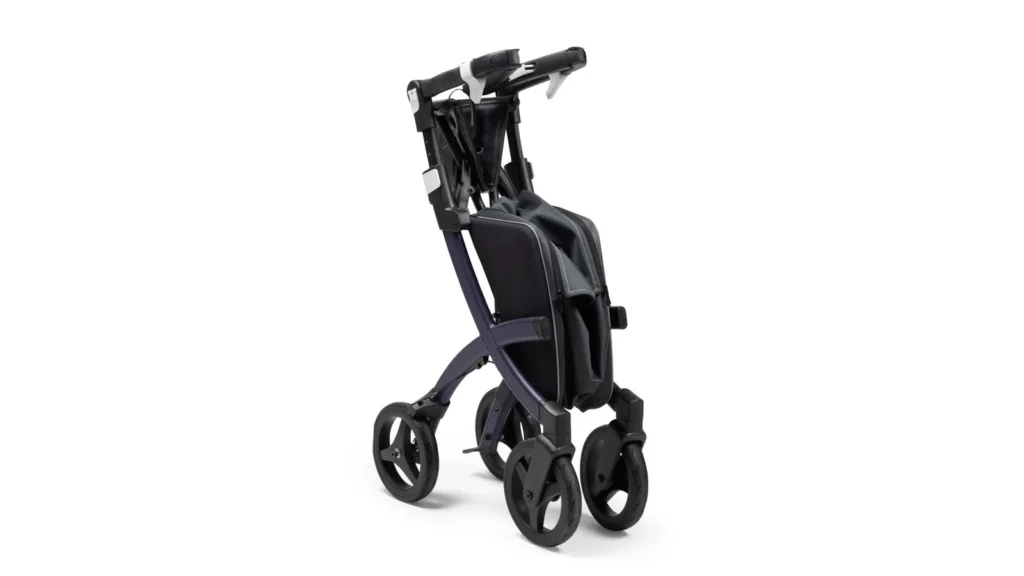
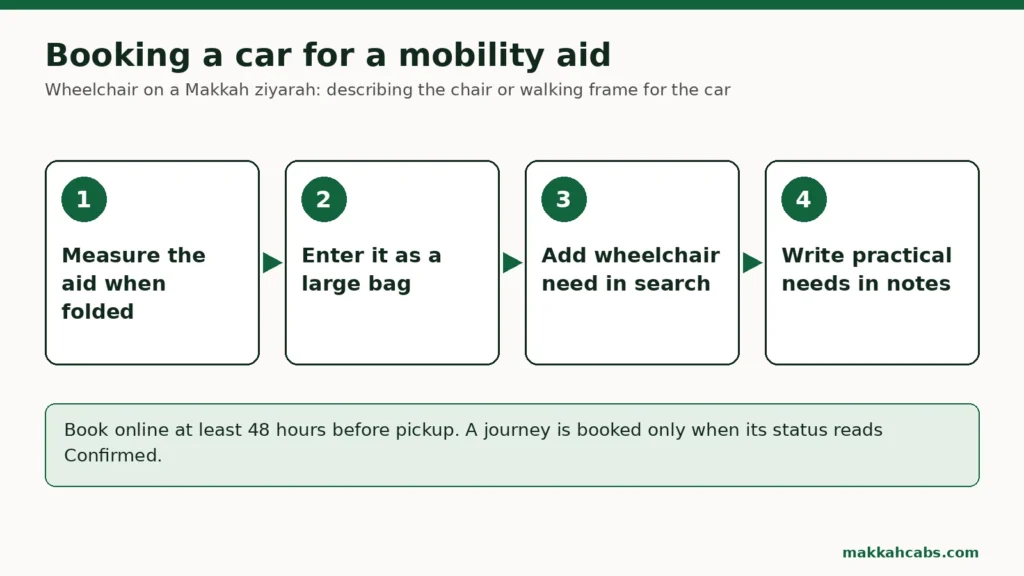
Taking a wheelchair on a Makkah ziyarah works best when the car is booked for the equipment as well as the person: measure the wheelchair or walking frame folded, enter it as a large bag, tick the wheelchair requirement in the search if the traveller needs it, and describe in the booking notes what the traveller can and cannot do when getting in and out. A folded aid is luggage that must fit in the boot. The traveller’s needs are a separate question about seats, steps and help. Describe both clearly before you book, and the vehicle that arrives is far more likely to suit the day.
This guide is for families planning a ziyarah or an outing in Makkah (Mecca) with a relative who uses a folding wheelchair, a rollator or a walking frame. It explains what the wheelchair requirement in our planner does, how to measure and describe the equipment, how the aid affects the vehicle class, what to expect at common visiting places, and how to write the booking notes without sharing more personal information than the journey needs. There is a comparison table, a worked example and a checklist. Airport arrivals and departures are a different subject and are not covered here.
What the wheelchair requirement in the planner does
When you search a journey on Makkah Cabs, you can add a wheelchair requirement alongside the passengers, bags and child seats. It is then confirmed for the vehicle, which means the booking team checks it before the journey reads Confirmed.
What it does not do is describe the equipment. “Wheelchair” covers a lightweight transit chair that folds flat and a heavier self-propelled chair with fixed parts. It covers a traveller who can stand and pivot into a seat and one who cannot. The requirement flags that there is a need. The booking notes explain what the need is.
It is also worth being clear about what an ordinary booking is not. A folded aid carried in the boot is different from a journey that needs a specially adapted vehicle, such as one with a ramp or lift for a person who stays seated in the wheelchair. If the traveller cannot transfer from the wheelchair to a vehicle seat, say so plainly and ask the booking team before paying whether a suitable vehicle can be supplied. Do not assume it can. Our accessibility statement sets out the approach to accessibility across the site.
Measuring a folding wheelchair or walking frame for the car
“It folds” does not tell anyone whether it fits. Measurements do. Before you search, take five minutes with a tape measure.
- Folded length, width and height. Fold the aid the way it will actually be folded on the day, with the footrests on or off as you will have them, and measure the largest dimensions.
- Weight. Lift it and estimate honestly. A heavy chair affects who can lift it into the boot.
- Removable parts. Footrests, cushions, side panels, trays and bags hanging from the handles all take space. Decide what comes off and where it will go.
- Anything powered. A powered chair or mobility scooter is a different matter from a folding manual chair. Describe it in the notes and ask the booking team before paying; do not assume it can be carried.
Write the measurements down and keep them on your phone. They go in the booking notes, and they are the fastest way to answer any question from the booking team.
Folding walker in a Makkah taxi: small aid, real space
A folding walker in a Makkah taxi is easy to underestimate. A simple walking frame folds fairly flat, but a four-wheeled rollator with a seat and a basket can be as bulky as a small suitcase once folded.
Treat it the same way as a wheelchair:
- Enter it as a large bag. It needs boot space, and the planner’s capacity check can only allow for what you enter.
- Keep it last in, first out. Load the walker last so it can be taken out first at the destination, before the traveller has to stand without it.
- Check the brakes and folding catch before you leave the hotel. A walker that will not fold, or will not lock open, becomes a problem at the kerb.
A walking stick or a folding stick usually travels with the passenger and does not need a large-bag space. A crutch pair can sometimes go in the footwell, but if in doubt, count it.
Boot space for a wheelchair on a Makkah ziyarah
The planner shows only the vehicle classes that pass the capacity check for the passengers and bags you enter. When a folded aid is counted as a large bag, the classes with more large-bag space become the natural choice. The figures below come from the booking system; each class is an example model “or similar”.
| Class (example, or similar) | Seats | Large bags | Fit for a folding aid |
|---|---|---|---|
| Economy (Toyota Camry class) | 4 | 2 (Camry 3) | A compact folding chair or walker for a small party with light day bags |
| Business and Executive | 4 | 3 | One aid plus a little more room for bags |
| Hyundai Staria (VIP van) | 6 | 2 | More seats, but boot space is limited; check a bulky chair carefully |
| Premium SUV (Chevrolet Tahoe) | 6 | 4 | A folding wheelchair plus day bags for five or six people |
| Hyundai H1 (family van or MPV) | 7 | 6 | Room for an aid, a pushchair and a cool box |
| GMC Yukon XL | 7 | 6 | Similar space in an SUV body |
| Toyota Hiace | 11 | 10 | Larger families with more than one aid |
The large-bag figure describes suitcase-sized spaces. A folded wheelchair is an awkward shape rather than a neat box, so use the measurements and ask the booking team if you are unsure. A larger class also brings practical advantages for a traveller with limited mobility: more legroom, and in vans a wider door opening. Our guide to choosing a car or van for a Makkah outing compares the classes in more detail.
Getting in and out: the part the measurements do not show
A vehicle can carry the chair and still be difficult for the traveller. Think about the person, not only the equipment.
Seat height. Some people find a saloon car seat too low to rise from; others find a van step too high. Ask the traveller which they manage better, and mention it in the notes.
Which seat. A front passenger seat often has the most legroom and the easiest door. If the traveller needs it, say so, and plan the rest of the seating around it.
Who helps. Do not assume the driver will lift the traveller or the chair. A vehicle booking does not include personal assistance unless it has been discussed and confirmed. Decide within the family who helps the traveller in and out, who folds the aid and who lifts it into the boot.
Time. Transfers take longer than people expect, especially in heat and at a busy kerb. Be ready at the pickup point on time so the time you need is within the time booked. Each vehicle class has an included waiting allowance at pickup, but it is not shown on the search results, so if you know the start will be slow, ask the booking team to confirm the waiting in writing.
Ziyarah for a relative with limited mobility: the places themselves
A ziyarah for a relative with limited mobility depends as much on the places as on the car. We cannot tell you where a vehicle may stop at any site, which entrances will be open or what the surfaces are like on a given day. Those are managed locally. What we can do is point to the official information, and help you plan around what it does and does not say.
Hira Cultural District and Jabal al-Nour
Hira Cultural District sits next to Jabal al-Nour. The district’s official experiences page lists the Revelation Exhibition and the Holy Quran Museum, and describes the Path to the Cave of Hira as a path that begins in the district and leads to the site of the first revelation. Saudipedia describes Jabal al-Nour as rising 642 m above sea level, about 4 km north-east of the Grand Mosque, with the cave itself narrow enough to hold only a few people.
The practical implication is simple: for a traveller who uses a wheelchair or walking frame, a visit to the district’s museums and exhibitions is a realistic plan, and the climb to the cave is not something a car booking can help with. The district’s website does not give accessibility details on the pages we read, so check with the district directly about access inside the buildings. Our guide to a Hira Cultural District visit without the climb sets out how to plan a district-only visit.
Masjid Aisha at Al-Taneem
Saudipedia describes Masjid al-Taneem, known to many families as Masjid Aisha, as having parking areas for buses, taxis and private cars, shaded courtyards, restrooms and water coolers. That is useful background about the site. It is not a promise about where a car can stop on the day or how far the traveller will need to go from the car. Our note on finding Masjid Aisha and the right pickup point helps with naming the place clearly.
Heat and pace
The Ministry of Health’s heat illness guidance names older people and people with chronic conditions among the most vulnerable to heat, and advises resting in shade and planning outdoor activity for cooler times. A wheelchair user is often exposed to sun on hard surfaces for longer than the people pushing them. One site at a cooler time of day is usually better than three at midday. Our guide to two short Makkah ziyarah trips instead of one long day looks at splitting the visits.
At the drop-off and pickup: doing things in the right order
Most difficulties with a mobility aid happen in the two minutes at the kerb, not on the road. Agree an order within the family before you leave, so nobody improvises in traffic.
At the drop-off:
- One adult gets out first and takes the aid from the boot.
- The aid is unfolded, locked open and placed beside the traveller’s door.
- Only then does the traveller get out, with help on the side they prefer.
- The day bags come out last, and someone checks the seats and footwell for anything left behind.
At the return pickup, reverse it: the traveller sits in first, then the aid is folded and loaded, then the bags. If the car has to stop somewhere busy, the traveller’s safety comes before speed. Send the driver a live location as you approach the meeting point, so the car can stop as close to you as the road allows. Our guide to a hotel frontage or an agreed meeting place explains how to choose a meeting point that works for slower walkers.
Writing it in the booking notes
Booking notes should describe practical needs, not medical history. Nobody needs a diagnosis to plan a journey. They need to know what the traveller can do and what the equipment is.
A useful note for a wheelchair on a Makkah ziyarah looks like this:
- Equipment: “Folding manual wheelchair, folded about 80 × 35 × 75 cm, around 14 kg. Footrests detach.”
- Transfer: “Traveller can stand briefly and turn into the front seat with help from her son.”
- Help: “Family will fold and lift the chair.”
- Pickup point: the named meeting place, ideally one where the kerb is level and there is shade.
- Lead contact: the name and phone number of the family member who will be with the traveller.
Replace the example figures with your own measurements. Keep the note short and factual. If the traveller prefers some details to stay private, leave them out; describe the practical effect instead, such as “needs extra time to get in and out”.
Worked example: Mr Farooq’s morning at Hira Cultural District
Abdul Farooq is 78 and uses a four-wheeled rollator for longer walks and a folding wheelchair when he will be on his feet for a long time. His daughter Sana, her husband Tariq and their twelve-year-old son are with him in Makkah. They want a morning at the Hira Cultural District museums.
Measuring. Sana folds both aids in the hotel room and measures them. The wheelchair is the larger of the two. They decide to take only the wheelchair and leave the rollator at the hotel, because Mr Farooq will be seated for most of the visit.
Counting. Three adults and one child, the folded wheelchair as a large bag, and one day bag. Sana ticks the wheelchair requirement in the search. The planner shows several classes. Four people would fit an Economy car, but Mr Farooq finds low seats hard to rise from, so they choose a Premium SUV, which also leaves boot space to spare.
Notes. Sana writes: “Folding manual wheelchair, measurements attached. Traveller can stand and pivot into the front seat with help from family. Family will fold and lift the chair. Please allow a few extra minutes at pickup.”
Return. They book the return as a separate journey at a time that brings them back before the afternoon heat, and name a shaded meeting place. Our guide to agreeing the return before you set out helped them choose it.
On the day. They are at the hotel meeting point five minutes early. Tariq folds the chair while Sana helps her father into the front seat. At the district, the chair comes out first. The family keeps to the museums and leaves the path to the cave for another trip, by Tariq and his son alone.
If the aid or the traveller’s needs change
After booking, only the pickup time can be changed online. The vehicle, the passengers and the destination cannot. If the family decides to bring a larger chair, or a second aid, contact the booking team rather than hoping it will fit on the day. If a bigger vehicle is needed, that may mean a new booking plus a cancellation request on the old one.
Bookings are subject to our cancellation terms (free cancellation with a full refund up to 48 hours before pickup; inside 48 hours the deposit element of the price is kept) if the customer cancels. If we or the transport partner cancel, or cannot supply the journey and no suitable alternative is accepted, the customer receives a full refund for the affected journey. The full terms are on the cancellation and refund policy.
An approved change of pickup time carries a £5 rescheduling fee, converted into the booking currency and added to the cash paid to the driver at pickup. Online bookings need at least 48 hours’ notice, and each journey has a minimum booking value equivalent to £40. Makkah Cabs takes full payment online; the booking team updates the status within 1 to 12 hours, and the journey is booked only when it reads Confirmed.
Mobility aid checklist
Work through this before you pay.
- Measure each aid folded: length, width, height and weight.
- Decide which aids will actually travel and leave the others at the hotel.
- Enter each folded wheelchair or walker as a large bag.
- Add the wheelchair requirement in the search if the traveller needs it.
- Ask the booking team first if the traveller cannot transfer from the wheelchair.
- Choose a class with the seat height and boot space the traveller needs.
- Decide who in the family helps with transfers and who lifts the aid.
- Write practical needs, measurements and the lead contact in the notes.
- Check official site information and plan a shaded, level meeting point.
- Book the return as its own journey, at a cooler time, and wait for Confirmed on both.
With the equipment measured and the traveller’s needs written down, the car can be matched to the person rather than the other way round. When you are ready, open the Makkah Cabs planner, add the passengers, the folded aid and the wheelchair requirement for each journey, and read the notes back before you pay.