
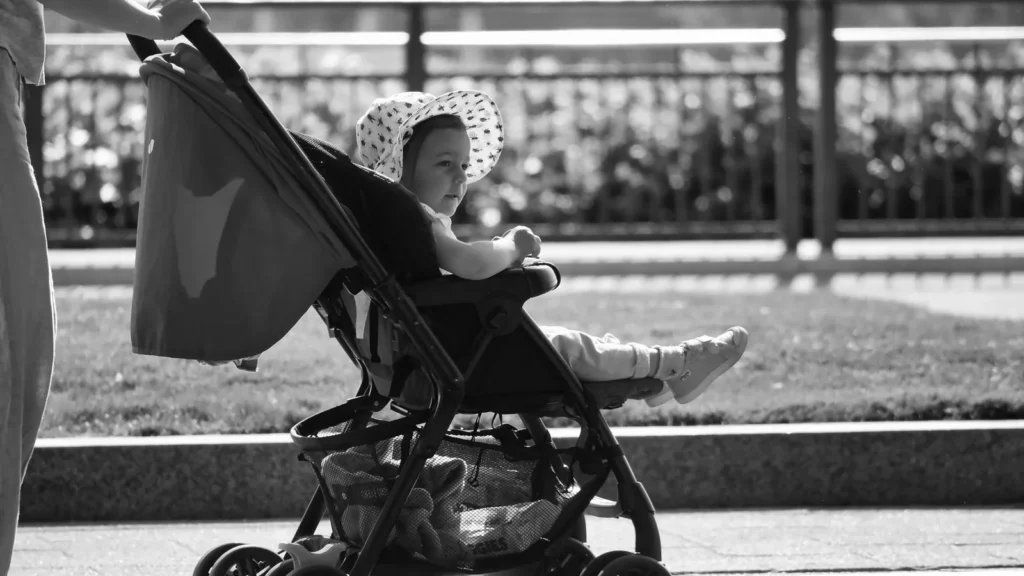
A pushchair in a Makkah taxi is luggage, and it should be booked as luggage: enter each folded pushchair as a large bag in our planner, count the other bulky items for the day the same way, and let the capacity check show you only the vehicles that will take everything. Small bags that sit on laps or at your feet are cabin bags. The suitcases that stay at the hotel do not count at all. Get that split right and the car that arrives will have room for the children, the pushchair and the day’s supplies, with nothing left on the pavement.
This guide is for parents and grandparents planning a day out in Makkah (Mecca) with babies and toddlers: a ziyarah, a visit to Hira Cultural District, or an afternoon with relatives across the city. It explains how different pushchairs pack, how to build the day load, which vehicle classes suit which loads, how to fold and unfold at the kerb without stress, and how heat and timing shape a day with small children. There is a comparison table, a worked example and a checklist before you book.
Why a pushchair in a Makkah taxi counts as a large bag
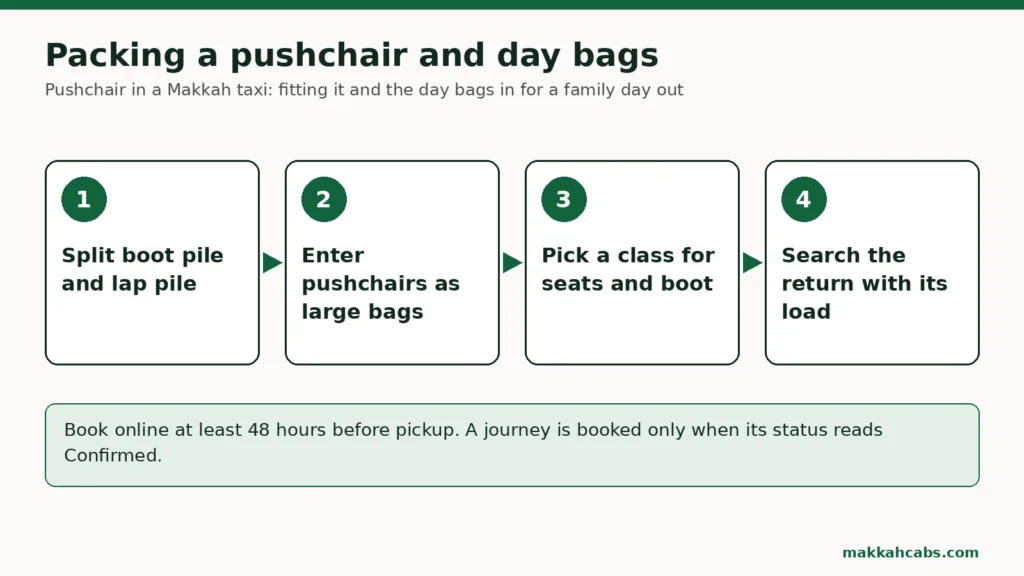
When you search a journey on Makkah Cabs, you enter the passengers, then the large bags and the cabin bags. The planner shows only the vehicle classes that pass the capacity check for that party and luggage.
A folded pushchair does not sit on a lap and rarely fits in a footwell. It needs the same kind of boot space as a suitcase, so it belongs in the large bags. If you leave it out, the capacity check assumes the boot is free for something else, and the smallest vehicle it offers may not take it.
The same rule applies to other bulky items for the day: a cool box, a folding wheelchair or walker, a travel cot you are taking to a relative’s room, or shopping you expect to bring back. Count each as a large bag.
What does not count is the luggage staying behind. If the suitcases remain at the hotel, leave them out. A family that needed a seven-seat van with six large bags for the airport may need far less for an outing.
How different pushchairs pack
“We have a buggy” tells nobody how much space it needs. Pushchairs fold in very different ways.
Compact fold strollers
Lightweight travel strollers fold small, sometimes to the size of cabin luggage. One may share a boot comfortably with a day bag. Still count it as a large bag; the planner has no smaller category for a stroller, and the space is real.
Full-size pushchairs and travel systems
A pushchair with a carrycot or a car seat attachment is bulkier. The frame folds, but the carrycot or seat unit often comes off and travels separately. Count the frame and, if it cannot sit inside the boot with it, count the carrycot too.
Double and tandem pushchairs
A pushchair for two children is usually the bulkiest item a family carries on a day out. Measure it folded before you search, and expect it to take most of the boot in a four-seat car.
Baby carriers and slings
A carrier worn by an adult takes no boot space. Some families use a carrier for the baby and bring a compact stroller for the toddler, which can bring the load down by a whole large bag.
Family day bags for ziyarah: building the day load
The easiest way to count is to lay everything out on the hotel bed the night before and sort it into two piles.
Boot pile (large bags):
- each folded pushchair or stroller;
- a cool box or insulated bag of any real size;
- a walking aid for an older relative;
- anything you are taking to someone else, or expect to bring back.
Lap pile (cabin bags):
- the changing bag;
- a small backpack with water, snacks and wipes;
- handbags and a light jacket or shawl;
- prayer mats and small personal items.
Enter the boot pile as large bags and the lap pile as cabin bags. Then remove anything the family can live without. The family day bags for ziyarah should be what the family will actually use in a few hours, not everything it owns.
Our guide to counting passengers for a Makkah taxi covers the people side of the same search, including why babies are counted as passengers.
Which vehicle class fits the load
The seat and large-bag figures below come from the booking system. Each class is shown as an example model “or similar”. The last column is a rough guide for a family day out, not a promise; the capacity check decides what the planner offers.
| Class (example, or similar) | Seats | Large bags | Typical day-out load |
|---|---|---|---|
| Economy (Toyota Camry class) | 4 | 2 (Camry 3) | Two adults, one or two small children, one compact stroller and a cool bag |
| Business and Executive | 4 | 3 | As above with a little more boot room |
| Hyundai Staria (VIP van) | 6 | 2 | More people but limited boot; best with compact strollers |
| Premium SUV (Chevrolet Tahoe) | 6 | 4 | A full-size pushchair plus a cool box for five or six people |
| Hyundai H1 (family van or MPV) | 7 | 6 | Two pushchairs, a cool box and a grandparent’s walking aid |
| GMC Yukon XL | 7 | 6 | Similar space in an SUV body |
| Toyota Hiace | 11 | 10 | Two families with several pushchairs |
Remember that child seats occupy seat positions, and that an infant seat and a booster take room in the back row. A family with two children in car seats and a double pushchair often needs a larger class than the headcount suggests. Our guide to choosing a car or van for a Makkah outing compares the classes in more detail, and our note on a child seat in a Makkah taxi explains how to add the seats.
Folding and unfolding at the kerb
Most of the stress of a pushchair in a Makkah taxi happens in the few minutes at the kerb, often in heat, with a child on one hip and traffic behind. A plan agreed in the hotel room makes those minutes calm.
Before you leave the hotel:
- practise the fold once so the adult doing it knows the catch;
- take the bags off the handles and empty the basket into the changing bag;
- decide who carries the baby and who handles the pushchair.
At the drop-off:
- The pushchair adult gets out first and takes the pushchair from the boot.
- The pushchair is unfolded and locked open on the pavement, away from the road.
- Only then is the baby lifted out of the car seat and into the pushchair or a carrier.
- The last adult checks the seats and footwells for dummies, bottles and phones.
At the return pickup, reverse it: children in their seats and buckled first, then the pushchair folded and loaded, then the bags. We cannot promise where a vehicle may stop at a given site, so agree a named meeting place and send the driver a live location as you approach. Our guide to a hotel frontage or an agreed meeting place explains how to choose a pickup point that works with children in tow.
Never leave a child in the parked car while you fold the pushchair or fetch a bag. The Ministry of Health’s heat illness guidance is plain that children should not be left in cars, which can reach dangerously high temperatures.
Day out in Makkah with a toddler: heat, water and timing
A day out in Makkah with a toddler is shaped more by the child than by the itinerary.
Heat. The Ministry of Health advises planning outdoor activity for cooler times, resting in shade, drinking plenty of fluids and wearing light, loose clothing. A pushchair with a sunshade helps, but a toddler strapped in on a hot surface warms up quickly. Check the forecast for the Makkah region on the National Center for Meteorology website before you choose the day and the time.
Indoor time. Places with indoor space give small children somewhere to rest. Hira Cultural District publishes opening hours for its museums and exhibitions, which differ from the district itself and by day of the week, so check the hours for your day before you set the pickup times.
One site, not three. A toddler who has been in and out of a car seat four times is a tired toddler. Choose one place and a realistic return time. If the family wants more, a second short outing on another day often works better than one long one.
Naps and feeds. If the baby sleeps in the pushchair, a return that lands in the middle of a nap means moving a sleeping child into a car seat. Some families time the return for just after a feed or a nap instead.
Supplies. Pack more water than you think you need, and keep it in the lap pile, not the boot, so it is reachable during the drive.
The return load is often bigger
The morning load is not always the afternoon load. Families pick things up: shopping, souvenirs, a bag of dates, a gift for relatives. A cool box that went out empty may come back full.
A Makkah outing there and back is two journeys, because the pickup and destination of a journey must be different. Each journey has its own passengers and bags. Search the return with the load you expect to bring back, not the morning’s count.
If the return includes collecting bags from a hotel, or dropping at a different hotel, that changes the load and the destination. Our guide to collecting bags after a Makkah visit covers that case. And if you plan to stop on the way, our guide to putting the stops of a Makkah visit in the right order explains how stops work; up to eight stops can be added to a journey, in journey order.
Who carries what
A family day out goes more smoothly when each adult has one job. Agree it before you leave.
- Pushchair adult: folds, unfolds and loads the pushchair; knows the catch.
- Baby adult: carries the baby between the car seat and the pushchair or carrier.
- Bag adult: carries the changing bag and water, and does the last check of the car.
- Lead contact: the person whose name and phone number are on the booking, who speaks to the driver and shares the live location.
In a small family one person may do two jobs. What matters is that nobody assumes someone else has the water.
Worked example: the Rahimi family at Hira Cultural District
Zainab and Omar Rahimi are staying near the Clock Tower with their two children: Aisha, who is three, and baby Hamza, who is five months old. Zainab’s parents are with them. They plan a morning at Hira Cultural District, about 13 km by road on our route checks, with lunch back at the hotel.
Sorting the load. The night before, Zainab lays everything out. The boot pile is a full-size pushchair with a carrycot, a compact stroller for Aisha and a small cool box: three large bags. The lap pile is the changing bag, a backpack with water and snacks, and her mother’s handbag: three cabin bags. The suitcases stay in the room.
Counting. Four adults, one child, one infant. An infant seat for Hamza and a child seat for Aisha, added in the search.
Choosing the vehicle. Six people rule out the four-seat classes. The six-seat Staria’s boot is small for three large bags. Zainab chooses a seven-seat family van, which leaves room for the pushchairs, the cool box and her father’s legs.
The return. Zainab expects to buy a gift at the district, so she searches the return with four large bags, not three. Both journeys are booked four days ahead, paid in full online, and read Confirmed later that day.
On the day. Omar practises the carrycot fold in the room. At the district he unloads the pushchairs first, locks them open away from the road, and only then does Zainab lift Hamza out. On the way back, children are buckled in first, pushchairs folded second, bags last. Nobody leaves the water in the boot.
Common mistakes with pushchairs and day bags
- Entering “no bags”. A family that searches with no large bags to see the smallest car often finds the pushchair will not go in. The capacity check can only work with what you enter.
- Copying the airport luggage. The suitcases are at the hotel. Counting them books a bigger vehicle than the day needs.
- Forgetting the second stroller. A toddler who “can walk” usually ends the afternoon in a stroller. If it is coming, count it.
- Hanging bags on the handles. A loaded pushchair will not fold, and the bags spill at the kerb. Empty the handles before the car arrives.
- Water in the boot. Keep drinks in the lap pile, where they can be reached during the drive.
- The same count both ways. Search the return with the afternoon’s load, including shopping.
- Planning to leave things in the car. Do not assume the driver will keep a pushchair or bags in the vehicle during the visit. Take what you need with you, and book the return as its own journey.
Each of these is easy to avoid at the planning stage and awkward to fix on the day. A pushchair in a Makkah taxi is only a problem when it is a surprise.
If the load changes after booking
After booking, only the pickup time can be changed online. The vehicle, the passengers, the destination and the load cannot. If the family decides to bring a double pushchair instead of a stroller, or a relative’s pram as well, contact the booking team rather than hoping it will fit on the day. If a larger vehicle is needed, that may mean a new booking plus a cancellation request on the old one.
Bookings are subject to our cancellation terms (free cancellation with a full refund up to 48 hours before pickup; inside 48 hours the deposit element of the price is kept) if the customer cancels. If we or the transport partner cancel, or cannot supply the journey and no suitable alternative is accepted, the customer receives a full refund for the affected journey. The full terms are on the cancellation and refund policy. An approved change of pickup time carries a £5 rescheduling fee, converted into the booking currency and added to the cash paid to the driver at pickup. Online bookings need at least 48 hours’ notice, and each journey has a minimum booking value equivalent to £40.
Pushchair and day bag checklist
Work through this before you pay.
- Lay out everything for the day and split it into a boot pile and a lap pile.
- Enter each folded pushchair, stroller and cool box as a large bag.
- Enter the changing bag, backpacks and handbags as cabin bags.
- Leave out suitcases that stay at the hotel.
- Add infant seats, child seats and boosters in the search.
- Choose a class with room for the seats and the boot pile together.
- Search the return with the load you expect to bring back.
- Practise the fold and agree who carries what.
- Check the heat forecast and the site’s hours before you set pickup times.
- Book at least 48 hours ahead and wait until each journey reads Confirmed.
A day load that is counted honestly gives the family a car with room for everything and a calmer start at the kerb. When you are ready, open the Makkah Cabs planner, enter the pushchairs and day bags for each journey, and check the vehicles it offers before you pay.