
A multi-stop Makkah visit by taxi is booked as one journey with stops added in the order the car will reach them. The Makkah Cabs planner allows up to eight stops between the pickup and the destination, and the order you enter is the order the driver follows. That order matters more than it looks on a map. It decides who is in the car at each point, whether the vehicle is big enough at its fullest, how much doubling back the route involves, and where the journey ends. It is also worth knowing what a stop is for: a place where someone gets in or out along the way, not a period of waiting while you spend time at a site. When you want time at a place, that is usually a separate journey.
This guide is for anyone planning a day in Makkah that involves more than one place: collecting relatives from another hotel, dropping someone off on the way, or visiting more than one site. It explains how stops work in the planner, how to choose a sensible order, why road distances in Makkah can differ by direction, when a stop should become its own journey, and what can and cannot be changed once you have booked.
What a stop is, and what it is not
In the booking system, a journey is one pickup place, one destination, a pickup date and time in Saudi local time, the passengers and their bags. Adding stops to a Makkah journey places them between the pickup and the destination, in journey order, up to eight of them.
A stop is designed for:
- collecting someone, for example a relative at another hotel;
- dropping someone off, for example a grandparent who wants to go back early;
- a brief pause, where people get in or out and the car moves on.
A stop is not:
- a sightseeing visit where the party leaves the car for a long time;
- a waiting product. Each vehicle class has an included waiting allowance at pickup, but it is not shown on the search results, and a stop does not mean the car will wait while you visit somewhere. If you need the driver to wait at a stop, ask the booking team before you pay and get the answer in writing.
Keeping to that definition prevents the most common disappointment with multi-stop bookings, which is a family expecting the car to wait at each place for as long as they want. Our earlier piece on whether the vehicle can stay with your group looks at that question in more detail.
Why the order changes the journey
Road distances in Makkah are not the same in both directions. One-way systems, junctions and the roads around the central area mean the route from A to B is often not the route from B to A. Live route checks in our booking system show this clearly:
| Route | Road distance |
|---|---|
| Clock Tower to Hira Cultural District | about 13 km |
| Hira Cultural District to Clock Tower | about 11 km |
| Clock Tower to Masjid Aisha | about 13 km |
| Masjid Aisha to Clock Tower | about 19 km |
| Clock Tower to Hilton Jabal Omar | about 1.5 km |
The same logic applies within a multi-stop journey. Putting stop B before stop C may produce a different route and a different total distance from putting C before B, even though the places are identical. That is why the planner shows the route in the order you enter the stops, and why it is worth reading the route summary before you pay. We do not quote journey times, because they vary widely.
Five principles for a sensible order
There is no single correct way of ordering stops on a Makkah outing, but a few principles help.
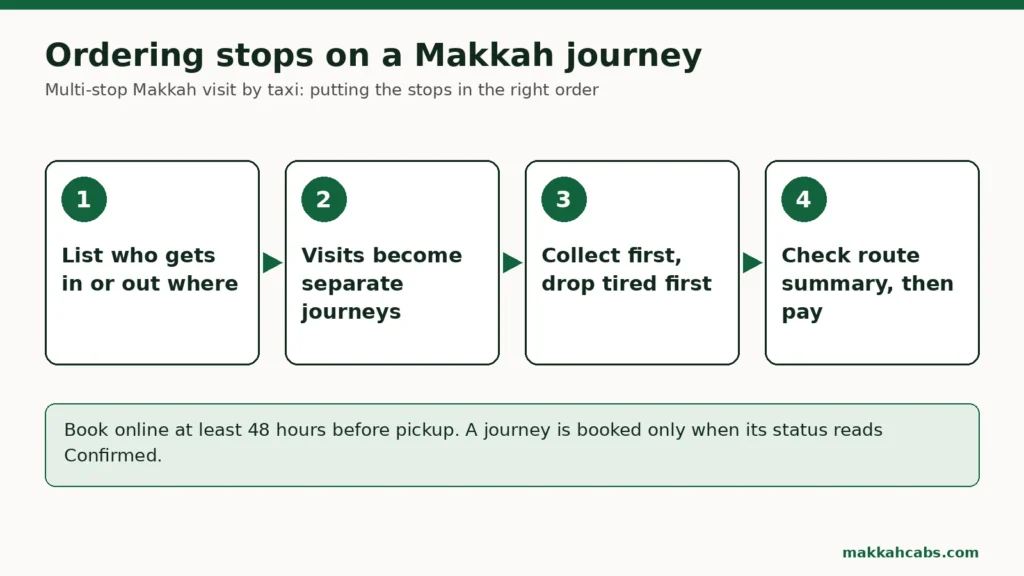
1. Collect before you drop
If the journey involves both picking people up and dropping them off, it is usually better to collect everyone first. That way the full party is together for the main part of the day, and anyone being dropped off later is dropped from a car that is already on its way.
2. Put fixed times where they can be met
If one place has a fixed time, such as a booked session or an appointment, plan the stops so the car reaches it without a detour first. Anything flexible can come after.
3. Drop the least energetic first
On a return journey with several drop-offs, put first the people who most need to rest: older relatives, young children, anyone unwell. The last stops can be the people who are happy to ride a little longer.
4. End where the next thing starts
The destination of the journey is the last place the car goes. If the family is going on to a meal, a visit or another hotel, make that the destination rather than adding it as a stop and ending somewhere else.
5. Avoid doubling back
Look at the route summary. If the car goes past a later stop on the way to an earlier one, try the order the other way round and compare. Because distances differ by direction, the shorter-looking option on a map is not always the shorter route.
Stop, or a separate journey?
This table helps decide how to book each place on your list.
| What happens at the place | Book it as | Why |
|---|---|---|
| A relative gets in | A stop | Brief, and the car continues with them |
| Someone gets out and stays | A stop | Brief, and the car continues without them |
| The whole party visits for a while | The destination of one journey, then a new journey onwards | A stop is not a waiting period |
| Part of the party visits, the rest stay in the car | Usually two journeys, or ask the booking team | Waiting is not included unless confirmed in writing |
| A short photo pause at the roadside | Ask the booking team | Where a car can stop is not always possible or permitted |
| The final place of the day | The destination | The journey ends there |
For a day that includes two or more proper visits, the cleaner plan is a chain of journeys: hotel to the first site, the first site to the second, the second back to the hotel. Each leg has its own pickup time, which you set after thinking about how long you want at each place. Our article on choosing essential and optional Makkah stops helps decide which places deserve a visit and which only need a pass.
Passengers change along the way
A multi-stop journey can carry different people at different points. The vehicle has to be large enough for the fullest stretch.
- Enter the maximum number of people who will be in the car at any one time, including children and infants, and their bags.
- The planner shows only the vehicle classes that pass the capacity check for what you enter.
- If three relatives join at a stop, the car must be sized for everyone after that stop, not only for the people at the first pickup.
- If the numbers are uncertain, settle them before you pay. The number of passengers cannot be changed online after booking.
Our guide to counting the people joining a visit goes through this step by step.
Where the car stops at each place
Each stop needs a place the driver can actually reach and the passengers can actually find. Around the Haram and in busy central areas, where vehicles may stop is managed on the day by the authorities, and we do not promise a particular entrance or frontage at any stop.
For each stop:
- use the name exactly as the planner shows it, or check a typed address carefully in the route summary;
- describe the meeting point in the booking notes, with who will be waiting there;
- give the phone number of the person being collected;
- be ready to send a live location.
If you have a list of saved map pins, our article on turning saved pins into a visit request explains how to translate them into a booking the driver can follow.
Children, heat and short stops
A short stop can easily become longer than planned, and cars heat up quickly in Makkah sunshine. The Ministry of Health warns not to leave children in cars, which can reach dangerously high temperatures. If a stop involves one adult getting out, make sure another adult stays with any children, or take the children too. Keep water in the car for everyone on a longer multi-stop journey.
A worked example: an afternoon with a stop each way
Bilal Karim is staying near the Clock Tower with his wife and their two children. His aunt and uncle are at the Hilton Hotel and Convention Jabal Omar. The family wants to spend an afternoon together at the Hira Cultural District, next to Jabal al-Nour, which Saudipedia places about 4 km north-east of the Grand Mosque in a straight line; by road from the Clock Tower it is about 13 km.
The outward journey. Bilal books one journey: pickup at his hotel in the Clock Tower, a stop at the Hilton Jabal Omar to collect his aunt and uncle, destination Hira Cultural District. He enters six passengers, because that is the fullest the car will be. The planner shows the classes that fit six with their day bags. He notes the aunt’s phone number and the agreed meeting point at the Hilton in the booking notes.
Why that order. The Hilton Jabal Omar is about 1.5 km from the Clock Tower by road. Bilal’s household is the larger and slower to get ready, so the car starts with them, and the aunt and uncle only need to be ready at the Hilton shortly afterwards. Bilal reads the route summary to confirm the car does not double back.
The visit. The Hira Cultural District is the destination, not a stop, because the family wants time there. The outward journey ends when they are dropped off.
The return. Bilal books a second journey: pickup at the Hira Cultural District, a stop at the Hilton Jabal Omar to drop his aunt and uncle, destination his own hotel. The aunt and uncle are older, so they get out first. He sets the return pickup time after thinking about how long the family wants at the site and how long everyone takes to walk back to the car.
The check. Both journeys are booked more than 48 hours ahead. Bilal waits until each reads Confirmed, which happens within 1 to 12 hours of payment, then shares the plan with his aunt.
A second example: two visits in one day
Hana and her husband want a fuller day with their teenage son: a morning at the Hira Cultural District, then a late afternoon at one of the city’s parks. The Royal Commission for Makkah City and Holy Sites lists both the Hira Cultural District and parks such as Al-Ju’ranah Park and King Abdullah Park among Makkah’s landmarks.
Both places are visits, not stops, so Hana books a chain of three journeys rather than one journey with stops:
- Hotel to the Hira Cultural District.
- The Hira Cultural District to the park, with its own pickup time after the morning visit.
- The park back to the hotel, with its own pickup time in the evening.
Because the park is not one of the planner’s popular locations, she types it in and checks it in the route summary. Each leg is sized for three people, and each is confirmed separately. If the morning runs long, she can request a new pickup time for the second leg in her account, knowing that an approved change carries the £5 rescheduling fee and that the request is pending until approved.
A chain of journeys costs more management than one booking, but it matches what the family will actually do, and nobody expects a car to wait for hours at a stop.
Writing the booking notes for several stops
The booking notes are where the driver learns what each stop is for. Keep them short and in journey order. For example:
“Stop 1, Hilton Jabal Omar: collect two adults, Mrs Karim, phone number in booking. They will wait at the agreed meeting point. Destination: Hira Cultural District, drop-off only.”
Useful details for each stop:
- whether people get in or get out;
- the name of the person at the stop and their phone number;
- the meeting point in words, and whether you will send a live location;
- anything the driver should know about the passengers, such as a folding pushchair or an older person who needs time to get in.
Do not use the notes to add stops that are not in the booking. The driver follows the stops as booked.
Before you pay: read the route summary
The route summary is the last chance to catch an order that does not work. Before paying, check:
- the stops appear in the order you intended;
- each typed address has resolved to the right place;
- the route does not obviously double back past a later stop;
- the passenger and bag numbers are the fullest the car will carry.
If anything looks wrong, change it before paying. Payment secures a provisional request, and after that, stops can only be changed with the booking team.
Changing the order after booking
Only the pickup time can be changed online, using Request a new pickup time in your account. The request stays pending until the booking team approves it. An approved new time carries a £5 rescheduling fee, converted into the booking currency and added to the cash paid to the driver at pickup. A rejected request costs nothing.
Stops are places, and places cannot be changed online. That includes adding a stop, removing one or changing the order. The same applies to the destination, the number of passengers and the vehicle. For any of these, contact the booking team. If the answer is a new booking, remember that bookings are subject to our cancellation terms (free cancellation with a full refund up to 48 hours before pickup; inside 48 hours the deposit element of the price is kept) when the customer cancels, so ask before cancelling anything yourself. If we or the transport partner cancel, or cannot supply the journey and you do not accept a suitable alternative, you receive a full refund for the affected journey under the cancellation and refund policy.
If a stop turns out to be unavailable, or the person who asked for it cannot come, see what to do if a requested stop is unavailable. And do not ask the driver to reorder the stops on the day. The driver works from the booking.
Common mistakes with multi-stop journeys
- Treating a stop as a visit. If the party wants time at a place, make it a destination and book the next leg.
- Sizing the car for the first pickup only. Enter the fullest number on board.
- Entering the stops in the order you thought of them. Reorder them for the route, and read the summary.
- Forgetting that the return is its own journey. The outward booking does not bring anyone back.
- Several people giving the driver instructions. One lead contact deals with the booking team.
A checklist for a multi-stop Makkah journey
- List every place, and next to each write whether people get in, get out, or spend time there.
- Turn any “spend time” place into a destination, and plan the next leg as its own journey.
- Order the stops: collect first, fixed times reachable, least energetic dropped first, end where the next thing starts.
- Enter the maximum number of people on board at any point, with their bags.
- Read the route summary and try another order if the car doubles back.
- Add meeting points and phone numbers for each stop in the booking notes.
- Book at least 48 hours ahead, including the return.
- Wait for every journey to read Confirmed before sharing the plan.
- Keep an adult with any children if someone gets out at a stop.
- Send any change of stops through the lead contact to the booking team.
Once the order is settled, the booking takes a few minutes. Enter your pickup, your stops in journey order and your destination in the Makkah Cabs planner, check the route summary, and book the return the same way.