

Counting passengers for a Makkah taxi means entering every person who will be in the vehicle, in the right box: adults, children and infants are counted separately in our planner, and the total, together with the bags, decides which vehicle classes you are shown. Count the people who are really coming on this outing, not everyone staying at the hotel, and include babies. The count is fixed once you book, because the number of passengers cannot be changed online, so it is worth ten careful minutes before you search.
This guide is for the family member who organises an outing in Makkah (Mecca): a ziyarah, a visit to Hira Cultural District or Masjid Aisha, or a trip to see relatives across the city. It explains how the planner counts people, answers the common question “do infants count as passengers in a Saudi taxi?”, and shows how to build the list household by household, what happens when someone joins or drops out at the last minute, and why the outward and return trips may need different numbers. There is a table of who goes where, a worked example and a counting checklist.
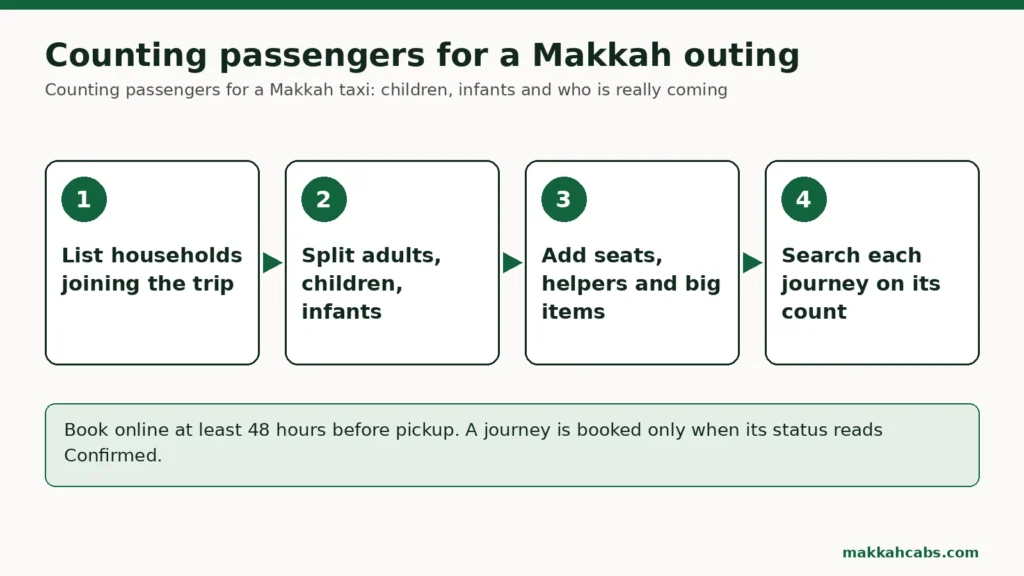
Counting passengers for a Makkah taxi: how the planner does it
When you search a journey, you enter the passengers in three groups, adults, children and infants, and then the large bags and cabin bags. The planner runs a capacity check and shows only the vehicle classes that pass it for that party and that luggage. Each class is shown with an example model and the words “or similar”.
That check is only as good as the numbers you give it. Two live searches show how quickly the choice narrows:
- four adults with four large cases were offered a Premium SUV and larger only;
- five adults with five large cases were offered seven-seat vehicles and larger only.
So a single extra person or one more bag can move the whole family into a different class. That is not the system being difficult. It is the system stopping you from booking a vehicle that will not take everyone.
The seat capacity of each class, taken from the booking system, is set out below. These are the figures the capacity check works with.
| Class (example, or similar) | Seats | Large bags |
|---|---|---|
| Economy (Toyota Camry class) | 4 | 2 (Camry 3) |
| Business and Executive | 4 | 3 |
| Luxury (Mercedes S-Class) | 3 | 3 |
| Hyundai Staria (VIP van) | 6 | 2 |
| Premium SUV (Chevrolet Tahoe) | 6 | 4 |
| Hyundai H1 (family van or MPV) | 7 | 6 |
| GMC Yukon XL | 7 | 6 |
| Toyota Hiace | 11 | 10 |
| Toyota Coaster (minibus) | 19 | 11 |
| Coach | 53 |
Counting passengers for a Makkah taxi comes first; choosing between classes is a separate decision. Our guide to choosing a car or van for a Makkah outing covers that. This article is about getting the count right first.
Do infants count as passengers in a Saudi taxi?
Yes. On our bookings an infant is a passenger and should be entered in the infants box. Leaving a baby out because “she will sit on her mother’s lap” makes the count wrong and the plan less safe.
Saudi Arabia’s Ministry of Health, in its in-car child safety guidance, advises that children be properly restrained in the back seat in a car seat suited to their age and weight, and that a rear-facing infant seat should not be placed in a front seat that has an airbag. A baby in a car seat occupies a seat position. So when you plan the vehicle, plan a seat for every person, including the smallest.
Two practical points follow:
- Add the seat in the search. Infant seats, child seats and boosters can be added in the planner and are then confirmed for the vehicle. Our note on asking about a child seat for your visit covers the seat itself.
- Mind the front seat. If the family is large enough that someone will sit in the front, that should be an adult, not a baby in a rear-facing seat. That can push a family of five into a larger class.
For the current legal requirements on child restraints in Saudi Arabia, check the official traffic authorities. This article gives planning advice, not legal advice.
Adults, children and infants: which box each person goes in
Use the age guidance shown in the planner when you search. The table below is about planning, not definitions: it shows what each kind of traveller means for the count and for the vehicle.
| Traveller | Enter as | What it means for the vehicle | What to add |
|---|---|---|---|
| Grandparent, parent, adult cousin | Adult | One seat each | Mobility needs in the notes, a walking aid as a large bag |
| School-age child | Child | One seat each | A booster or child seat if needed, added in the search |
| Baby or toddler | Infant | Plan a seat position for the car seat | Infant seat in the search, pushchair as a large bag |
| Teenager | Use the planner’s age guidance | One seat, like an adult | Nothing extra |
| Guide or helper travelling in the car | Adult | One seat, like anyone else | A line in the notes explaining who they are |
If you are unsure which box a traveller belongs in, follow the planner’s own wording, and if it is still unclear, ask the booking team before you pay rather than after.
Who is really coming: building the list household by household
The mistake most families make is not a wrong number. It is counting the wrong group. The people staying in your hotel are not the people joining this outing. Grandparents may rest. A teenager may stay behind to sleep. A cousin from another hotel may want to come.
The simplest method is to ask each household, not each person:
- List the households involved in the outing, for example “our family”, “Aunt Rukhsana’s family”, “Grandpa and Grandma”.
- Ask each household for its own number, split into adults, children and infants, and what it will carry for the day.
- Ask each household what could change: “Might anyone drop out? Might anyone else join?”
- Add the numbers up and write the total down with the date you checked it.
This takes the guesswork out of the conversation. It also stops the organiser from carrying someone else’s assumptions. If a relative is joining from a different hotel, they are part of the count, and there is a separate question of how they reach the vehicle. Our guide to meeting relatives at another Makkah hotel explains the options for starting the day together.
Put names, not only numbers, in the notes
A number tells the capacity check how many seats are needed. Names tell the driver and the booking team who they are looking for. In the booking notes, add a short line such as “Lead traveller Bilal Hussain; party of eight including one infant in a car seat and one child on a booster; one relative joins at the first pickup.” Keep it to the facts that affect the journey, and leave out anything private.
This matters most when the party is collected in more than one place or when the lead traveller is not the person who paid. It also gives you something to check the Confirmed booking against: if the notes say eight and the passenger count says seven, you have found the mistake before the day rather than at the kerb. Counting passengers for a Makkah taxi is easier to get right when the list is written down in one place that everyone can see.
Guides, helpers and companions take seats too
Anyone who travels in the car is a passenger. A licensed guide who rides with you, a family friend who helps an older relative, or a helper who looks after the children each need a seat. Their role does not remove them from the count. If you are thinking about booking a guide, our article on a Makkah driver or a licensed guide explains how the two roles differ and whether the guide travels in your vehicle.
Different counts for the outward and return journeys
A Makkah outing there and back is two journeys, because the pickup and destination of a journey must be different. Each journey has its own passenger count. That is useful, because the two counts are often not the same.
- Someone leaves early. The outward trip has seven people; the return has five. The two people leaving early need their own journey.
- Someone joins at the site. A relative meets you at the museum and comes back with you. The outward trip has five; the return has six.
- Someone finishes somewhere else. One household goes on to dinner at another hotel. That is a different destination and a different journey.
Search each journey with its own true numbers. A return searched with the morning’s count may offer a class that is too small for the afternoon. If the difference is large, or households want different return times, it can be simpler to use two vehicles. Our guide to two vehicles for one Makkah outing sets out when a split works better.
Last-minute extra passenger in Makkah: what can and cannot change
This is the question that catches families out. Once a journey is booked, the number of passengers cannot be changed online. Only the pickup time can be changed online, by request, and even that needs approval. The place, the destination, the number of passengers and the vehicle cannot be altered through the account.
So a last-minute extra passenger in Makkah is not a small edit. The practical options are:
- Ask the booking team. They can tell you whether the booked vehicle can take the extra person, or what else is possible. Do not assume the answer is yes.
- Book a separate journey for the extra person or people, if there are at least 48 hours before pickup, because online bookings need 48 hours’ notice. Each journey has a minimum booking value equivalent to £40.
- Make a new booking and request cancellation of the old one, if a larger vehicle is needed. Bear in mind that bookings are subject to our cancellation terms (free cancellation with a full refund up to 48 hours before pickup; inside 48 hours the deposit element of the price is kept) if the customer cancels, so the refund for the first booking is assessed under that rule, rather than decided solely by the change in party size.
What you should not do is turn up with an extra person and hope. The driver has a vehicle chosen for the number on the booking. An extra adult may simply not have a seat, and a baby without a seat position is not a safe solution.
The lesson is to ask the “might anyone else come?” question before you book, not after. Our note on one guest joining from next door looks at the common case of a neighbour or friend who hears about the outing late.
When someone drops out
The reverse also happens. A grandparent feels tired, or a child is unwell, and the party shrinks on the morning.
- The booking stays as it is. The vehicle still comes, and there is nothing to change online, because passenger numbers cannot be edited there.
- There is no refund for fewer people. Transport is priced per vehicle and per journey, not per person, and customer cancellations are subject to our cancellation terms (free cancellation with a full refund up to 48 hours before pickup; inside 48 hours the deposit element of the price is kept).
- Tell the driver on the day if it helps, so they are not waiting for someone who is not coming.
A smaller party in a larger vehicle is not a problem. A larger party in a smaller vehicle is. When you are unsure whether someone will come, it is usually wiser to count them in.
Worked example: the Hussain family’s Hira visit
Bilal Hussain is organising a morning at Hira Cultural District from the family’s hotel near the Clock Tower, about 13 km by road on our route checks. He starts by messaging the households.
- Bilal and his wife Nadia: two adults, one son aged seven, one daughter aged eleven months. A pushchair.
- Bilal’s parents: two adults. His father uses a folding walking stick; his mother walks well.
- Nadia’s sister Hafsa: one adult, staying at a hotel nearby, wants to come.
Bilal asks each household what might change. His father says he may rest instead. Hafsa says her husband may join too.
Counting the outward trip. Bilal decides to count both “maybe” people in, because an unused seat is easier to live with than a missing one. That makes six adults, one child and one infant: eight passengers. He adds an infant seat and a child seat in the search, and enters the pushchair as a large bag. Eight people is more than any seven-seat class holds, so he chooses from the Toyota Hiace and larger classes the planner shows.
Counting the return. Hafsa and her husband will go back to their own hotel afterwards. Bilal searches the return to the family hotel with four adults, one child and one infant, and a separate journey for Hafsa. The return for his own family fits a seven-seat class.
Booking. He books at least 48 hours ahead, pays in full online, and waits until each journey reads Confirmed, which the booking team updates within 1 to 12 hours. He sends each household a short message with the pickup time and the count he booked.
On the day. Bilal’s father decides to come after all, and Hafsa’s husband does not. The outward vehicle has one spare seat. Nobody is left on the pavement.
Common counting mistakes
- Copying the airport count. The number that arrived at the hotel is not the number going on this outing.
- Leaving out the baby. An infant is a passenger, and a car seat needs a seat position.
- Forgetting the helper. A guide or companion in the car takes a seat.
- Counting only the first pickup. A relative collected on the way still needs a seat for the rest of the drive.
- Reusing the outward count for the return. Search the return with its own numbers.
- Planning to add people on the day. Passenger numbers cannot be changed online, and the vehicle is chosen for the booked number.
- Understating to see a smaller car. If the smaller car arrives and the family does not fit, the outing starts badly and the booking is subject to our cancellation terms (free cancellation with a full refund up to 48 hours before pickup; inside 48 hours the deposit element of the price is kept) if you cancel it.
Payment and confirmation
Makkah Cabs takes full payment online. Payment secures a provisional request. The booking team updates the status within 1 to 12 hours, and each journey is booked only when it reads Confirmed. The account shows the passenger count for each booking. Check it against your household list once more when the status changes, and share the confirmed count with the households so everyone knows the plan.
If the count has changed after booking, contact the booking team rather than hoping the vehicle has room. The full cancellation terms are on the cancellation and refund policy.
Passenger counting checklist
Work through this before each outing search.
- List the households joining this outing, not everyone at the hotel.
- Get each household’s own number of adults, children and infants.
- Ask every household who might drop out and who might join.
- Count “maybe” people in unless you are sure they are not coming.
- Enter infants as passengers and plan a seat position for every car seat.
- Add infant seats, child seats and boosters in the search.
- Include any guide, helper or companion who travels in the car.
- Count the pushchair, walking aid and cool box as large bags.
- Search the return with its own count, and any separate returns as separate journeys.
- Book at least 48 hours ahead and wait for Confirmed before sharing the plan.
- Remember that the passenger count cannot be changed online after booking.
A careful count gives the capacity check honest numbers and the family a vehicle with a seat for everyone who turns up. When your list is ready, open the Makkah Cabs planner, enter adults, children and infants for each journey, and check the vehicles it offers before you pay.
If you cancel, cancellation is free with a full refund up to 48 hours before pickup; inside 48 hours the deposit element of the price is kept, and your statutory rights are unaffected. If we or the transport provider cancel, you receive a full refund for the affected journey.